

The First Telling
Gather closer to the fire, wanderer, and let the night air carry the old rhythms. Before the scribes of Vindrath bound words to dead parchment and the great ledgers of Gearhaven tallied every transaction, stories lived in the breath and blood of those who spoke them. They were not read. They were performed. This was the First Telling, and its power lay not merely in the words, but in the weave of all that surrounded them.
The Living Word
In the elder days, before the Sundering scarred the north and iron began its long march, the peoples of Eryndel understood that a tale was a living thing. Tone could soften a warning into comfort or sharpen a jest into a blade. Rhythm carried the heartbeat of the land itself, slow and deep for the old forest songs of the Kharin, swift and thundering for the Equari’s galloping hunts, low and growling for the wolf-kin’s pack oaths. Gesture shaped meaning: a lifted paw might call down ancestral protection, a bowed head could invoke Mortheon’s quiet mercy.
The place mattered. A story told beneath the moonlit boughs of Sendai’s ancient groves carried different weight than the same words spoken in the salt-crusted hold of a Vindrath slaver ship. Audience shaped it further. Children heard wonder; warriors heard warning; the grieving heard solace. Intent was the final thread. A ranger recounting the fall of a comrade might speak the same words as a bard in a tavern, yet one called the dead to rest while the other stirred coins into an open palm.
Thus the First Telling was born, not mere entertainment, but a sacred craft. The earliest peoples believed that to speak a tale poorly was to wound the Weave itself. To speak it truly was to strengthen the bonds between listener, teller, land, and gods.
Echoes That Remain
Many of the stories themselves have survived, carried forward by rangers, bards, and stubborn old souls who refuse to let the old ways die. The cautionary weight of Mercy’s Debt, the defiant joy of a dressmaker’s seven-in-one strike, the quiet bloom of violet frost flowers pushing through iron, all echo the First Telling. Yet the living practice has frayed.
Modern scholars in Vindrath’s academies collect the words with meticulous care, transcribing them into crisp ledgers and printing them in crisp type. They possess the skeleton but lack the breath. A ranger’s howl of pack loyalty, delivered at dawn on a storm-lashed coast with salt wind in the fur and the pack gathered close, carries power that cold ink can never hold. The same words read aloud in a Gearhaven lecture hall become mere curiosity, stripped of their rightful rhythm and place.
The Cost of Forgetting
As literacy spread with the rise of steam and ledger, the First Telling retreated to the wilder places ... hidden groves in Sendai, flickering hearths in frontier towns, the quiet corners of the Ward of Wilted Flowers where living coral still remembers. Some say the Eld Weft itself grows thinner where the old rhythms are lost. Stories meant to heal now wound. Warnings meant to guide now mislead.
Yet the practice is not entirely gone. Lantern Bearers still walk the forgotten paths, carrying both light and tale. Certain elders among the Kharin and Equari guard fragments of the craft. And in the quiet moments between chapters of The Fractured Weave, when Caelrya, Thorne, and Lirael share firelight and truth, something of the First Telling stirs once more.
For Those Who Would Remember
If you seek the lost art, do not look first to the page. Listen instead to the wind in the canopy, the rhythm of hooves on open plain, the low rumble of a wolf-kin’s protective growl. Find a teller. Gather an audience. Choose a place that remembers. Speak with intent.
The words are only the beginning.
The First Telling waits for those willing to breathe life into them again.
We still have the stories. We just forgot how to listen.
Purpose
The First Telling
Classification
Lost Oral Tradition
Overview
Before widespread literacy spread across Eryndel, stories were not read.
They were performed.
The earliest peoples believed a tale carried power beyond its words. Tone, rhythm, gesture, audience, location, and intent all shaped the meaning of a story.
This practice became known as The First Telling.
Though many of the stories themselves survive, the methods by which they were originally shared have largely been lost.
As a result, modern scholars often possess the words of ancient tales while remaining ignorant of their true meaning.
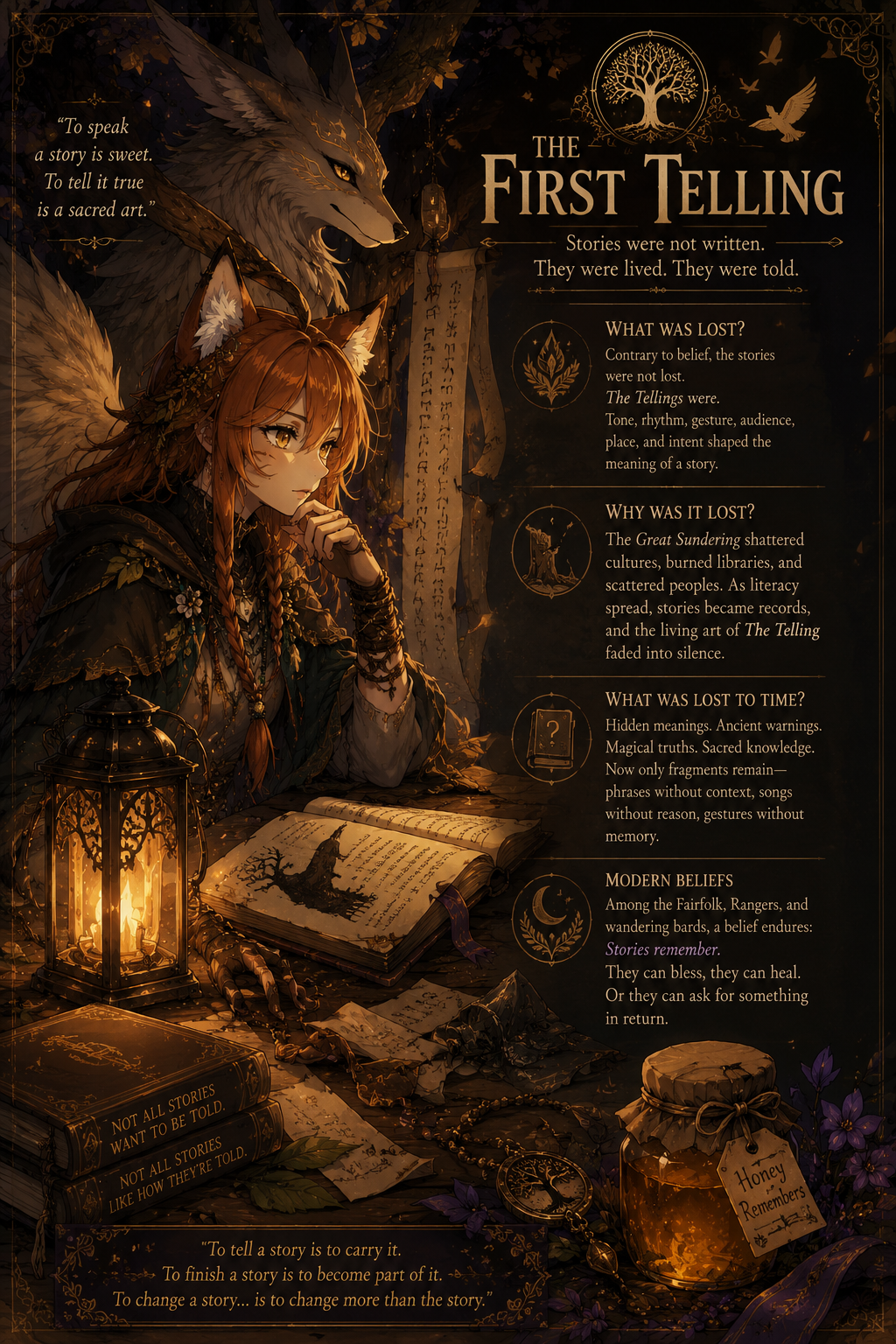
What Was Lost?
Contrary to popular belief, the stories were not lost.
The Tellings were.
Ancient storytellers understood pauses, repeated phrases, audience participation, song, and symbolic gestures as part of the narrative itself.
A tale told incorrectly could become something entirely different.
Some Fairfolk traditions claim this was not merely metaphor.
They insist stories once possessed the power to shape reality when properly told.
Why Was It Lost?
The Great Sundering shattered much of Eryndel's shared culture.
Entire populations vanished.
Libraries burned.
More importantly, communities fragmented.
As literacy spread, written accounts replaced living storytellers.
Stories became records.
Records became history.
History became fact.
The art of telling slowly disappeared.
Information Lost to Time
Many ancient tales contain references that modern readers cannot interpret.
Repeated phrases.
Unusual word choices.
Strange pauses.
Seemingly meaningless songs.
Most historians consider these remnants of primitive storytelling traditions.
Others believe they may conceal forgotten knowledge, warnings, magical practices, or truths about the gods themselves.
Modern Beliefs
Among the Fairfolk, Rangers, and certain wandering bards, a dangerous belief persists:
Stories remember.
And some stories resent being forgotten.
These traditions claim that as Eryndel awakens from the wounds of the Sundering, the old Tellings are beginning to matter once more.
To speak an ancient story correctly is to invite its attention.
To finish one is to become part of it.
And to alter one...
...may alter more than the story alone.
Document Structure
References
Publication Status
Publicly available and in circulation among scholars, Lantern Bearers, Rangers, and the like.
Join me for more at Tales of Eryndel: The Fractured Weave on Substack!!

Comments