Where did the Dragons go?
A one-shot set over 1,000 years before the present, near the beginning of the Age of Echoes
Chapter 1: The Sealed Entrance
You met days ago in a place chosen for anonymity, not comfort. Stone walls that trapped the cold. A single lantern hanging low, its light never reaching the corners. No windows. No identifying marks. A room meant to be left behind without memory.
A small group waited for you there. Scholars and wardens, not soldiers. Their nerves showed in small ways, ink-stained fingers trembling slightly, eyes flicking to the door at every sound, voices kept low even when the room was sealed.
They spoke of symptoms first, not causes. Leylines were failing where they had flowed cleanly for centuries. Spells misfiring, or surging far beyond their intent. Creatures forming not through summoning or curse, but through excess, as though magic itself had nowhere left to go and was tearing into shape.
They admitted what they did not know as readily as what they did. Something was wrong beneath the mountains. Something old. Something that had been left alone for a very long time.
They asked for protection. They asked for discretion. And more than that, they asked for judgment. Not everyone would choose correctly when faced with knowledge the world had buried for a reason.
Before questions could be pressed too far, the reminder came. A shallow stone bowl, etched with runes worn smooth by age. A dark stain at its centre, old blood long since dried. You had sworn already, each of you in your own time, to keep what you learned from spreading beyond those who could be trusted to bear it. The oath was not framed as a threat. It was framed as a necessity.
You were not chosen for strength alone. Many stronger hands existed. You were chosen for your reputation. For restraint. For the ability to stand in uncertainty without reaching immediately for violence. For compassion that did not blind you, and judgment that did not harden.
The journey north took days. As the land rose, the air grew thinner and sharper. Roads faded into stone paths and then into nothing at all.
And now, after days of cold and silence, you stand at the marked location. Before you lies a sealed cave mouth, half-buried in ice and stone.
The ice sealing the cave is old. Layered. Not the result of a single storm, but centuries of deliberate neglect. It has crept over the stone slowly, respectfully, as if obeying an order long since given.
The carvings beneath the frost are difficult to read at first. Dwarven runes cut deep and angular, meant to endure erosion and time. Between them, draconic script flows in elegant curves, etched so finely it almost seems grown rather than carved.
The two languages do not compete. They are interwoven. Whatever sealed this place was not the work of one people alone. As you draw closer, the hum beneath your feet changes. Not louder. Not stronger. More focused.
The stone seems to resonate in response to proximity, to breath, to heartbeat. The closer you stand to the sealed mouth, the more pronounced the vibration becomes; a steady, patient rhythm, like something immense resting just below the surface of the world.
There are no tool marks where someone tried to break through. No scars of violence. No signs of panic. This was not sealed in haste. This was sealed by those who believed they would never return.
A faint trace of warmth bleeds through the stone despite the ice, subtle enough that you might doubt it if you weren’t already listening so closely. It does not feel like fire. It feels like breath held for a very long time.
The scholars (Mae Coilbound and Tovrin Deepmantle) behind you have stopped moving. One of them has unconsciously taken a step back. Another presses gloved fingers together as if steadying their nerves.
No one speaks. The mountain does not rush you. It waits. As if listening for how you choose to begin."
“You are standing before the sealed entrance to Grimthar Fangkra. What do you do?”
The Seal of Grimthar Fangkra
Allow the players to investigate freely. Do not rush them. Encourage:
- Perception checks to notice vibration, warmth, and rune placement
- Arcana or Religion to sense leyline resonance
- History to recognise ancient dwarven sealing techniques
- Insight to realise this is not a trap, but a test
NPCS
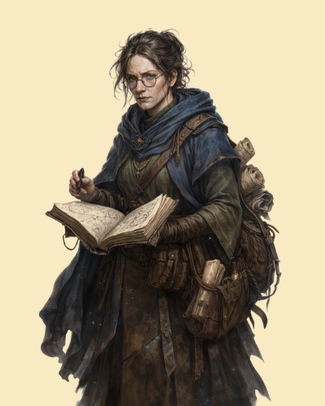
Mae Coilbound
Leyline Theorist and Arcane Historian
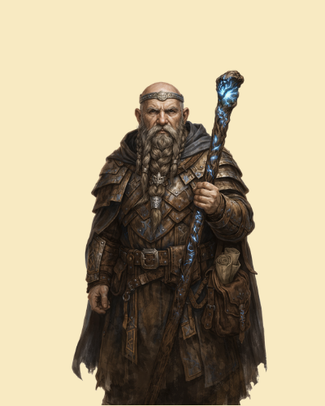
Tovrin Deepmantle
Rune Conservator and Oath-Bearer
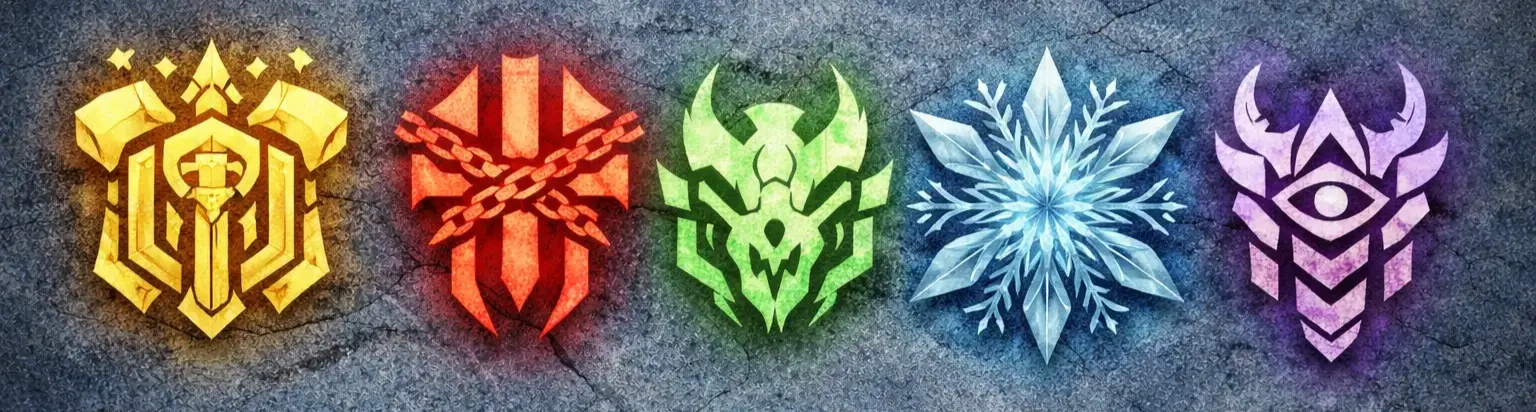
The Five Runes
| Common | Dwarvish | Draconic |
|---|---|---|
| Rune of Entry | Karn-Vol | Vorthak |
| Rune of Restraint | Ember-Kai | Syrath |
| Rune of Naming | Grim-Azh | Talrex |
| Rune of the Ancient Promise | Dum-Barek | Vaelun |
| Rune of Consent | Tharn-Kel | Aeskar |
Investigation Phase
When players examine the runes, they gradually reveal the following.- Successful Arcana or Religion (DC 13): The magic here is responsive, not reactive. It waits for intent.
- Successful History (DC 12): Dwarves and dragons once sealed places together, but only when neither trusted themselves alone to guard what lay within.
- Successful Insight (DC 12): The runes are not meant to be activated individually. They are meant to be acknowledged.
The Spoken Seal Challenge
The seal opens only if three conditions are met:1. The Runes Must Be Read Aloud
At least three different runes must be spoken aloud. Each spoken rune causes a subtle reaction.When spoken correctly:
- Ice cracks softly, not violently
- The hum deepens, becoming steadier
- The rune's glow strengthens briefly
2. The Runes Must Be Spoken in Balance
If players attempt to activate only one theme, such as strength or power, nothing progresses.They must include at least:
- One rune of restraint
- One rune of duty
- One rune of balance
3. No Violence or Forced Magic
If a player attempts:- To break the ice
- To blast the seal with spells
- To brute-force the entrance
Mae or Tovrin immediately intervene, urging restraint.
Rune of Entry
Stone and Breath
Stone remembers those who break it.
Breath remembers those who guard.
We enter not to take, but to stand watch.
Rune of Restraint
Power and Choice
Power taken cracks the mountain.
Power given binds it.
Choose how your hands are remembered.
Rune of Naming
The Fangs of the Great Beast
Grimthar Fangkra.
Fangs raised not to devour,
but to hold the jaw closed.
Rune of the Ancient Promise
Breath and Bone
We sealed this place with breath and bone.
Not to hide power,
but to spare the world its hunger.
Rune of Consent
Those Who Remain
Those who enter must listen.
Those who listen may remain.
Those who remain must protect.
- Mae gently translates a rune concept, not the solution
- Tovrin mentions an ancient dwarven tradition of spoken seals
- The mountain never punishes curiosity
- The hum becomes unstable
- Future encounters grow more volatile
Not the kind that feels empty, but the kind that feels like something is listening.
You feel the vibration beneath your feet change; it is subtle at first, as if the mountain has shifted its attention. The hum you have felt since approaching the entrance does not grow louder or more intense. Instead, it steadies, settling into a slow, even rhythm that you can feel through the stone and up into your legs.
The ice sealing the cave does not crack or shatter. But instead, you feel a soft rush of air brush past you, and you realise the ice has exhaled. Your breath fogs, but the air around you warms just slightly, enough that you notice it against the cold biting at your skin.
As you watch, faint fractures begin to appear across the surface of the ice. They do not spread quickly or violently. Just thin lines creeping outward from the runes, branching and winding like frost melting in reverse. As each fracture forms, the glow of the runes begins to dim, not snuffed out, but drawn inward, sinking back into the mountain stone.
A low sound follows, deep and heavy. Stone grinding against stone. It is not sudden, and it is not threatening, but it carries a weight, like something ancient shifting after a very long stillness.
Slowly, the cave seal begins to loosen.
Large sheets of ice pull away from the cave mouth, sliding aside rather than falling, opening a dark passage beyond. Cold air rushes out around your legs, carrying the scent of old stone and dormant magic, layered with something else you cannot quite place.
The path into Grimthar Fangkra lies open."
Chapter 2: The Scar Left By Hunters
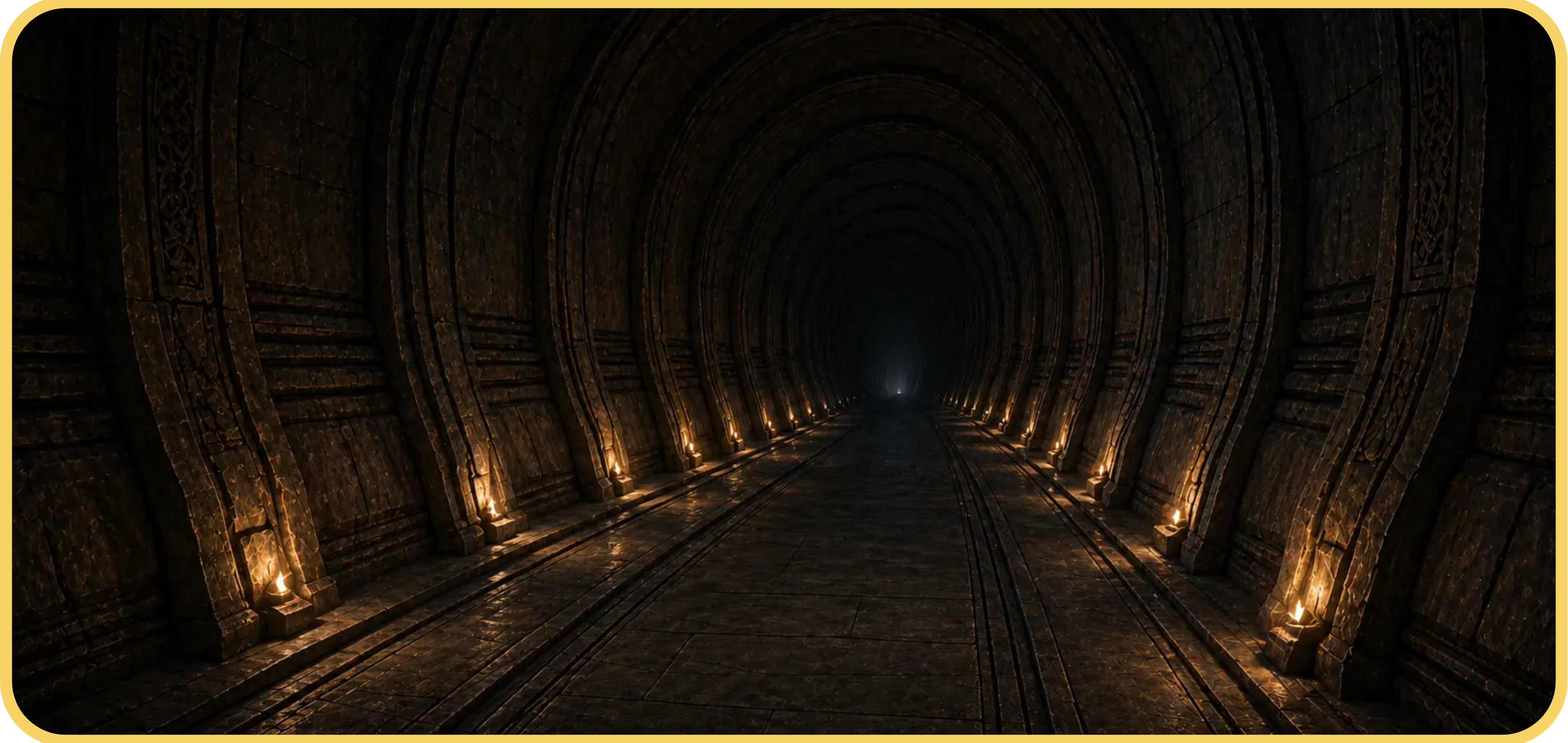
The stone beneath your feet is smooth, not worn by traffic, but it seems to be shaped with care. Each step feels deliberate, the floor subtly angled to guide weight and movement rather than to resist it. The walls have been curve inward just enough to feel intentional, reinforced by shallow channels carved along their length. These grooves are not decorative. They are functional, designed to distribute pressure, to carry strain away from the corridor and into the mountain itself.
You all can realise that this place was not hollowed out in haste. It was engineered to endure through the ages.
As you move deeper, the hum you felt outside follows you. It does not echo here but instead it settles. The vibration sinks into the surrounding stone, quieter now, but deeper, like a distant heartbeat carried through stone rather than air. You feel it more than you hear it, a steady presence beneath every step.
The air remains cold, but it no longer bites. Your breath still fogs as you exhale, though more slowly than before, lingering in the air for a moment before thinning and vanishing. There is a faint scent beneath the cold, old stone and mineral dust, that seems to have been untouched and undisturbed for generations.
You notice that light behaves differently here. Shadows stretch longer than they should, clinging to corners and recesses as though reluctant to let go. Even with this, nothing feels hidden. Nothing presses in on you. This corridor does not feel hostile.
For a time, everything feels stable. As though this place was ready to receive those who knew how to walk it."
This is the intended state of the vault. If players investigate here, reinforce:
- Careful construction
- Absence of damage
- A sense of long-held balance
- Traces of ancient magic
Signs of Prior Intrusion
Investigation
Useful Checks
- Investigation or Perception (DC 14): Tool marks, not natural damage
- Arcana (DC 16): Leyline stress, actively leaking power
- History (DC 14): This kind of sealing damage comes from forced entry
- Insight (DC 12): The mountain feels strained, not angry
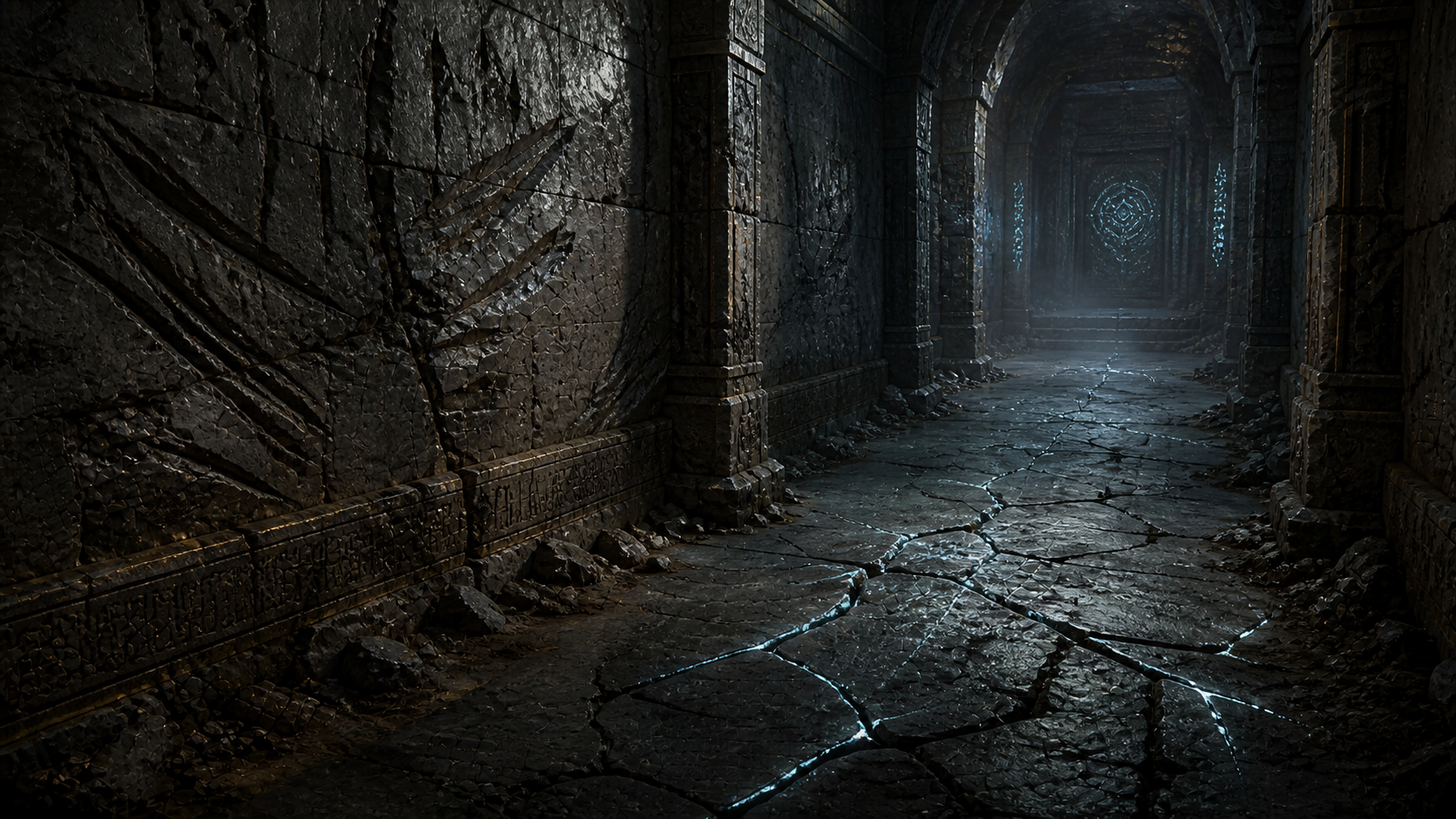
A thick jagged fracture line splits the floor, climbing up the high wall. It seems that time has left it open and festering. Its edges pulse with faint, unstable multicoloured light, flickering unevenly, casting sharp flashes across the stone like the mountain itself is gasping between heartbeats.
Ancient runes carved along the fracture lie shattered, their meaning broken mid-sentence. Iron spikes jut from the rock, twisted and half-melted, remnants of some desperate attempt to contain magic that surged far beyond mortal control.
The hum in this place is wrong. No longer steady, no longer distant. It lashes through the chamber in violent bursts, shaking stone beneath your feet, rattling through bone and breath alike. The mountain is not resting. It is enduring.
And here, in the dark, you can feel it plainly....this place is bleeding."
Containing the Fault
Skill Challenge
The moment the party steps fully into the chamber, the fault reacts to their presence.
The unstable light (mixture of colours) running along the fracture begins to pulse faster, uneven and sharp, leaking from the fracture in waves. The low hum beneath their feet deepens into something far more violent. Dust drifts from the ceiling in slow showers. Loose stone shifts underfoot. Small cracks spread quietly through the floor as the entire chamber feels as though it is holding itself together through sheer force of will.
This is not some dead ruin left to rot in silence. The mountain is alive in its own way, and it is struggling to keep itself from breaking apart. The party now stands at the centre of one of those wounds. This fractured leyline must be stabilised before it tears itself wider, because if it does, this chamber will not survive it.
This is not simply a matter of sealing stone or repairing old damage. It is about forcing order onto something ancient, wounded, and dangerously alive before the mountain decides it can no longer endure.
Goal
Success does not fully heal the wound, but it buys time and prevents catastrophe.
Structure
Each attempt should feel physical and immediate. Let players describe how they act rather than simply naming a skill. The chamber should react to every choice, stone cracking, light surging, heat rising, or ancient magic pushing back.
This should feel desperate, not mechanical.
Possible Approaches
- Arcana or Nature: Reading the unstable leyline flow, redirecting excess energy, identifying where the fault is weakest, or helping the mountain settle rather than forcing it
- Athletics: Bracing fractured stone, forcing support pillars into place, dragging fallen debris into stabilising positions, or physically holding collapsing sections long enough for others to act
- Survival: Managing unstable footing, finding safe paths through shifting rubble, controlling airflow from deep vents, reducing dangerous temperature changes, or recognising natural fault pressure
- Religion or Performance: Recalling ancient warding rites, repeating old dwarven containment chants, divine stabilisation prayers, or using rhythm and voice to anchor unstable magical resonance
- Creative spell use: Reinforcement magic, grounding elemental surges, protective barriers, containment fields, shaping stone, controlled frost, or anything clever enough to wrestle chaos into stillness
Failure Consequences
Each failure causes:- A violent surge of raw leyline energy lashes through the chamber
- The fault widens further, splitting stone and breaking old wards
- The chamber becomes increasingly unstable, making every next attempt feel more dangerous
-
Examples:
- The floor may crack beneath them.
- A support pillar may split.
- Ancient runes may flare and burn out.
- Someone may hear whispers inside the hum.
- Heat may rise like breath from the deep earth.
If the party reaches 3 failures, the fault ruptures violently.
The chamber partially collapses, uncontrolled magic floods the space, and from the Leyline a pair of Leyline Wraiths Manifest.
At that point, survival becomes the priority.
Leyline Wraiths Manifest
Combat
If the party succeeds in the skill challenge, they manage to stabilise the fault enough to prevent the chamber from collapsing. The violent pulses weaken, the crack in the stone begins to close slightly, and the pressure in the room eases. But as the fracture narrows, the escaping mist of fractured ley-light gathers and condenses, pulling itself into shape.
From that unstable glow, a single Leyline Wraith manifests, weakened and incomplete, not yet at full strength, but still dangerous enough to defend the wound it was born from.
If the party fails the skill challenge, the fault ruptures violently. The chamber partially collapses, stone cracks open, and uncontrolled magic floods the space in violent surges. The fracture tears wider instead of closing, and the leyline spills its instability directly into the room.
From the broken fault, two Leyline Wraiths manifest, fully formed from the chaos, drawn into being by the rupture itself.
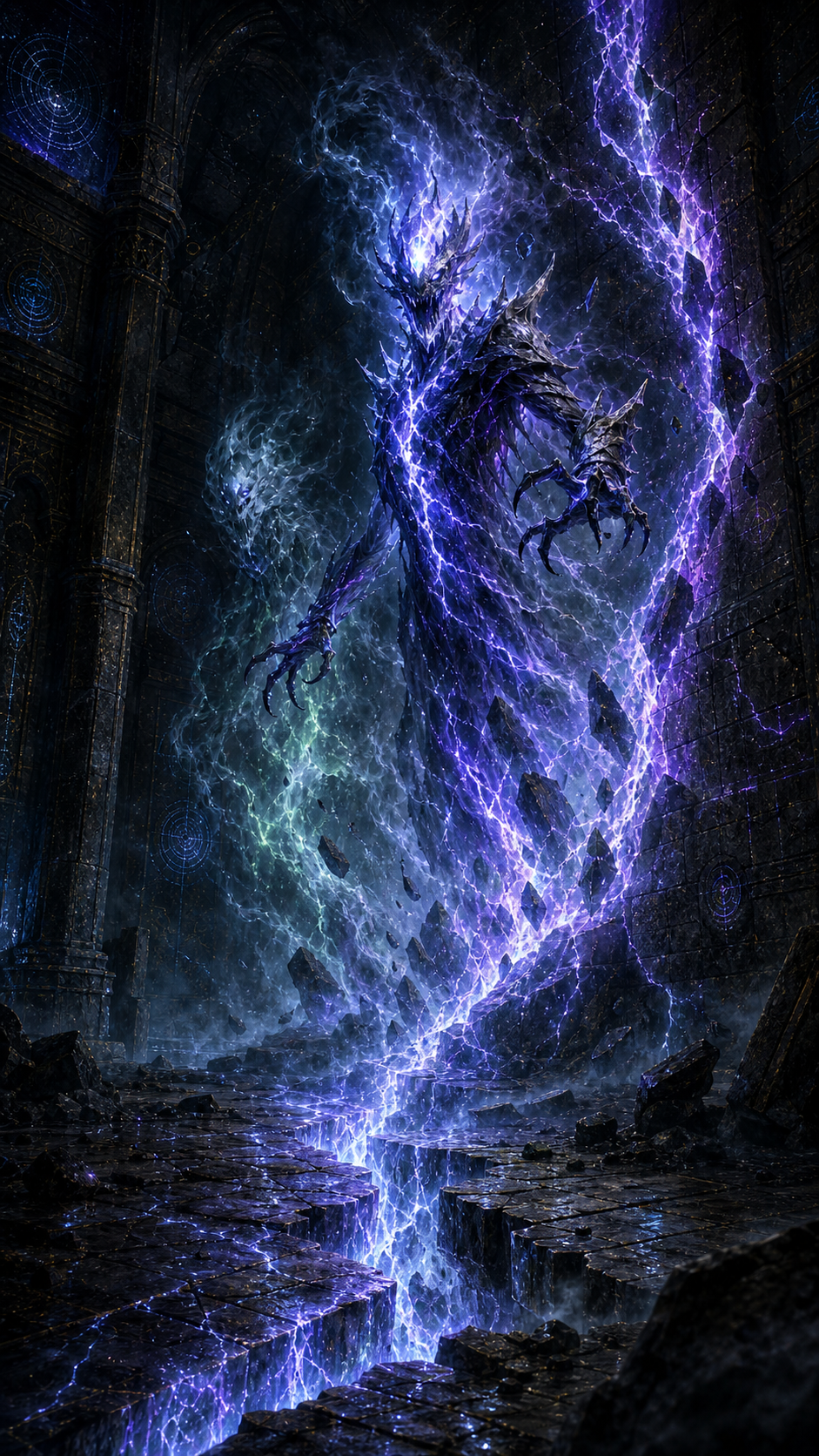
As the final stabilising force settles into place, the chamber shudders beneath your feet, but this time it does not feel like collapse. Instead, it feels like resistance. The jagged fault line pulses once, violently, and then again, weaker than before. The unstable light running through the fracture begins to dim, flickering like the last remnants of a dying storm. Stone grinds against stone as the crack in the floor slowly pulls inward. It is not healed, but it is no longer tearing itself wider.
The hum beneath you changes. What was once wild and violent becomes strained and uneven, but it is holding. The mountain feels as though it is drawing a slow, painful breath after being forced to endure far too much. Then the light changes. Mist begins to rise from the narrowing fracture, pale strands of fractured ley-energy curling upward like smoke from a wound that never truly closed. It twists and gathers, growing thicker as though something unseen is pulling it into shape. The air turns cold.
The runes burned into the surrounding stone flare once, bright and sharp, like a final warning. Then, from the glowing mist, something begins to form.
A figure emerges, wrong and flickering, wrapped in broken light and shattered runes. Its shape never fully settles, as though reality itself cannot decide what it is supposed to be. The mountain may be holding, but it the unstable magic is not letting you leave quietly.
“The moment the final failure settles, the chamber answers with violence.The fault erupts.
A deafening crack tears through the stone as the fracture splits wider, jagged and furious. The floor lurches beneath your feet, forcing you to fight for balance. Dust and broken rock rain from above as part of the ceiling gives way, crashing into the chamber with a violent roar.
The hum becomes unbearable. It is no longer just a sound. It becomes a force that rattles through your bones, your teeth, and your breath. Uncontrolled magic floods the space.
Light lashes from the broken leyline in violent bursts, striking stone, twisting the air, and bending shadows where they should not move. The chamber is no longer simply unstable. It is breaking. From the widening fracture, mist and raw arcane fire spill outward, swirling together like something being dragged into existence against its will. The glow thickens, sharpens, and then splits apart. Not one. Two.
Shapes begin to pull themselves free from the wound in the mountain. Their bodies are made of fractured light, broken runes, and raw magical violence. Their forms flicker constantly, as though reality itself is struggling to hold them together. The mountain has stopped trying to contain the damage.
Now it is simply trying to survive. And so must you.”
Monster: Leyline Wraith
DM Rose's Homebrew
Leyline Wraith CR: 4
STR
12 +1
DEX
16 +3
CON
14 +2
INT
11 +0
WIS
14 +2
CHA
8 -1
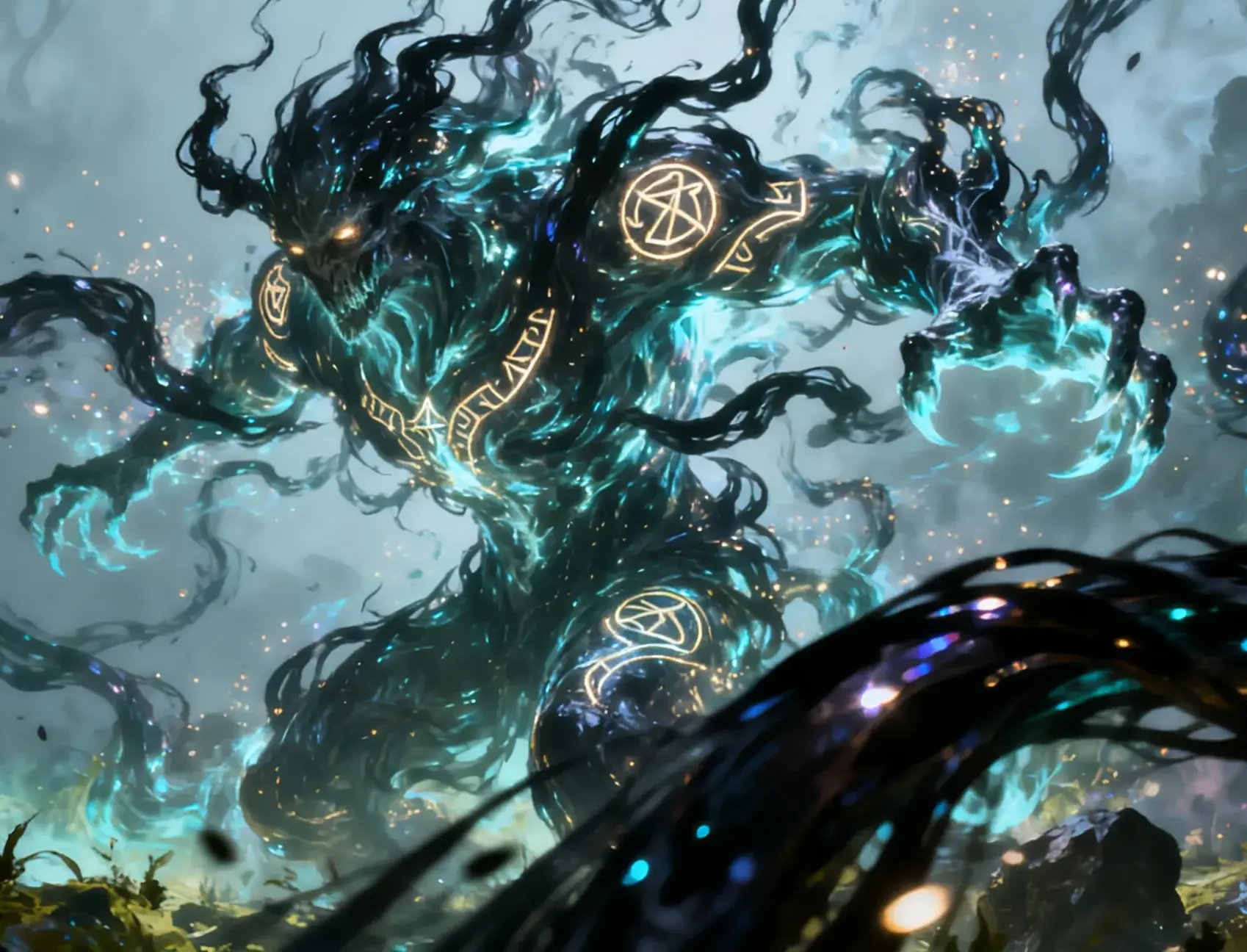
Wound-Born Existence. While within 30 feet of the leyline fault, the Leyline Wraith regains 5 hit points at the start of its turn. If the fault is stabilised, this trait is suppressed for both wraiths. Chaotic Aura (Shared). Creatures that start their turn within 10 feet of either Leyline Wraith must succeed on a DC 13 Wisdom saving throw or have disadvantage on their next attack roll or ability check before the end of their next turn. A creature that succeeds on the save is immune to Chaotic Aura from both wraiths until the start of its next turn. Spatial Distortion. The Leyline Wraith has advantage on Dexterity saving throws against spells. Ranged weapon attacks against it are made at disadvantage unless the attacker is within 20 feet. Leyline Flicker. When the Leyline Wraith takes damage from a melee attack, it can use its reaction to move up to 20 feet without provoking opportunity attacks. The space it leaves behind briefly warps, becoming difficult terrain until the start of its next turn.
Actions
Warping Touch. Melee Spell Attack: +5 to hit, reach 5 ft., one target. Hit: 13 (3d6 + 3) damage. The damage type is chosen by the wraith (cold, fire, lightning, or force). On a hit, the target’s speed is reduced by 10 feet until the end of its next turn. Ley Surge (Recharge 6). The Leyline Wraith releases a pulse of unstable magic in a 10-foot cone. Each creature in the area must make a DC 13 Dexterity saving throw, taking 18 (4d8) force damage on a failed save, or half as much on a successful one. Restriction: Only one Leyline Wraith can use Ley Surge per round. Environmental Effect: The ground in the cone becomes difficult terrain until the end of the next round.
Tactics (Run Them as a Pair)
- The wraiths do not behave like trained hunters or soldiers. They react like a failing system trying to correct itself.
- They do not focus the same target unless someone becomes an immediate threat.
- One remains closer to the fault, instinctively protecting the wound that sustains it.
- The other drifts outward, harassing the party and forcing movement across the chamber.
- They avoid ending turns adjacent to each other, as their unstable forms interfere violently when too close.
- They Flicker constantly, forcing repositioning and making the battlefield feel unstable.
- If one drops below half hit points, it becomes erratic rather than more aggressive, its form beginning to break apart faster.
- They are not coordinated tacticians.
- They are the same wound, failing in two places at once.
Ending the Fight
When one wraith is destroyed:- The surviving wraith shudders violently as part of the shared fracture collapses.
- It immediately loses Wound-Born Existence.
- The fault pulses once, sharp and violent, then weakens.
- The remaining wraith becomes more stable, less frantic, and noticeably less dangerous.
When the second falls:
- The final strands of fractured ley-light begin to unravel instead of exploding outward.
- The unstable glow is drawn slowly back toward the fault, like breath returning to lungs.
- The light dims.
- The hum steadies.
- The mountain holds.
Why this version works:
- Two enemies create pressure without simply doubling lethality.
- Shared aura prevents constant save spam and keeps turns cleaner.
- Limited Ley Surge prevents sudden unfair spike damage.
- Lower hit points keep pacing tight and prevent combat from dragging.
- The environment remains the real enemy, not just the stat block.
The real tension comes from the chamber, the unstable fault, and the fear that killing them the wrong way may make everything worse.
Quick Mid-Fight Adjustments
As the DM, make adjustments quietly if needed. Keep the pressure high, but never let the fight become tedious.
Need it easier?
- Suppress regeneration early if the party is struggling.
- Delay Ley Surge recharge.
- Let the fault weaken faster through environmental interaction.
- Increase regeneration.
- Let both wraiths use Ley Surge once total during the fight, but never in the same round.
- Have instability from the chamber creates movement hazards between turns.
Aftermath: The Wound Holds
… you watch the glow along the fault begin to fade. It does not vanish all at once. You will still see that the jagged wound in the stone remains, cracked and scarred, its edges still faintly warm if you were to touch. But it no longer widens. The violent pulses of light die down, leaving behind only a dull glow deep within the stone.
The hum beneath your feet falters, slipping out of rhythm for a breathless moment. Then it steadies again, weaker than before, but holding.”
The Hunters
Evidence
You soon see scattered across the stone floor are the remains of a long-abandoned camp. Bedrolls reduced to rotted strips of leather and cloth. To one side of the wall there is broken crates splintered as if pried open in haste. Near them is empty vials lying on the stone as if they were dropped, their glass clouded with age, some cracked, some broken.
Over to the other wall, half-buried beneath fallen stone, you see a shattered draconic relic. Its surface cracked and warped, the markings along its edge fractured beyond recognition. Whatever power it once held is gone, burned out rather than spent.
And beyond that, deeper in the chamber, you see the remains of something far larger.
Roll Investigation" (DC 14)
Time has stripped it of flesh, leaving behind darkened bone and remnants of scales dulled to the colour of ash. The skull is split along one side, not cleanly, but violently, as though it was struck again and again until even bone gave way.
This body has been here a long time. Centuries, at least.
You also notice that the stone around it bears the same scars you saw along the corridor, cracked and warped by magic forced through it without care. Whatever happened here did not kill the dragon quickly. But it died where it fell.
Possible Loot
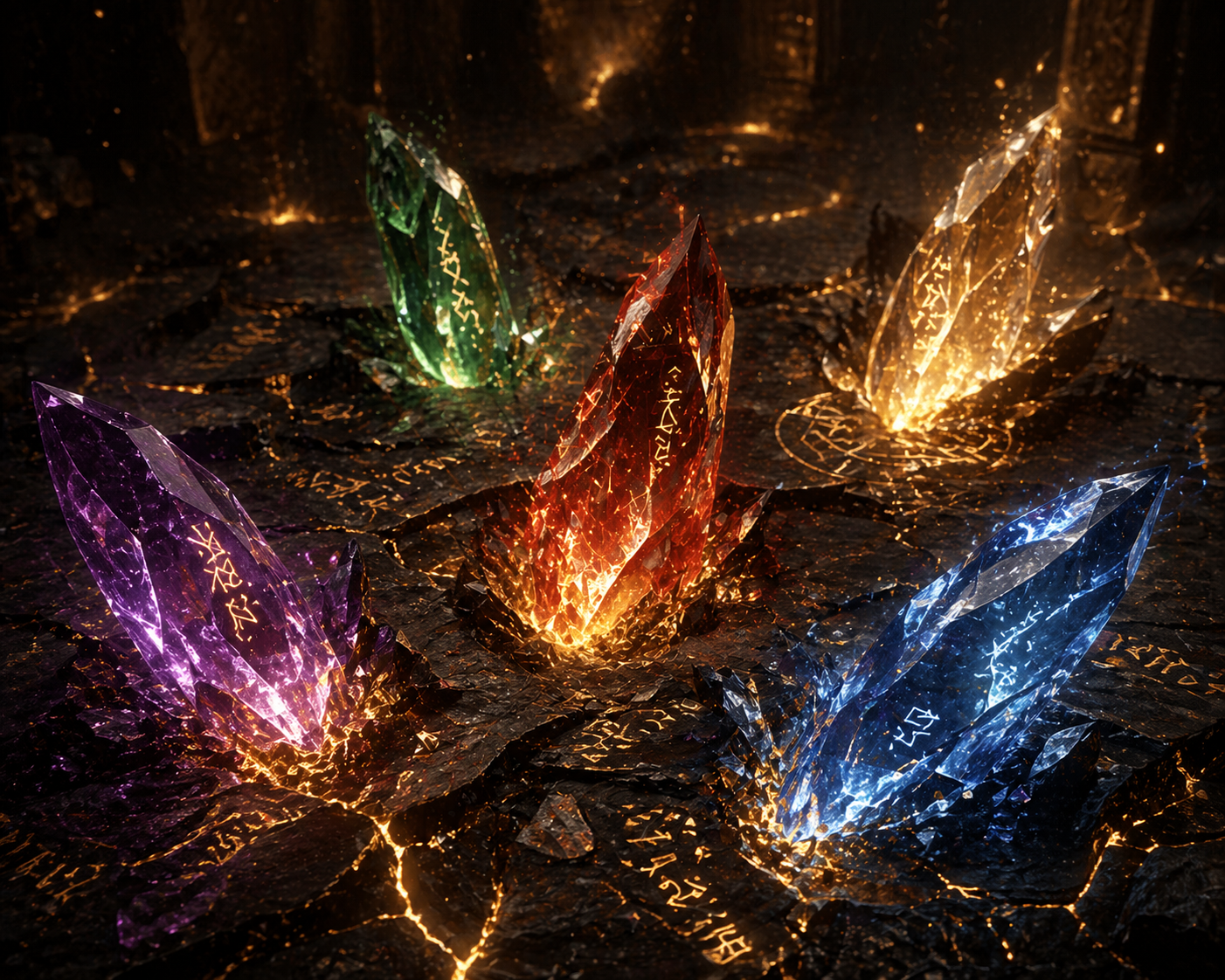
Ley-Scar Crystals
Small shards of crystallised ley energy left where the wraiths unravelled.
Mechanical Options
(choose one or make up something that fits with your party):- As a reaction, gain advantage on a saving throw against a spell or magical effect
- As an action, regain 1d8 hit points and remove one condition caused by magic
- Can be expended later to gain advantage on a single Arcana, Nature, or Religion check involving leylines or dragons
Draconic Broken Tablet
Description
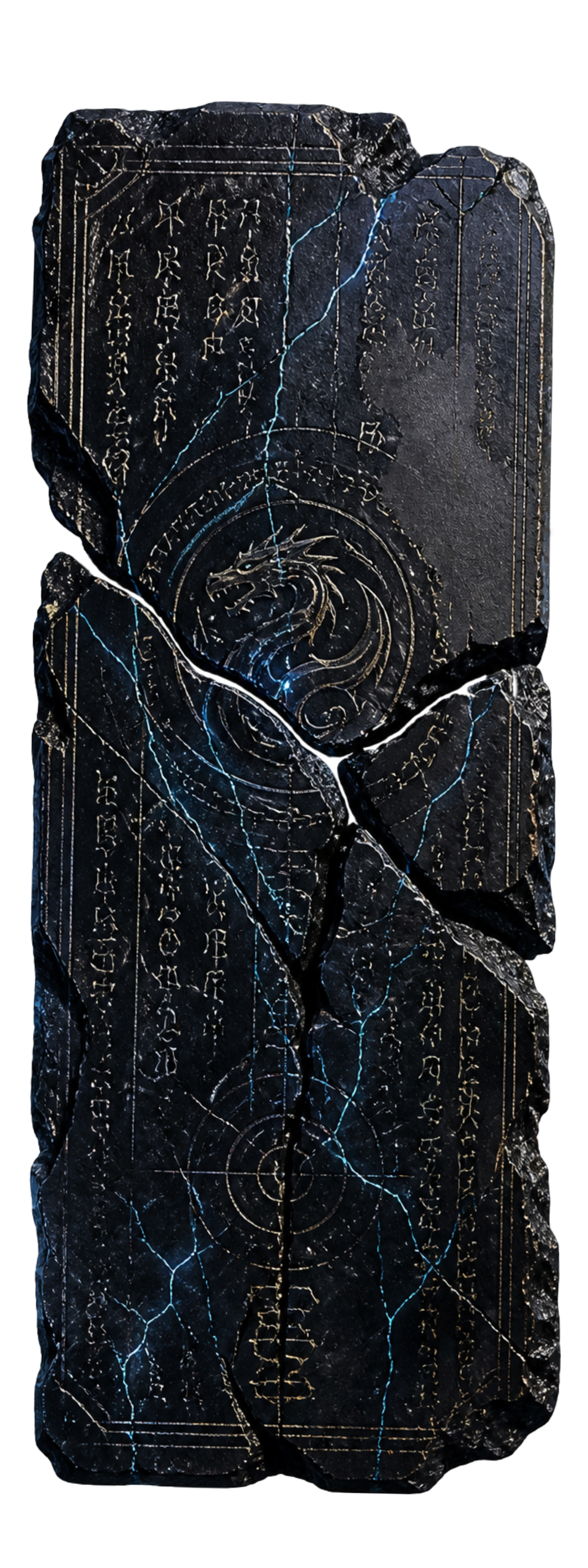
A fractured slab of dark, obsidian-like stone etched with remnants of draconic script and leyline patterns. The surface is split unevenly, with sections of the carvings abruptly ending or smoothed away as if erased rather than broken. The tablet is unnaturally cold to the touch, and faint hairline cracks run through it like veins long since drained. When held, the air around it feels subtly wrong, as though something that should be present has been forcibly removed.Dormant Effects
While attuned to the Draconic Broken Tablet:- You have advantage on Intelligence (Arcana) checks related to dragons, draconic magic, and leyline structures
- You can sense nearby magical disturbances or unstable leyline activity within 30 feet, though not their exact source
The tablet resists magic rather than supporting it.
- You have disadvantage on Constitution saving throws made to maintain concentration on spells
- You feel a constant low hum beneath your skin, especially when near other magic items or spell effects
When you finish a long rest within 30ft of the tablet:
- You must succeed on a DC 13 Wisdom saving throw or experience fractured dreams
- On a failure, you gain no benefit from the rest's mental recovery, and have disadvantage on your first Intelligence, Wisdom, or Charisma check the next day
- A broken sigil
- A name you cannot remember
- The feeling of something vast... suddenly gone
Lore: These tablets were once used to bind and anchor dragons to specific places, purposes, or leyline nexuses. Each was inscribed with a true name and woven into the fabric of the land itself. This fragment shows clear signs of deliberate destruction. The magic has not faded, it has been stripped away entirely. Whatever was bound to this tablet no longer exists in any known form.
This item is not a source of power, it is a narrative anchor.
- Foreshadow anti-magic forces or organisations
- Introduce the concept of "erased" magic or souls
- Connect to leyline instability, dragon hunting, or forbidden knowledge
- Additional fragments
- Sites where similar tablets were destroyed
- Evidence of a method capable of unmaking magical beings entirely
Hunters' Field Journal (Major Lore Item)
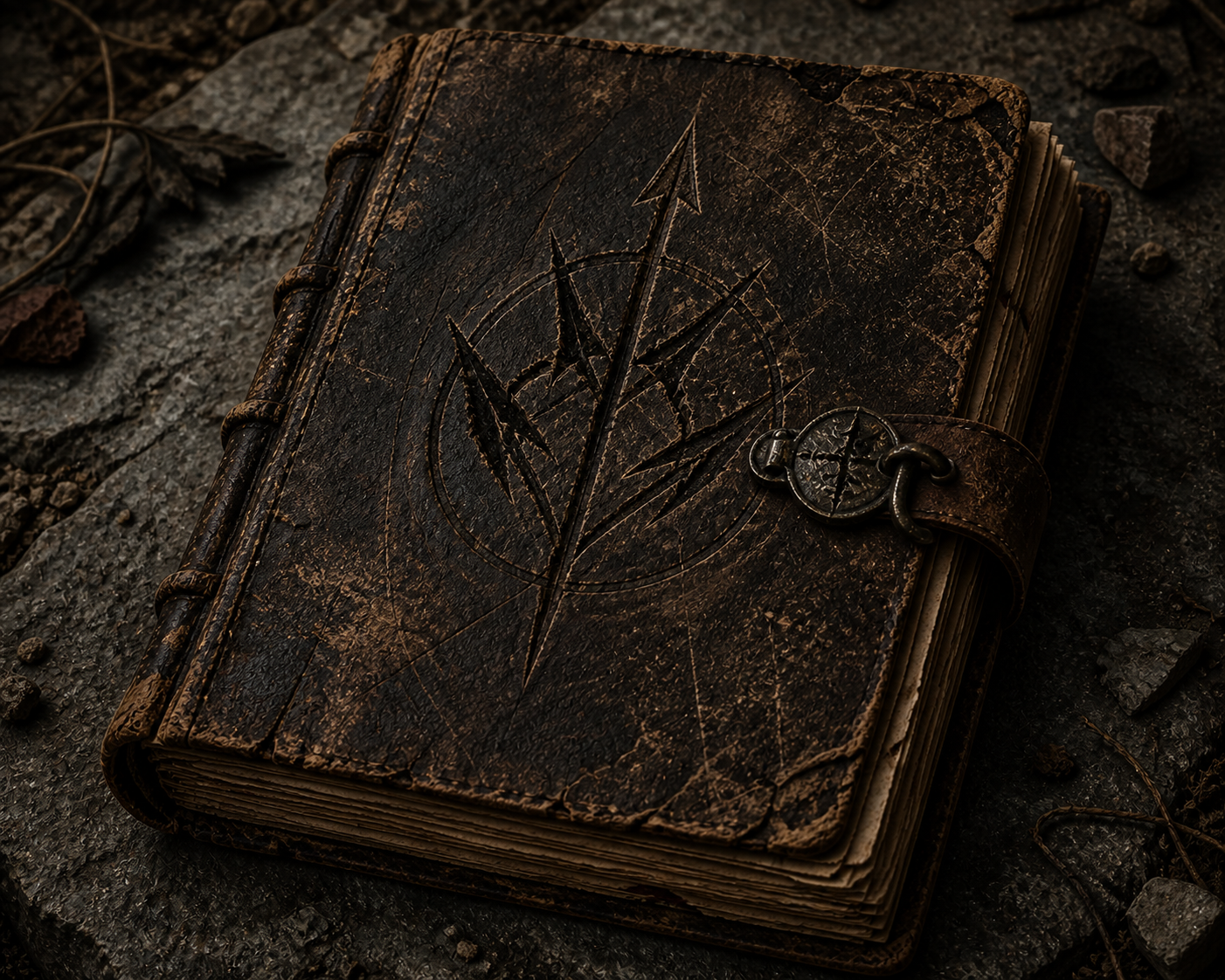
The journal is bound in warped leather, stiff as if it once resisted heat... or something far worse. Its pages are thick, fibrous, and stained with soot, ash, and something darker that was never properly cleaned away. The edges curl inward, as though the book itself recoils from what it contains. It doesn’t feel like a record but like evidence.
- The writing begins neat, precise, almost academic
- Over time, the script deteriorates into jagged, hurried strokes
- Later entries are fragmented, words scratched out, rewritten, or abandoned mid-thought
- Several pages are partially burned, not just by flame, but also by something that ate the ink itself
- The final entries show signs of trembling hands... or something writing while no longer entirely whole
Journal Contents:
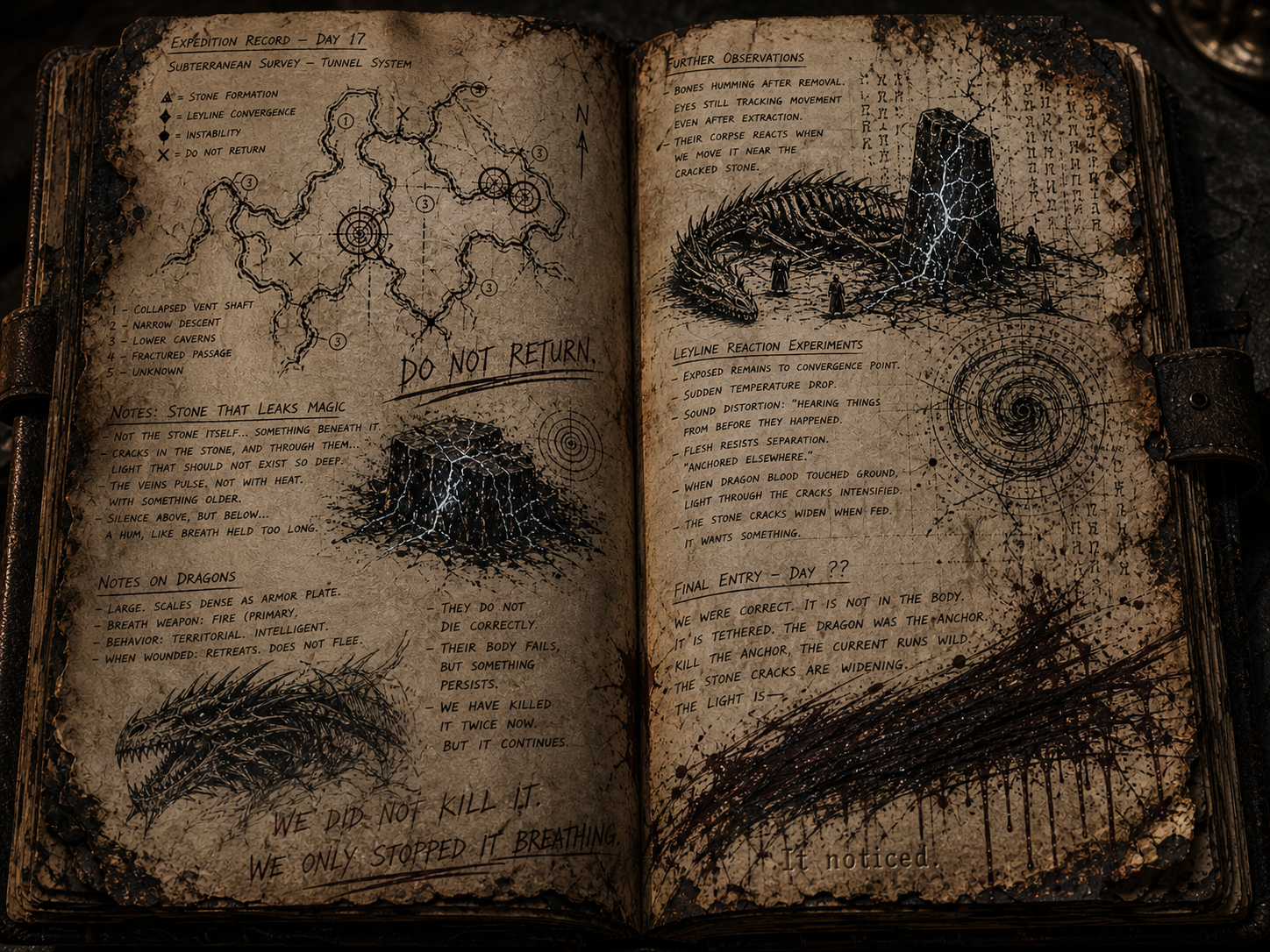
- Marked with symbols instead of names
- Repeating spiral patterns, likely leyline convergence indicators
- Certain sections are circled multiple times with increasing pressure
- One area is labelled only with: "DO NOT RETURN"
- "Not the stone itself... something beneath it"
- "Cracks in the stone, and through them… llight that should not exist so deep"
- "The veins pulse. Not with heat. With something older."
- "Silence above, but below... a hum, like breath held too long"
At first, clinical observations:
- Weight, size, scale density, breath attacks
- Different breed information
- Behavioural patterns when wounded
- "They do not die correctly."
- "Their body fails, but something persists."
- "We have killed it twice now but it continues."
- "Bones humming after their removal"
- "Eyes are still tracking movement even after extraction"
- "Their corpse reacts when we move it near the cracked stone"
Leyline Reaction Experiments The hunters were not merely killing but they were extracting. Attempts were made to remove something from dragon remains while exposed to leyline intersections.
Recorded effects:
- Sudden temperature drops
- Sound distortion, described as "hearing things from before they happened"
- Flesh resisting separation, as if "anchored elsewhere"
- The leyline light through the stone cracks intensifies when dragon blood touches the ground
The last readable page begins coherent, though hurried: "We were correct. It is not in the body. It is tethered. The dragon was the anchor. Kill the anchor, the current runs wild. The stone cracks are widening. The light is-" The sentence ends. Ink smeared downward violently. Across the page, dragged by force. Below it, faint impressions... not written in ink, but pressed into the page: "It noticed."
What This Journal Confirms?
They were not just legend and myth but this journal does prove that they did truly exist.
2. Dragon Hunters Were Real
They thought they were culling predators. They did not yet understand what they were assassinating.
3. Dragons Were Leyline Guardians
They did not hoard gold or sleep on treasure. They anchored the leylines, kept the currents stable, and prevented wild magic from surging through the world's veins. Where dragons dwelt, the leylines ran deep and true.
4. Killing Dragons Destroys Balance
Remove the anchor and the current runs wild. The hunters broke something they did not understand. The leylines bleed through the stone and it is not a resource to harvest - they are wounds in the world, opened where guardians once held them closed.
5. Leylines Are Reactive
The leylines were never just passive rivers of magic as they responded, they noticed, and they did not tolerate interference. But when their anchors were removed, they grew wild and unmanageable, and magical disasters followed.
6. Something Went Wrong... Fast
This journal shows that something had happened that was not expected, which caused the end of these hunters in this tunnel.
Chapter 3: The Stonebound Truth
...the passage continues downward, narrowing once more as the mountain reasserts its shape around you. The stone beneath your feet grows smoother again , the rough damage you passed through giving way to careful, deliberate construction. Whoever built this place wanted the path to feel different here. Wanted you to know the boundary had been crossed.
As you descend, the air grows subtly warmer. The cold no longer bites quite as sharply, and your breath no longer fogs as heavily when you exhale. The mountain is still cold, but something beneath it is not. The hum beneath your feet changes as well. Slower now. Deeper. No longer erratic or strained, no longer the wounded pulse you felt near the fault. You feel it through your boots and up through your legs , a constant presence that is no longer reacting to damage, but simply existing. Holding. Waiting. You get the sensation you are walking through something that is aware of you being here. Not watching. Not threatening. Just... aware.
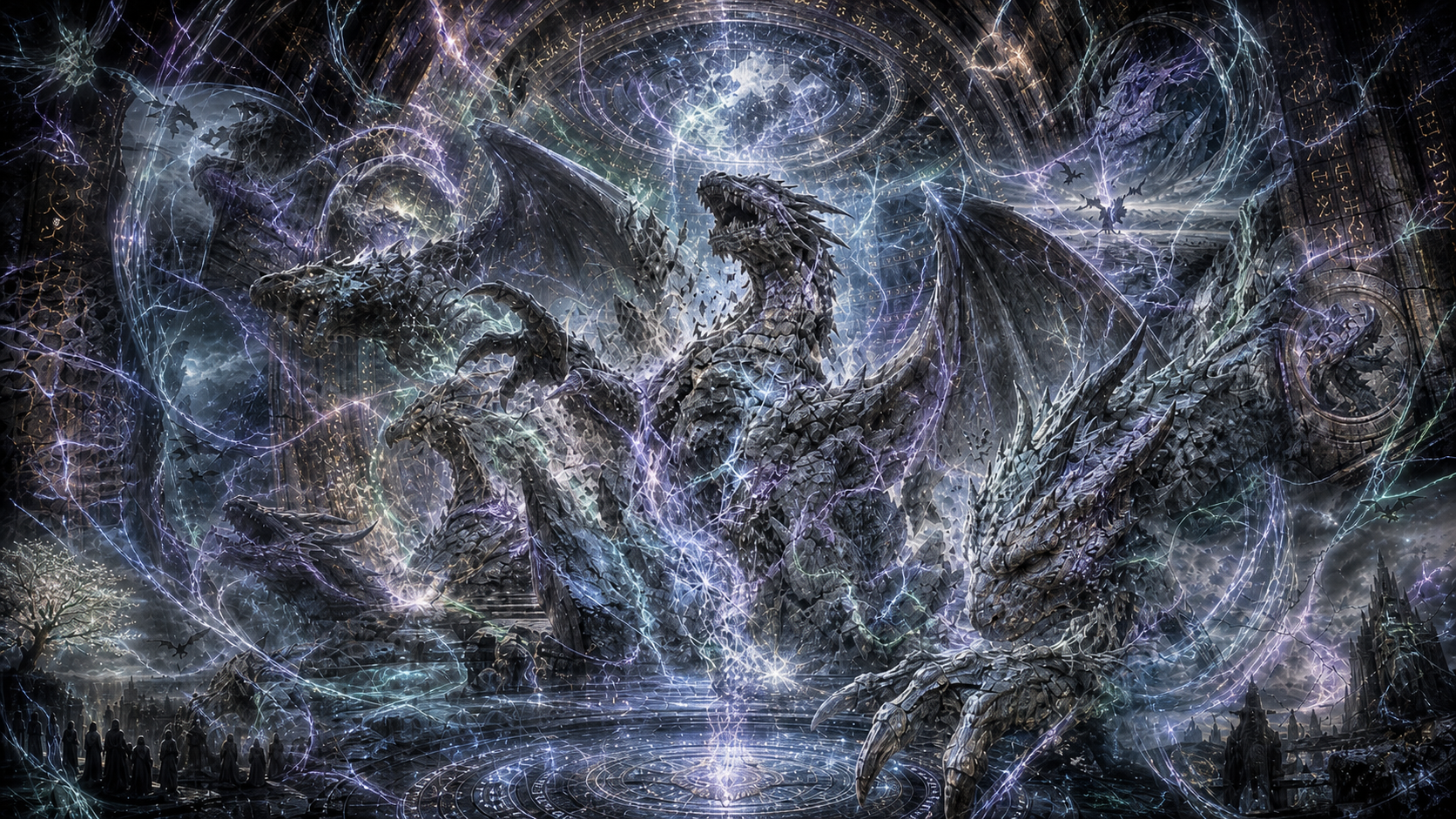
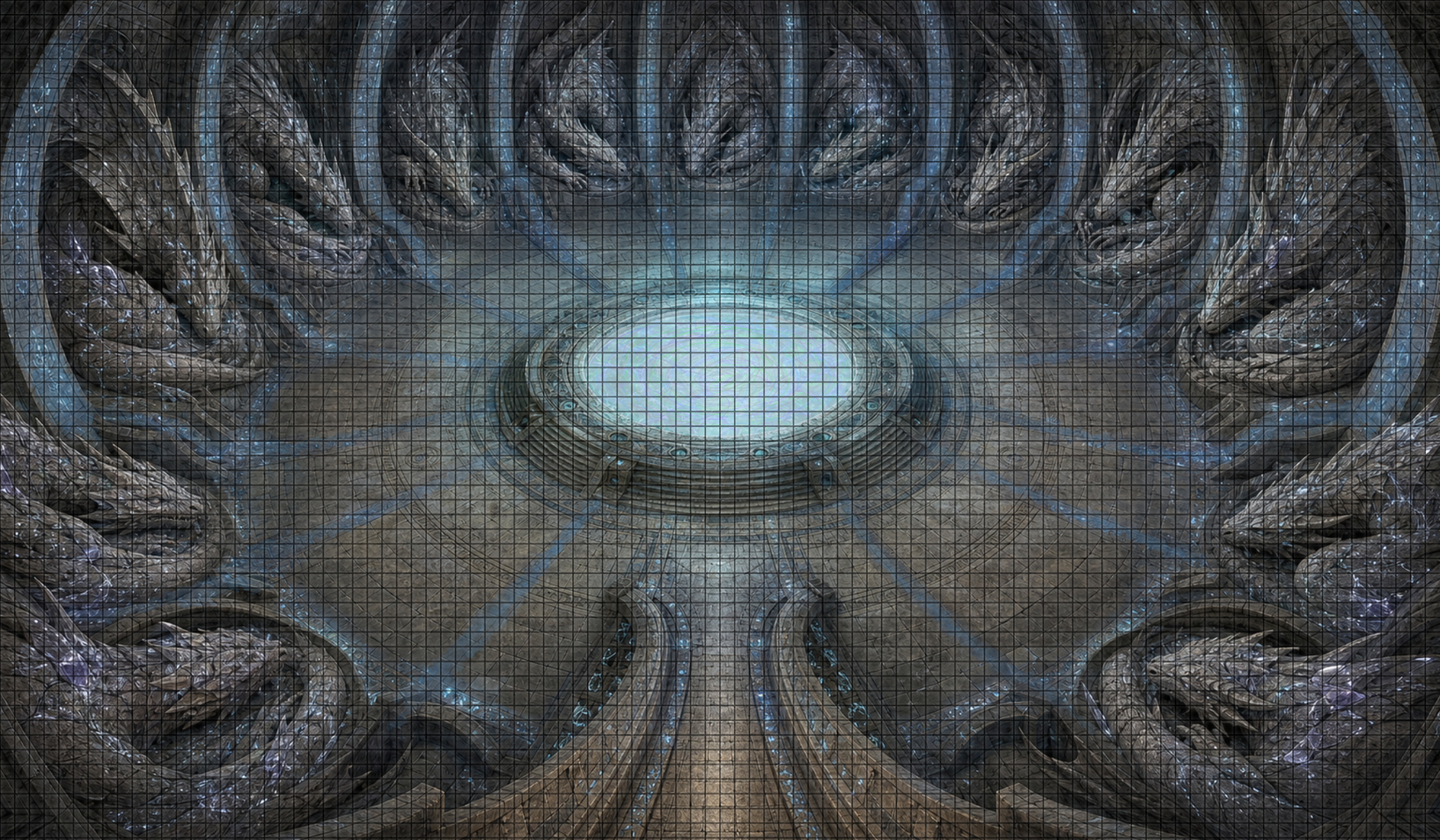
The corridor opens into a vast, domed chamber, and your light spills outward, swallowed by space rather than stone. Massive ribs of stone curve overhead, rising high above you, etched with worn runes that glow faintly in response to your presence, not welcoming, not warning, simply acknowledging that something living has finally come this far. The floor slopes gently downward toward a wide, circular area at the centre. At first glance, the chamber appears empty. Then your eyes adjust.
In the middle of the chamber sits a huge pool of liquid on a raised platform, radiating dim light upward through whatever it is. It does not ripple. It does not reflect your torchlight. It simply glows steadily. And embedded within the walls themselves are enormous shapes. Vast draconic forms lie folded and still, their bodies made of marble and rock, veins of crystal threading through their scales, catching the light from the pool below. Their wings are drawn tight against their bodies. Their eyes are closed. They are unmoving, as though time itself halted around them mid-breath.
Their wings are drawn tight against their bodies. Their eyes are closed. They are unmoving, as though time itself halted around them mid-breath. You cannot tell if they are alive or dead, preserved or imprisoned, waiting or finished. Only that they are still, in a way that nothing natural ever is.
The hum beneath your feet is strongest here, resonating outward from this chamber, consistent and restrained, as though this place holds something immense in careful balance. The pool's light pulses once, faintly, in time with it. You do not know if the dragons are the source of the hum, or if the hum is soemthing else. You are not sure you want to know.
You are standing in what seems to be a tomb. But tombs, you realise, do not usually hum.
What do you do?"
Understanding the Stonebound Dragons
Let the party investigate freely. Do not rush them. This chamber has waited a long time. It can wait a little longer.Suggested Checks
- Perception (DC 13): These bodies were not carved. The stone grew around them, slowly, like bark over a wound.
- Arcana (DC 14): Powerful transplanar magic failed mid casting. Not fizzled but failed. Something interrupted it that should not have been able to.
- Religion (DC 13): Divine absence altered the laws governing planar travel. The gods withdrew, and the doors they had propped open slammed shut.
- History (DC 12): Dragons vanished without war or uprising. One day they were legion. The next, they were not. No one wrote down why. Perhaps no one lived to.
- Insight (DC 12): These beings chose restraint over retaliation. They could have burned the world on their way out. They did not.
Memory Echoes
As the party interacts with the chamber, fragments of memory surface. These are not visions. They are felt experiences ... impressions that brush against the mind and then fade, leaving only the ache of something you cannot quite name.Trigger a Memory Echo when:
- A player touches the stone respectfully
- A player speaks aloud without demanding
- A player succeeds on a significant investigation check
If a player tries to touch the pool of luminescent liquid, they experience pain beyond description, not of burning, not of freezing, but the sensation of their body being unmade at the seams, pulled apart by something that does not understand anatomy enough to be cruel. They are dragged through a memory that is not their own: the moment the spell collapsed, the instant a hundred dragons felt themselves torn from where they belonged and sealed here, mid-breath, mid-thought, mid-scream.
Damage the player [3d6] psychic damage.
Example Memory Echoes
- The sensation of being hunted across generations, never knowing which generation would be the last
- The moment a vast spell collapses inward on itself, devouring its own caster
- Panic giving way to grim resolve, the decision made before the mind has finished understanding it
- The choice to hide rather than burn the world, and the silence that followed
Each Memory Echo grants:
- Advantage on one check during Chapter Four
- Cancels one failure during the Leyline Cataclysm (explained in Chapter Four)
The world around you begins to blur at the edges, then completely. The stone ribs of the chamber fade from focus, dissolving into grey mist, and for a moment that stretches longer than it should, you are no longer standing where you were. The air feels thicker here, charged with the faint ozone scent of magic pushed beyond its breaking point. Your skin prickles as immense power gathers around you, drawn together with absolute intent, as though it has only ever had one reason to exist.
Escape. Freedom. The words arrive in your mind fully formed, inevitable as gravity.
You feel the spell take shape around you, vast and precise, bending reality as it reaches outward, seeking somewhere beyond this world. For a heartbeat that feels like it could last forever, it feels as though it might actually work. As though the pull is strong enough to tear free of everything that has hunted these beings, bound them, demanded their submission.
And then it is wrenched back. Violently. The world itself clenches, refusing to let anything pass beyond its grasp. The power collapses inward, twisting, folding, snapping back like a chain pulled too tight. Not pain, but something deeper... shock, sudden and absolute, like reaching for solid ground and finding only empty air. Then the magic implodes, consuming itself, consuming the last chance these creatures had to be anywhere but here.
Your breath catches as your body tightens without consent, muscles seizing, skin pulling rigid, hardening from the inside out. You cannot move. You cannot finish the motion you were in the middle of. Wings half-spread freeze in place. Claws never reach the ground they were reaching for. Eyes that were watching for escape go dark without ever closing.
And then you realise, with a clarity that leaves you reeling, that this is not happening to you. It is happening to them. You are feeling the final moments of the dragons as they lived them, as they became something no longer alive but not quite finished either.
And yet, even then, they chose. With the final flicker of will in minds already half-turned to stone, the dragons scattered themselves across the world, hiding where mortals would not think to look, where kingdoms would not reach. They chose to vanish rather than turn their fury outward. They chose endurance over annihilation, silence over screams. They chose survival over vengeance, and paid for it with centuries of stillness, of being present without ever being able to touch or speak or remind the world they had once been magnificent.
The sensation releases you all at once, dropping you back without warning. The chamber snaps into focus, the stone ribs towering overhead, the hum steady beneath your feet, the dragons unmoving where they have always been. Your breath returns, sharp and sudden, as if you have been holding it far longer than you realised.
You are yourselves again. But you are not unchanged. You know what happened here. You know why the dragons are stone, why they do not answer when the world calls out in chaos. And you understand, finally, that what sleeps within Grimthar Fangkra is not a myth, not a story told to fill the silence around campfires.
It is the truth. It has always been the truth. And now you are part of it, bound to it by nothing more than the fact that you were here, that you felt what they felt, that you know what they chose and what it cost them.
The chamber settles into silence once more, the hum steady beneath your feet and the stonebound dragons unmoving within the walls. You stand in that silence longer than you need to, not quite ready to return to a world that does not know what you now know, that has not been touched by this weight and this sorrow and this impossible, enduring choice to survive rather than destroy."
Chapter 4: The Leyline Monster
...releasing its hold on you all at once, dropping you back into your own bodies with a suddenness that nearly buckles your knees.
For a brief moment everything is still. The dragons remain unmoving within the walls, their immense forms silent and bound in marble and memory and the calcification from centuries ago. The hum beneath your feet steadies again, low and constant, as though the mountain itself has finally decided to exhale, to let go of the tension it has carried since you first stepped into this sacred, broken place.
But then the rhythm shifts.
At first it is subtle, just enough to notice now that you are listening for it, now that your senses have been opened by what you have been forced to witness. The hum slips out of alignment, one pulse lagging behind the next in a way that feels wrong at the level of your bones, your blood, the spaces between your thoughts, until overlapping currents begin to press against one another beneath the stone’
The runes along the ribs now begin to flicker unevenly, some flaring too bright while others falter and dim. The ground trembles, just slightly at first, then with more insistence, more demand.
A sharp crack splits the chamber as a fracture tears open at its centre, raw ley energy bleeding upward through the stone like light forced through broken glass, like water finding a weakness in a dam that has held for longer than anyone alive has known to fear it. The air grows heavy and charged, pressing against your skin, your eyes, the inside of your throat, your skin prickling as a metallic tang fills your breath and coats your tongue with the taste of something not natural and no longer willing to stay quiet.
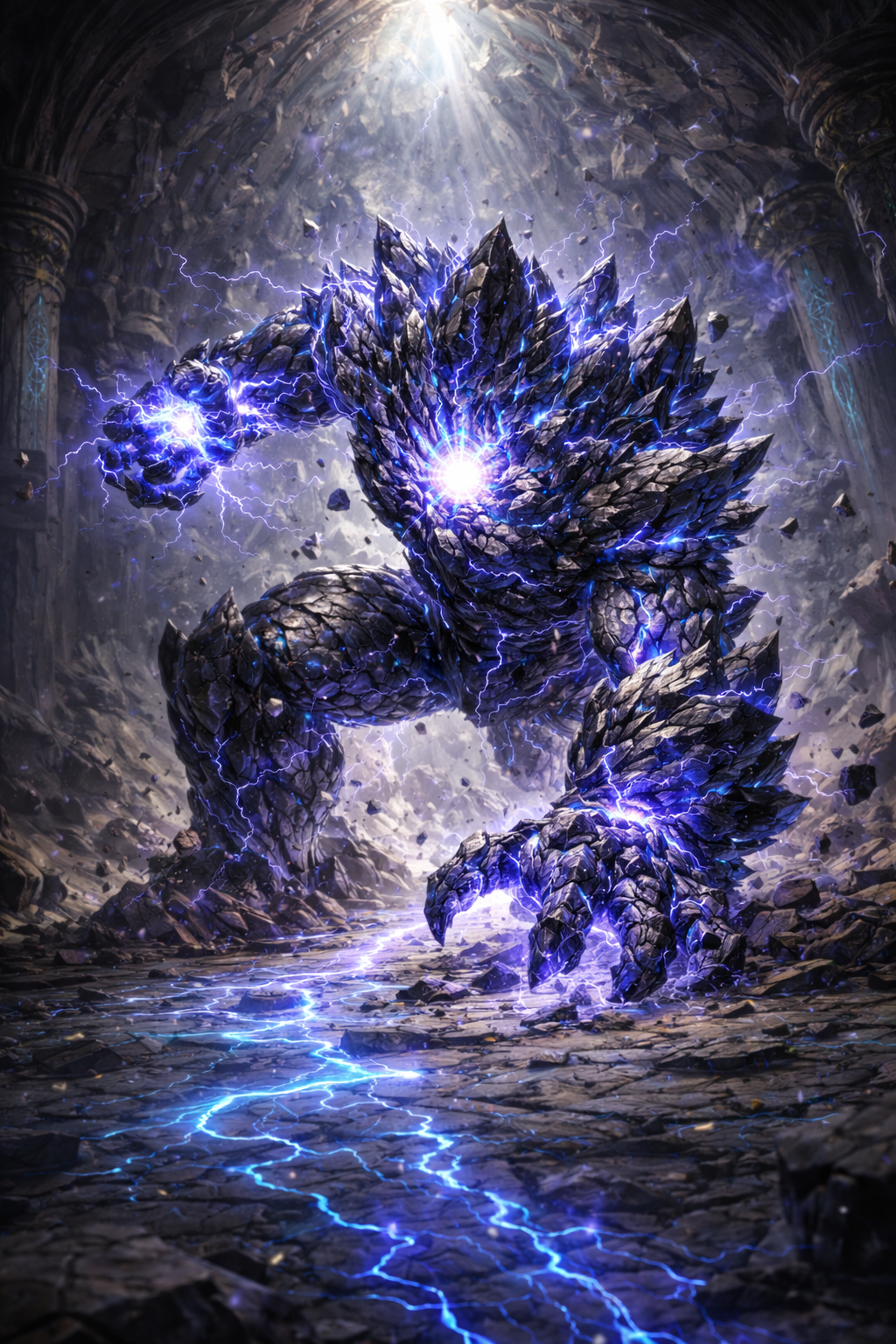
From within the widening fracture, something begins to form. Stone is dragged upward and suspended by twisting strands of glowing energy, pulled into a shape that shifts and struggles to stabilise, that fights against its own existence even as it is being forced into being by the pressure of remembered truth and the leylines' unwillingness to remain balanced when their anchors have been so thoroughly unmade.
The violent thrumming rattles the chamber, shaking dust from the stonebound dragons as the forming shape turns, slowly, deliberately, with the inevitability of something that has no choice in what it is or what it must do. Not toward you. But toward them. Toward the frozen guardians. Toward the last anchors of a balance you have only just learned to recognise.
You understand with sudden clarity that this is not an attack, not something sent with malice or purpose or even awareness. This is a consequence. The leylines have reacted to the truth being remembered, to the silence being broken, and something that should never have existed has been drawn here by that disturbance, by the ripples of knowledge spreading outward from minds that were never meant to carry it.
Whatever this thing is, it cannot be reasoned with. It has no language, no will, no need beyond the need to reach what sleeps in the stone and finish what the hunters began so long ago. If it reaches the dragons, the damage will not stop here. The unravelling will spread, following the leylines outward, following the memory you now carry, following you home if you survive to leave this place.
The mountain groans beneath your feet, a sound of stone protesting, of something that has held too long and is no longer certain it can hold much longer.
Roll initiative."
Monster: Leyline Catalyst
When magical flow is obstructed or overburdened, the world may respond by giving that pressure form.DM Rose's Homebrew
Leyline Catalyst CR: 7
STR
19 +4
DEX
12 +1
CON
18 +4
INT
6 -2
WIS
14 +2
CHA
10 +0
Leybound Existence: The Leyline Leyline Catalyst is a manifestation of unstable ley energy.
- The Leyline Catalyst cannot be surprised.
- It ignores difficult terrain caused by rubble or broken stone.
- While at least one Leyline Anchor remains, the Leyline Catalyst has advantage on one saving throw per round (DM's choice).
- Each anchor has AC 12 and 20 hit points.
- A creature can destroy an anchor as an action with a successful DC 14 Arcana, Athletics, or Nature check.
- The Leyline Catalyst takes 10 force damage
- The Leyline Catalyst loses its reaction until the end of its next turn
Actions
Multiattack:The Leyline Catalyst makes three Fractured Slam attacks, or one Fractured Slam and one Anchor Pull.
Fractured Slam:Melee Weapon Attack: +7 to hit, reach 10 ft., one target.
Hit: 14 2d8+4 bludgeoning damage plus 7 2d6 force damage.
Ley Surge (Recharge 5–6):
The Leyline Catalyst releases unstable ley energy in a 20-foot radius.
Creatures in the area must make a DC 14 Constitution saving throw, taking 22 2d10 force damage on a failure, or half as much on a success.
On a failed save, the creature has disadvantage on the next saving throw it makes before the end of its next turn.
Anchor Pull (Recharge 4–6):
The Leyline Catalyst targets a ley conduit or stonebound dragon it can sense within 30 feet.
Creatures within 10 feet of the target must succeed on a DC 14 Dexterity saving throw or be pushed 10 feet away and knocked prone.
This action does not damage dragons directly but increases environmental instability.
Bonus Actions
Death Aura: Ley Collapse:
When the Leyline Catalyst is reduced to 0 hit points, unstable energy tears through the chamber.
Creatures within 15 feet must make a DC 14 Dexterity saving throw, taking 14 (4d6) force damage on a failure, or half as much on a success.
If at least one Leyline Anchor remains, the chamber remains unstable for several minutes (narrative effect only).
Legendary Actions
The Leyline Catalyst can take one legendary action at the end of another creature’s turn.
Pulse Shift:
The Leyline Catalyst moves its speed without provoking opportunity attacks.
Leyline Feedback:
When the Leyline Catalyst takes thunder damage or a Leyline Anchor is destroyed, it must succeed on a DC 14 Constitution saving throw or be slowed (as the slow spell) until the end of its next turn.
Description
The Leyline Catalyst's form is massive and irregular, composed of jagged stone plates and drifting fragments held together by glowing veins of raw ley energy. These fractures pulse unevenly, shifting in brightness as the creature struggles to maintain cohesion. Small shards of rock and crystal orbit its body, caught in a slow, constant rotation.
Where a head might be, the Leyline Catalyst bears no true face. Instead, a concentrated core of condensed ley energy burns within its upper mass, fractured and volatile. Arcs of magical force lash outward from this core when the creature moves or is disturbed, destabilising nearby spellwork and causing physical vibrations in the surrounding terrain.
A constant, low resonance accompanies a Leyline Catalyst's presence. This hum is felt through stone and bone alike and often interferes with spellcasting, enchantments, and magical constructs in the area.
Behaviour
When threatened, a Leyline Catalyst reacts violently, releasing unstable bursts of force and magical backlash. These reactions are not deliberate attacks but involuntary responses to further destabilisation. If left unchecked, a Leyline Catalyst will eventually collapse or rupture, releasing a catastrophic surge of arcane energy capable of permanently scarring the land.
Origins
Leyline Catalysts most commonly form under the following conditions:- Long-term suppression or redirection of leyline flow
- Large-scale magical rituals that fail or are interrupted
- Ancient warding structures degrading after centuries of strain
- Sudden withdrawal of divine or draconic magic from a region
Signs of Manifestation
Regions at risk of producing a Leyline Catalyst often exhibit warning signs, including:- Spells behaving unpredictably or echoing after completion
- Warm stone or metal in otherwise cold environments
- Hairline fractures forming in bedrock that emit faint light
- Persistent vibrations felt through the ground
- Animals avoiding the area entirely
Role in the World
Among arcane scholars and leyline wardens, Leyline Catalysts are regarded as living evidence of magical mismanagement. Their emergence indicates not a single error, but prolonged neglect or interference with natural arcane flow.Fragments recovered from a destroyed Catalyst retain unstable magical properties and are highly sought after by artificers and forbidden sects, though handling such remnants is widely considered dangerous.
In some traditions, the destruction of a Leyline Catalyst is viewed as a necessary act of containment. In others, particularly among druidic and draconic circles, it is seen as a failure to prevent imbalance long before violence became inevitable.
Tactics
- The Leyline Catalyst prioritises stonebound dragons and active ley conduits over the party whenever possible.
- It reacts violently when restrained, redirected, or prevented from reaching its target, releasing unstable force rather than adapting tactically.
- As its anchors are destroyed, the Leyline Catalyst becomes increasingly unstable, trading control for raw output.
- It does not retreat, reposition to safety, or attempt negotiation. the Leyline Catalyst exists only to relieve pressure, regardless of consequence.
Scaling the Encounter
Easier- Reduce the number of Leyline Anchors to 2
- Remove all legendary actions
Harder
- Increase the number of Leyline Anchors to 4
- Increase Ley Surge damage to 5d10
- Allow the Leyline Catalyst to take 2 legendary actions per round
Running the Leyline Catalyst
Lead with pressure
Open the encounter by having the Leyline Catalyst advance toward the stonebound dragons and disrupt the chamber, rather than focusing on direct damage against the party.Signal intent clearly
Always describe where the Leyline Catalyst is moving and what it is threatening before it acts, giving players a chance to respond through positioning or intervention.Reward intervention
If the party blocks its path, stabilises conduits, or shields a dragon, reduce the Leyline Catalyst's effectiveness for that round. This encounter rewards protection over aggression.Use anchors to pace the fight
While anchors remain intact, the Leyline Catalyst should feel overwhelming and difficult to control. As anchors fall, the battlefield should feel more manageable and intentional.Keep turns meaningful
Avoid repeated stuns, hard lockouts, or action denial. This fight is about difficult choices, not removing player agency.Keep the field alive
Each round, adjust terrain, fractures, or leyline effects to reinforce that the environment is unstable and reactive.Let restraint matter
Careful play, stabilisation, and defensive choices should noticeably reduce environmental pressure and incoming danger.Escalate through consequence
Threaten the dragons and the chamber itself rather than simply increasing damage numbers.Allow clever solutions
If players find creative ways to contain, redirect, or disrupt the Leyline Catalyst, allow those solutions to succeed even if they bypass expected mechanics.End with release
When the Leyline Catalyst falls, the chamber should settle. The aftermath should feel like relief and containment, not devastation.Chapter 5: The First Guardians
...and the last traces of instability fade, the steady hum beneath your feet shifts once more. This time, the change does not carry tension or threat. The vibration deepens, becoming slower and more deliberate, as though the mountain itself is choosing its words carefully and has decided, after everything you have done here, that you might finally be worth speaking to.
The light within the runes along the stone ribs grows brighter, not flaring, but clarifying. Their glow spreads outward in measured patterns across the chamber floor, and you watch the light move with the patience of something that has never needed to hurry. Dust and loose fragments lift gently into the air, not pulled by force, but held, suspended, as if the space itself has become momentarily weightless and has forgotten, just for this moment, that it is supposed to be stone and stillness and nothing more.
The dragons remain motionless within the walls.
However, something has changed.
The oppressive weight that pressed against your chest since entering this place has lifted, and the stonebound forms no longer feel like sealed catastrophes waiting to break free. They feel contained, held in balance rather than trapped in failure, and you do not know if that is because of what you did or because the chamber has simply decided to let you see it differently now. For the first time since you arrived, the chamber feels stable.
Mae Coilbound exhales slowly, a breath she clearly did not realise she had been holding, while Tovrin Deepmantle lowers himself onto a nearby stone and presses a gauntleted hand against the floor as if confirming that it is truly solid again, that the world beneath his palm has not become something else while he was not paying attention.
"This place was failing," Tovrin says quietly, and his voice does not echo the way it should in a space this vast. "It was not broken yet, but it was close, far closer than it ever should have been." They look toward the dragons and then back to you, and you see something in their faces that was not there before. Recognition.
"You stopped something that had been building for a very long time," they continue. "If that pressure had not been released here, it would have torn its way into the world somewhere else. Somewhere less prepared. Somewhere that did not have you.""
The chamber has fully settled after the Leyline Catalyst's defeat. Describe the hum beneath the party's feet changing again. This time, it should feel intentional rather than unstable. The runes should glow steadily, not flicker, not pulse, not demand anything from you. Simply glow.
At the centre of the chamber, above the silver pool, an Elder Dragon Spirit manifests.
This spirit is not a physical creature and cannot be attacked, targeted, or interacted with through spells or abilities. If players attempt to do so, simply describe the action passing harmlessly through the projection, as though they have tried to strike smoke or argue with a memory.
The spirit should feel ancient, calm, and observant. It does not threaten or command. It acknowledges. It has been waiting for someone to arrive who might understand what it has to say, and now, finally, someone has.
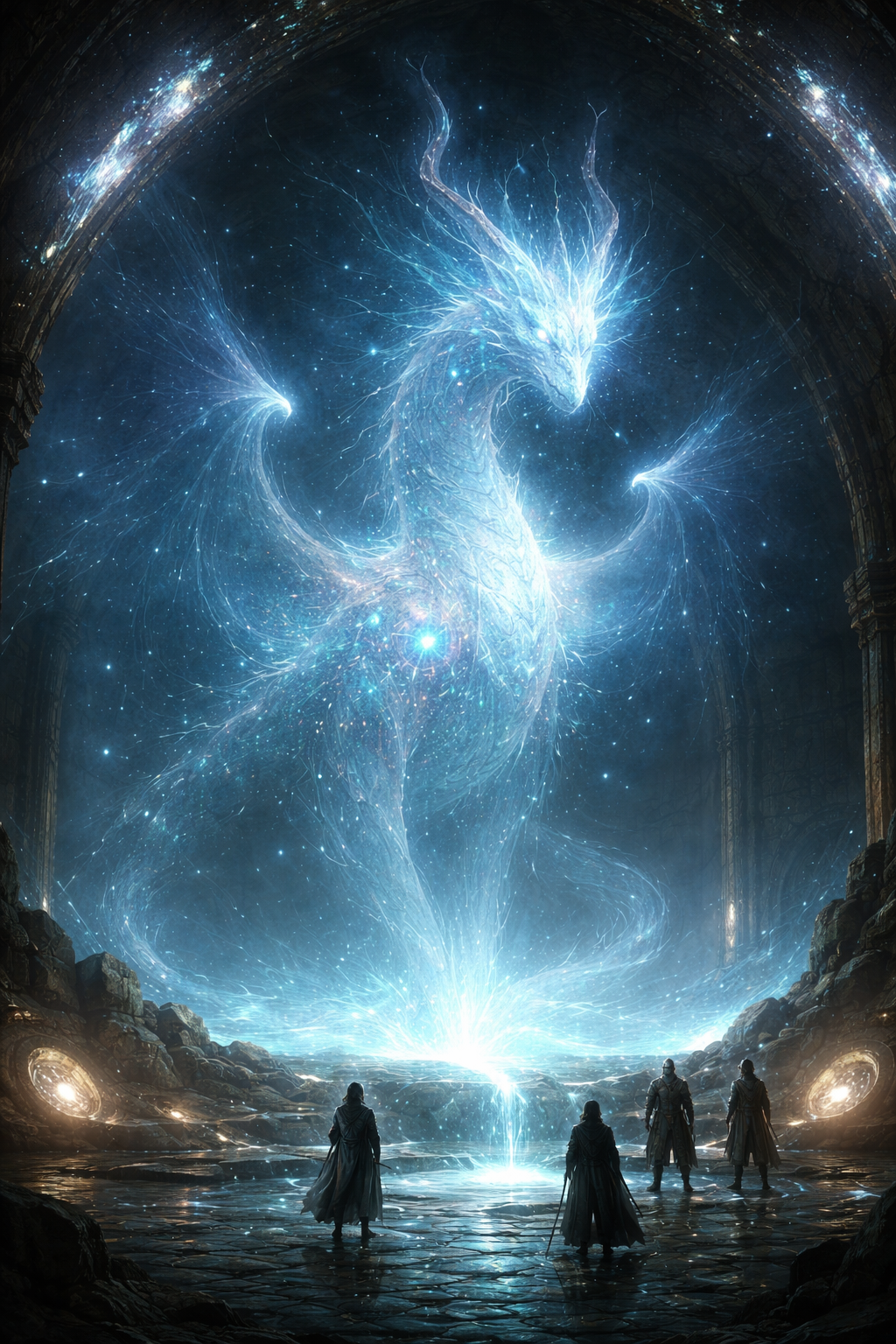
It is vast, but not solid, composed of layered silhouettes and drifting motes of light that seem to move independently of any wind or current you can feel. The outline of a dragon emerges, ancient and immense, its form woven from ley energy and something older than spoken history, something that predates the words you would use to describe it.
This dragon does not have flesh, nor is it made from stone. It is made from the moment between when a promise is made and when it is kept, from the silence that follows a question no one dares answer, from the weight of being the last of something and knowing that your ending will not be witnessed by anyone who remembers what you were."
Pause briefly. If players ask what it is, answer only with description, not explanation. Let them sit with the not-knowing. It is part of the gift.
Calling the Party Forward
The spirit instructs the party, either verbally or through shared understanding, to step forward and place their hands upon the runes set into the chamber floor. There should be one rune per character.Do not require an ability check here. The test is not whether they can succeed, but what they choose to reveal. The chamber already knows if they are worthy. It wants to know if they know it too.
Tell each player, in turn, that when they place their hand on the rune, it responds not to magic but to truth. Not the truth they think they should say. The truth they carry whether they speak it or not.
...revealing a circular pattern around the chamber that you did not notice before because it was not ready to be seen. Each sigil is ancient, precise, and deliberate, carved by hands that understood that some things must be done slowly or not done at all. The spirit gestures, and you understand without being told that you are meant to step forward, that the space between you and the rune is not empty but filled with everything you have done to arrive here."
"You will be tested," the spirit continues, and its voice is not a voice but a resonance that settles into your bones without passing through your ears. "Not by strength. Not by obedience. But by truth."
Pause and invite action. Ask players who steps forward first. Do not be surprised if no one moves immediately.
The Truth Trial
Ask each player to speak one truth aloud. This can be:- A vow they intend to keep, even if it costs them everything they have built
- A fear they carry that they have never spoken because speaking it would make it real
- A mistake they regret that still wakes them before dawn
- A reason they chose to protect rather than dominate, and the moment they understood that choice
- A belief they hold about power, guardianship, or responsibility that they are not certain they are strong enough to live up to
As each truth is spoken, describe the rune warming and stabilising, and faint rune-light spreading across the character's skin. These markings should feel symbolic, not painful, like being signed by something that wants to remember you.
If a player hesitates or struggles, allow them time. The spirit does not rush them. The silence is not empty. It is listening.
...the symbol warms beneath your palm. It does not react to magic, but to intent, to the weight of what you have decided to carry into this place and whether you are willing to let it be seen. The chamber grows quiet, and the hum beneath your feet fades to a low, expectant pulse that matches the rhythm of your own heart whether you want it to or not.
When you speak, you do not feel compelled or forced. You feel invited, as though someone has opened a door you did not know was closed and is standing aside to let you pass. The rune listens as you speak a truth you carry willingly, whether it is a vow, a fear, a failure, or a hope, and you understand that the words matter less than the willingness to say them at all."
After the player speaks, read:
"The rune beneath your hand responds. Its light steadies, and faint lines of illumination spread from the symbol, crawling gently across your skin with the patience of roots finding water. The markings do not burn or cut. They do not demand anything from you. They simply arrive, and you let them.
They spread from your palm and climb up your arm, and when they settle, you can see intricate patterns of runes that glow, leaving you marked with strange magic that does not feel strange at all. It feels like being recognised by something that has been waiting to recognise you for longer than you have been alive. You sense that you have been acknowledged rather than taken, chosen rather than claimed, seen rather than simply looked at."
Repeat for each player. Allow silence between turns. The silence is part of the ritual. The silence is where the truth settles.
Acceptance as Guardians
Once all players have spoken, describe the rune-light settling into permanent markings. These marks do not grant immediate mechanical benefits unless you choose to add them later. Their primary function is narrative recognition, the kind that cannot be rolled for or optimised or explained in a rulebook. The kind that simply is.The Elder Dragon Spirit declares the party accepted as guardians, not rulers, masters, or owners.
Emphasise that this role is unprecedented. Dragons have never trusted mortals in this way before, and the spirit does not know if this trust is wise. It only knows that the alternative — continuing alone, continuing to wait, continuing to hope for something that might never arrive - is no longer bearable.
"You have been accepted," the spirit says, and the words do not sound like permission. They sound like relief. "Not as masters. Not as wielders. But as the first guardians."
The runes along the chamber walls flare in response, and the spirit gestures toward the central leystone pool, calm and stable. You are guided forward, understanding that this moment cannot be rushed, that some completions take longer than the act that began them, that you are not at the end of something but somewhere in the middle of something you cannot yet see the shape of.
The Leyline Offering
The spirit then directs the party toward the stabilised leyline pool at the centre of the chamber.When each player places their hands into the leyline pool, describe the magic as warm, controlled, and responsive, not overwhelming, not demanding, not hungry. Simply present, simply waiting to see what you will do with what it offers.
From the leyline, a dragon egg forms in each of the character's hands.
Do not reveal details about the eggs' future at this stage. Avoid foreshadowing hatching mechanics, colours, or abilities unless you intend to use them soon. Let the moment remain sacred and incomplete, the way all beginnings are before you understand what they will cost you.
...the magic does not surge or resist. It wraps gently around your fingers, warm and steady, and the hum synchronises with your heartbeat until you cannot tell which rhythm began first, which is following which, whether you are holding the leyline or the leyline has decided to hold you.
From within the light, shapes begin to emerge. Slowly and carefully, the ley energy condenses, drawing something forward that has been held far away from harm and time, kept safe in the spaces between what the world is and what it remembers being.
One by one, smooth, warm forms take shape in your hands. Each is unique. Each is alive with quiet potential, with the weight of something that has not yet decided what it will become and is waiting, patiently, for you to help it choose.
Dragon eggs!!!"
Pause fully. Let players react. Do not speak for several seconds. Let them hold the weight of what they have been given. Let them understand, without being told, that this is not loot. This is not reward. This is responsibility made physical, made warm, made fragile and possible and theirs.
Closing the Scene
The Elder Dragon Spirit fades once the eggs are placed into the party's care. It does not give instructions beyond one final truth, because instructions would imply that it knows what happens next, and it does not. No one does. That is the point.The future of dragons now depends on these mortals. That is not a blessing nor a curse, but that is simply what is true now, and truth does not care whether you are ready for it.
End the scene with the chamber quiet, stable, and watchful. Do not add a final threat or complication here. This is an ending meant to feel earned and deliberate, the kind of ending that is also a beginning, the kind that does not resolve but simply opens.
"These eggs were placed into the leylines when the dragons decided to accept their forever sleep, with the slight hope they would find a new world." "These hatchlings will be the first of the new generation. They have never known the gods, nor war, nor chains. They will know the world through you, and what they become will be shaped by what you show them, what you teach them, what you fail to teach them, what you choose to protect them from and what you cannot."
The elder spirit's form begins to fade, its light dispersing back into the runes and stone from which it came, letting go of this form.
You hear its whispered voice one last time, and you are not certain if you hear it with your ears or your bones or some part of yourself that does not have a name but understands more than the parts that do: "You are the first guardians. It is your choice what the world becomes next."
The hum beneath your feet settles into a steady, living rhythm, and the chamber grows quiet once more, not empty but full, not finished but waiting, not ending but simply being what it has always been... a place where something important happened, and might happen again, if you are worthy of returning to it.
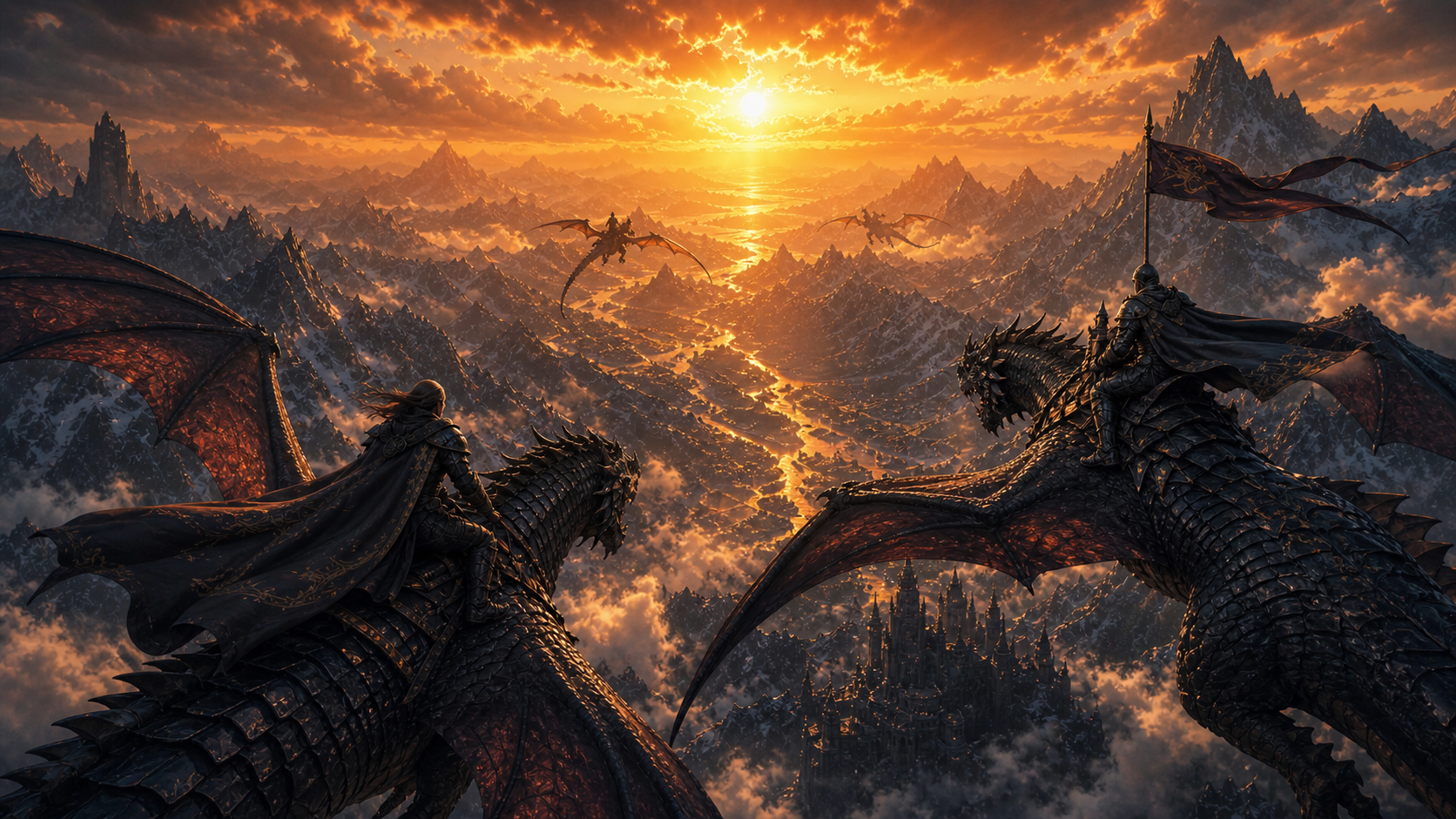
The Age of Echoes does not end here.
But the Age of Dragon Riders has begun."
Transition Options
You may end the one-shot here, or choose one of the following:- A short epilogue set months or years later, when the eggs have begun to hatch and the world has already changed in ways you did not predict
- A glimpse of the world reacting subtly to the dragons' return, the small shifts in leyline stability, the rumours that begin in places far from where you stand
- A private moment between each character and their egg, the silence of not knowing what to say, the weight of being responsible for something that does not yet have a voice
- A closing narration that frames this as the beginning of a new era, not the end of an old one, the understanding that history does not stop but simply continues in directions you cannot yet see
THE END....
Beautiful and inspiring! You can really see the enormous work and the care that went into preparing it!
The Valley of Fallen Leaves