

Dreadveil Octopus
Dreadveil Octopuses are among the most aggressive and cunning octopus species in the ocean. Their ability to control their ink through dark magic shaping it into moving forms and illusions makes the waters they inhabit dangerous and unpredictable.
Solitary by nature, these octopuses rely on deception, fear, and precision to dominate their territory. They use their ink not only to blind and escape, but to create terrifying shapes that confuse and drive off threats before striking.
Even the merfolk treat their domains with caution. A Dreadveil Octopus should never be underestimated it will exploit every advantage, using illusion, darkness, and disorientation to control the encounter and ensure its survival.
Basic Information
Anatomy
Dreadveil Octopuses have a large, bulb shaped head, with a rounded upper mantle that is slightly larger than that of most octopus species. Beneath this, where the head connects to the body, sits their central mouth, surrounded by their limbs.
They possess eight long, powerful tentacles, each lined with rows of suction cups. Thin webbing stretches between the tentacles, allowing for greater control when swimming, capturing prey, or enveloping targets.
Their overall form is both imposing and fluid, built for stealth, control, and sudden bursts of movement in the depths.
Biological Traits
Adaptive Camouflage
Dreadveil Octopuses possess advanced camouflage abilities similar to other octopus species, but far more refined. By detecting light wavelengths rather than true color, they can adjust their bodies to match their surroundings with remarkable precision. In addition to visual mimicry, they use chemical sensing through their skin and suction cups to replicate textures and environmental details. Even without true color vision, this combination allows them to achieve near-perfect camouflage, blending seamlessly into terrain, coral, rock, or other surfaces.Ink Manipulation
Dreadveil Octopuses can produce a dense black ink, used for both defense and hunting. Like other octopuses, this ink can:- Create a smokescreen for escape
- Cause temporary blindness
- Disrupt a target’s sense of smell
- Illusionary Shapes: Forming silhouettes of larger or more dangerous creatures to intimidate predators
- Territorial Displays: Expanding its apparent size to deter rivals
- Offensive Use: Directing ink toward targets to blind, disorient, or numb them before escaping
Genetics and Reproduction
Dreadveil Octopuses reproduce near the end of their lifespan, following a cycle similar to many natural octopus species.
When the time comes, individuals seek out a mate within or near their territory. The male uses specialized reproductive behavior to transfer genetic material to the female. Shortly after mating, it is common for the female to kill and consume the male, gaining additional nutrients needed for the next stage of the cycle.
Afterward, the female searches for a secure and hidden location often beneath rocks, within crevices, or inside sheltered caverns to lay her eggs. Once laid, she remains with them, guarding and caring for the clutch.
During this period, the female gradually stops feeding and devotes all her remaining energy to protecting and sustaining the eggs. Over time, her body weakens as she ensures the survival of her offspring.
When the eggs finally hatch, the young octopuses emerge into the world independently. Shortly after this, the mother dies, completing the reproductive cycle.
Ecology and Habitats
Dreadveil Octopuses primarily inhabit the ocean floor, appearing at various depths but always remaining close to the seabed. They favor environments where they can blend into their surroundings and maintain control over their territory.
They establish a central den within their claimed area, typically located beneath large rocks, within crevices, or inside underwater caverns. These locations provide natural cover, allowing them to hide effectively and avoid being caught off guard by approaching predators or prey.
Their dens are usually just large enough to house the octopus comfortably, sometimes with a small amount of extra space for maneuvering. Most dens have a single entrance, which allows the Dreadveil Octopus to monitor and control access, making ambushes easier and reducing the risk of surprise attacks.
Dietary Needs and Habits
Dreadveil Octopuses eat crabs, crayfish, clams, mollusks, snails, and small fish.
Behaviour
Dreadveil Octopuses are solitary and far more aggressive than most octopus species. They are highly territorial, claiming sections of their environment as both hunting grounds and places of refuge. Once an area is established, they will actively defend it against intruders, especially those they perceive as potential threats or valuable prey.
These creatures are intelligent and opportunistic hunters, often targeting unusual or unfamiliar prey out of both instinct and curiosity. When confronted with something they cannot immediately overpower, they rely on deception rather than retreat.
To intimidate or drive off threats, a Dreadveil Octopus will expand its presence using its ink manipulation, making itself appear larger or more dangerous. It can shape its ink into forms that resemble predators or unknown creatures, creating confusion and hesitation in its target.
If intimidation fails, it shifts to direct engagement. It uses its ink to blind and disorient the target before closing in, wrapping its tentacles around the victim to restrain and damage it. If it cannot secure a kill, it will inflict enough harm to force the creature to flee.
In some cases, it will mimic the presence of a larger predator through its ink constructs, suggesting that something more dangerous is nearby. This psychological tactic often causes threats to retreat without a direct fight.
Despite their intelligence, Dreadveil Octopuses do not cooperate with others of their kind. They are highly independent and do not tolerate sharing territory.
Additional Information
Perception and Sensory Capabilities
Dreadveil Octopuses possess highly specialized and unique sensory abilities, allowing them to perceive their environment in ways few creatures can.
Their eyesight is exceptionally advanced. The slit shape of their eyes grants them a wide field of vision, particularly useful in the open water. They also have strong peripheral awareness, enabling them to detect movement from multiple angles. Their eyes are adapted with reverse retinas, allowing them to perceive intense or disruptive light without being overwhelmed.
While they are colorblind in the traditional sense, they can detect variations in light wavelengths. This allows them to interpret their surroundings in a different way distinguishing objects and creatures based on subtle shifts in light rather than true color.
Their sense of touch is one of their most powerful tools. Through their suction cups, they can chemically analyze surfaces, identifying materials, textures, and biological traces. This allows them to detect prey, recognize environments, and even assist in refining their camouflage by matching the chemical and physical properties of their surroundings.
Dreadveil Octopuses can also perceive sound through vibrations in the water. By sensing these subtle disturbances, they can locate movement and activity even without direct visual contact.
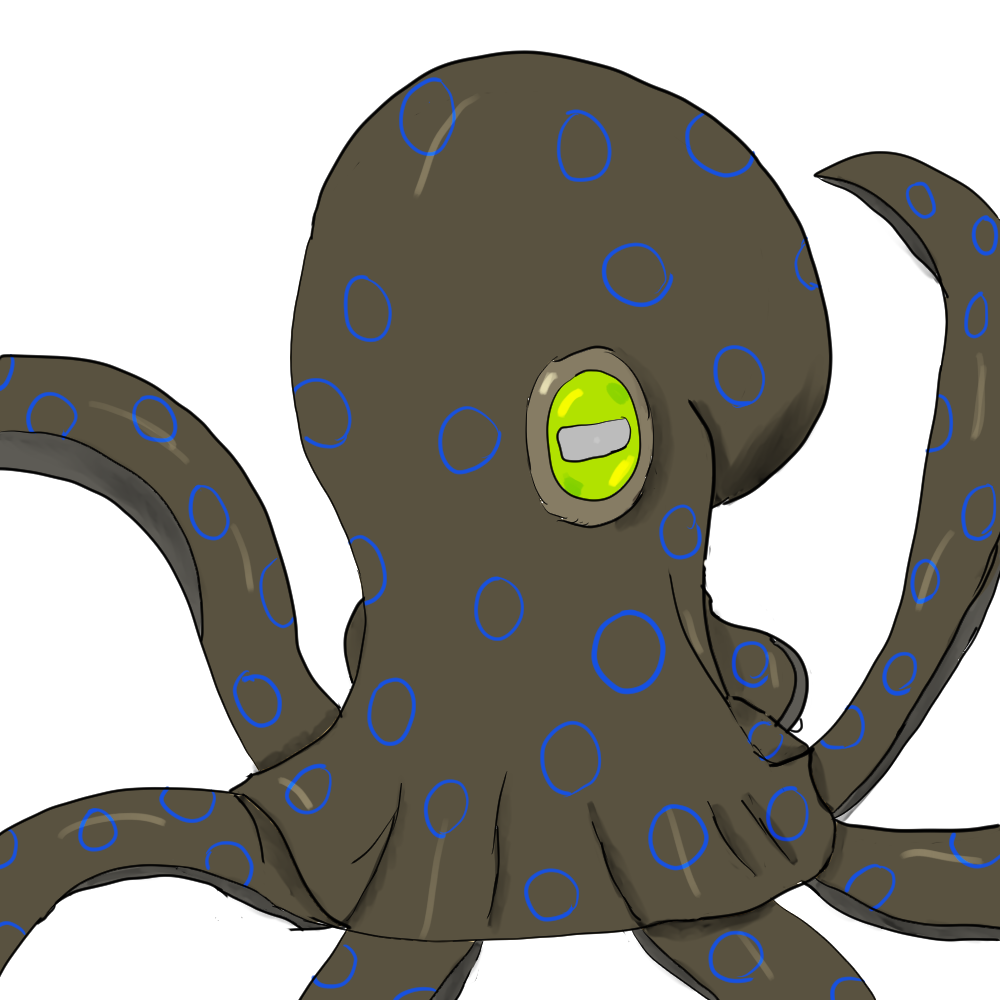
by Valcin (Marc Zipper)
Lifespan
6 to 12 years
Average Height
10 to 16 feet
Average Weight
45–110 lbs
Body Tint, Colouring and Marking
When it's not using its camouflage it's a muddy grayish brown and the under parts is a dark Gray and it has neon blue spot rings around it whole body.

Comments