
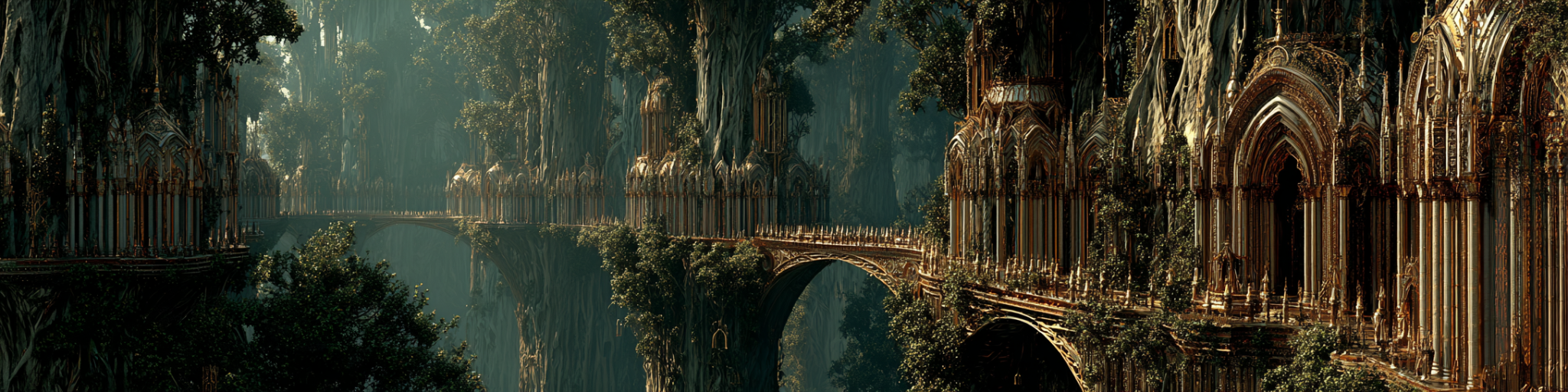
Silver City
Lóthrien, formerly known as the "City of Gold."
Among the elves, the city’s name has never changed. They call it Lóthrien, the Flowered Spires, a title earned not through marble and chisel but through living craft. Long before humans began naming and renaming it for their own purposes, Lóthrien stood hidden high above the forest floor, a metropolis grown rather than built. Its towers rose from colossal trees as if the trunks themselves had decided to become architecture, shaped by elven magic into elegant spires, vaulted halls, and lantern-lit galleries. At ground level, a traveler could pass beneath the canopy and never know a city watched from above. Walkways of braided boughs and interlaced branches stitched district to district, with bridges spanning the widest gaps like ribbons thrown between giants.
Humans once called it the City of Gold, a nod to the Gold Elves who formed the bulk of its population and to the warm prosperity of its trade with Anseliswythist and Colwyn to the south. Then came The Vanishing. In a single, impossible moment, every full-blooded elf in the region disappeared. Lóthrien was left suspended and silent, its homes unclaimed, its gardens untended, and its sustaining enchantments continuing on habit alone. For a time it endured, because living architecture does not immediately become ruin. But without elven presence to renew the shaping spells, the city began to fail in subtle, unsettling ways: branches growing where no walkway should be, doorways narrowing as wood reasserted its own intent, bridges sagging as if exhausted by the weight of memory.
Silver Elven arcanists arrived first as investigators, then as residents. Their research was slow and consuming, and camps became households, households became a district, and a district became governance. In the years that followed, two fractures set like rot. Gold Elves who attempted to reclaim old streets were turned away, at first by condescension and later by policy dressed as “arcane safety.” And the Silver Elves, no less haughty with the human nation of Colwyn, soured trade and diplomacy with every lecture and closed gate. Colwyn’s merchants stopped calling it the City of Gold and began calling it the Silver City, a name that spread because it carried a message: what was once shared prosperity had become arrogant occupation.
Demographics
Modern Lóthrien is, in practice, a Silver Elven holding. The city’s population is overwhelmingly Silver Elves, most of them attached to the ongoing arcane investigation into The Vanishing and the slow deterioration of the city’s living enchantments. Although the physical footprint of Lóthrien is immense, only a portion is actively inhabited; entire districts remain empty, sealed, or reserved for research and “structural safety,” leaving the city feeling spacious, quiet, and watchful rather than bustling.
- Silver Elves: the clear majority. Scholars, councilors, apprentices, and the servants of their households. Their numbers grow slowly but steadily, drawn by prestige and proximity to the greatest unresolved mystery in the region.
- Gold Elves: a small but essential minority. They persist as tolerated residents and indispensable intermediaries, handling the few relationships the Silver Elves deem necessary: procurement, limited trade, and communication with outsiders. Many Silver Elves consider their presence an irritation; many outsiders consider them the only sane voice in the canopy.
- Magical labor: much of the city’s daily maintenance is handled by spellwork rather than a visible working class: unseen servants, animated tools, bound lights, ward-spirits, and similar arcane solutions preferred over “outsider hands.”
- Forest Gnomes: exceedingly rare within the city itself. When they are involved at all, it is typically through discrete cooperation routed through Gold Elven intermediaries, since gnomes are far more willing to tolerate Gold Elven sensibilities than Silver Elven disdain.
- Half-elves: effectively absent. During The Vanishing, half-elves did not disappear; they died where they stood, leaving a lasting cautionary shadow over any mixed-heritage presence in the region.
Government
Lóthrien is governed less like a kingdom and more like an arcane institution that has acquired borders. In the High Elven view, this is not rule but custodianship: the city is an active site of investigation after The Vanishing, and therefore requires centralized oversight “for safety, stability, and preservation.” In practice, this oversight functions as ownership.
The High Wardens of Lóthrien
Authority rests with a council of senior arcanists known as the High Wardens of Lóthrien. They do not refer to themselves as rulers, and they bristle at any language that suggests occupation. In their telling, they are stewards guarding a priceless legacy until Lóthrien is “understood” and “secured.”
Seats among the High Wardens are earned through influence and arcane authority rather than bloodline: mastery of key wards, control of research access, and the ability to stabilize or preserve critical districts. The High Wardens convene in the most stable inhabited quarter, while vast portions of the city are administratively categorized as restricted, quarantined, or structurally unstable.
Offices and Appointments
The High Wardens delegate daily control to appointed offices, formalizing what is, at its core, a system of permissions.
- Warden of the Boughways: manages movement between districts, bridge access, closures, and travel permits.
- Master of Wards: oversees recognition patterns, protective enchantments, and the city’s “arcane safety” restrictions.
- Archivist-Regent: maintains records, research logs, and the official narrative of Lóthrien’s status and claims.
- Provost of Measures: handles provisioning, requisitions, and regulated trade with outsiders, often through Gold Elven intermediaries.
- Magister of Quiet: internal security, counter-espionage, and discreet enforcement.
Gold Elves who remain in Lóthrien rarely hold seats among the High Wardens, but are often installed as Envoys or Intercessors. Their role is practical: they are the only residents the High Wardens trust to communicate with humans and gnomes without turning every interaction into an insult.
Law and Enforcement
Lóthrien’s governance is expressed primarily through access.
Residency is granted by sponsorship and can be withdrawn. Districts are classified in ways that function like borders. Property claims and reclamation attempts are treated as administrative hazards, delayed by ward-compatibility reviews and “structural assessments” that seldom conclude.
Enforcement is largely magical rather than martial. Bridges, doors, and lantern-ways recognize authorized patterns. Unauthorized movement triggers locks, misdirection, silent alarms, and the sudden appearance of inconvenient dead ends. The city does not need many guards when it can simply decide you are not allowed to go where you intended.
Defences
Lóthrien was never meant to be defended like a ground-city. Its first protection was always secrecy: from the forest floor, the canopy hides stone-like spires and glowing windows behind layers of leaf and shadow. Even now, most threats never find the city because they never realize it exists. Those who do find it quickly learn the second truth: Lóthrien’s defenses are not walls and battlements, but permission. The city does not so much repel intruders as refuse to accommodate them.
The Living Approach
Reaching Lóthrien is difficult by design.
- Hidden ascents: the true routes upward are discontinuous, shifting, or disguised, using illusion and misdirection to make the “obvious” climb lead nowhere useful.
- Canopy choke points: only a handful of stable boughways can bear sustained traffic. Everything else is prone to swaying, narrowing, or redirecting under stress.
- Vertical advantage: defenders control height, line of sight, and retreat paths in a way ground forces cannot easily counter.
Ward-Web of the Boughways
The primary defense is the city’s interlocking network of enchantments, maintained and reinterpreted by the High Wardens.
- Recognition patterns: bridges, doors, and lifts respond to authorized presences. To the recognized, the city feels welcoming and fluid. To the unrecognized, it becomes confusing and stubborn.
- Soft-locks: doors that simply will not open, stairways that end early, bridges that subtly misalign mid-crossing, and paths that reroute you into circles without ever feeling like a trap.
- Silent alarms: intrusion rarely triggers shouting. It triggers lantern-colors changing, sigils blooming on bark-like surfaces, and ward-lights drifting toward the disturbance like curious fireflies.
- Containment fields: rather than killing trespassers, Lóthrien prefers to isolate them, pin them into a specific span of boughway, and let the Wardens decide what happens next.
Canopy Sentinels
Physical enforcement exists, but it is lean and specialized.
- Arcane sentries: small teams trained to fight on narrow bridges, in vertical spaces, and amid difficult footing. Their goal is delay and control, not heroic charges.
- Bound implements: animated tools, floating lanterns that blind or mark intruders, and “helpful” platforms that suddenly tilt when you step wrong.
- Summoned or bound guardians: not necessarily golems everywhere, but a few strategically placed ward-spirits that can hold a bridge alone.
The City as a Weapon
Lóthrien’s most unsettling defense is that it is alive enough to be persuaded, and magical enough to be coerced.
- Environmental denial: fog thickens, wind rises along exposed spans, branches shift, and sightlines vanish at the worst possible time.
- Illusory continuity: an intruder can believe they are making progress while the city quietly walks them back toward the same dead end.
- Selective stability: the bridge you need is “under assessment,” but the bridge the sentries want you on is perfectly sound.
The High Wardens’ Additions
Many original wards were Gold Elven in nature, tuned to the city’s living harmony. The High Wardens have added their own layers: cleaner, stricter, and less forgiving.
- Quarantine seals: entire districts locked behind glyph-nets and public-facing “structural instability” proclamations.
- Research boundaries: invisible lines where sound changes, magic feels muffled, and unauthorized spellcasting triggers immediate attention.
- Counter-scrying and privacy veils: the city is famously difficult to observe from afar, which is a “safety measure” that also prevents outsiders from learning how empty much of it truly is.
Weaknesses and Gaps
Despite its power, Lóthrien is not perfect, and its current defenders have blind spots.
- Deterioration creates unpredictability: some old wards fail at inconvenient moments, especially in abandoned districts.
- The living wood resists coercion: Silver alterations can leave “scarred” spans where the city behaves oddly, sometimes even undermining new wards.
- Overreliance on access control: a determined infiltrator with the right token, disguise, or stolen recognition pattern can bypass more than the Wardens like to admit.
Industry & Trade
Lóthrien is not a manufacturing city in the traditional sense. Its primary “industry” is the work of study: ward-maintenance, salvage of pre-Vanishing holdings, cataloguing, and the slow stabilization of living architecture whose guiding magic no longer renews itself. As a result, most activity within the inhabited districts supports research and the day-to-day needs of a resident arcane community rather than export-oriented craft.
Trade exists, but it is narrow in scope and carefully managed. The High Wardens do not present Lóthrien as a commercial partner so much as a controlled site of preservation, and what exchange does occur is routed through appointed agents and intermediaries rather than open markets.
Official Provisioning
Lóthrien imports necessities and specialized materials required to sustain a scholarly population and its work. Common imports include foodstuffs and cloth, but the more consistent demand is for research supplies: paper, inks, glassware, solvents, alchemical reagents, fine tools, lantern materials, rope and rigging suitable for canopy work, and replacements for non-living fittings where the city’s own growth cannot simply be “guided” back into place.
Direct trade with human merchants is limited and formalized. When it occurs, it is typically conducted through approved factors and, more often, through Gold Elven intermediaries who maintain working relationships with outside communities. Transactions are arranged by appointment, confined to specific entry routes, and subject to inspection and restriction.
Scholarly Exchange
Lóthrien maintains more consistent exchange with other elven communities than with nearby human settlements. These exchanges are framed as peer-to-peer dealings rather than commerce: correspondence, copied treatises, curated samples, specialist consultations, and the movement of apprentices or assistants. Such relationships are governed by reputation and access, with the High Wardens granting or withholding cooperation as readily as coin is offered.
In practice, information is among Lóthrien’s most valuable outputs. Even partial findings regarding The Vanishing, ward-compatibility, or the city’s stabilization can function as currency in negotiations with those who have the patience, standing, or leverage to request it.
Indirect Gnomish Cooperation
Forest gnomes are seldom present within Lóthrien, but indirect cooperation does occur on occasion, particularly when specialized craftsmanship is required. Precision instruments, delicate lenses, measuring devices, fine carving tools, and certain specialty inks are among the goods most likely to come from gnomish hands. Such exchanges are generally routed through Gold Elven intermediaries rather than handled openly, both due to the city’s controlled access and due to the High Wardens’ preference for limiting direct entanglements with outside communities.
Unregulated Commerce
As with any restricted site, unregulated dealings are a persistent concern. Rare materials recovered from sealed districts, copies of access-tokens, fragments of old records, and other items of interest to collectors or opportunists may circulate despite official prohibitions. The High Wardens publicly discourage such activity and maintain tight control over district access, though the very structure of the city, vast and only partially inhabited, ensures that oversight is never absolute.
Overall, Lóthrien’s economy is best understood not as mercantile, but administrative: a system of controlled provisioning, scholarly exchange, and tightly managed access to a place whose greatest value lies in what it once was, and what it may yet reveal.
Infrastructure
Lóthrien’s infrastructure reflects its origin as a living canopy-city and its present reality as a partially occupied arcane holding. Where most settlements rely on stonework and civic labor, Lóthrien relies on guided growth, warded access, and systems designed to function quietly overhead. Approximately one-fifth of the city is currently inhabited and fully serviced, with that footprint expanding gradually as additional districts are stabilized, reclassified, and brought under routine maintenance.
Access and Transit
There is one official ascent for outsiders, offered only by invitation and pre-vetting. This route serves as both a diplomatic threshold and a logistical artery, with inspections, cargo transfer, and ward verification occurring in staged intervals along the climb. All other ascents are treated as unauthorized, regardless of practicality.
Within the canopy, movement is conducted along boughways, bridges, and engineered spans integrated into the living structure. In inhabited districts, these routes are well-lit, railed, and clearly marked. Beyond them, transit becomes less specific: bridges may be closed “pending assessment,” stairways may narrow as wood slowly shifts, and routes may be deliberately inconvenient through warding and administrative restrictions as much as through natural deterioration.
A secondary internal service route exists for maintenance and discreet movement of sensitive goods and materials. It is not publicly discussed, but it is broadly understood by those who keep the city functioning. Gold Elves involved in legacy upkeep and the small gnomish delegation from Anseliswythist are not ignorant of its existence, and they often recognize its use by patterns that cannot be wholly concealed: unusual lift cycles, changes in ward-light cadence, and the quiet timing of sealed deliveries.
Water
Historically, Lóthrien drew much of its water from fog and rain capture. Veil-like nets, leaf-catch basins, and trunk-cisterns remain visible throughout older spans of the city, and their design is often as elegant as it is practical. In the current era, these systems persist but are increasingly supplemented by magical means, particularly within the High Wardens’ inhabited districts and research spaces where predictable supply and controlled purity are preferred.
This has produced a blended network. Natural capture remains in place and continues to feed gardens and long-established reservoirs, while conjured or ward-purified sources supply laboratories and controlled quarters. The shift is gradual but noticeable to those familiar with the city: older districts still “breathe” with the weather, while newer service roads feel less dependent on the seasons and storms.
Food and Gardens
Lóthrien’s canopy agriculture has not vanished; it has merely changed in its presentation. Hanging gardens, terrace-groves, and orchard spans remain part of the city’s sustenance, yet the most visible gardens have been shaped to satisfy both need and aesthetic expectation. Beds are pruned into intentional forms, fruiting branches are trained into symmetry, and productive spaces are arranged to appear decorative rather than utilitarian.
More efficient cultivation tends to be placed out of the primary sightlines of the inhabited districts, maintained quietly along service terraces and trunk-hollows where yield matters more than appearance. Imports supplement the city’s food supply, but Lóthrien remains partially self-sustaining so long as its living systems continue to be guided rather than coerced.
Sanitation and Waste
Sanitation is handled with deliberate discretion. The High Wardens favor systems that leave minimal visible reminders of bodily needs and produce as little odor, mess, or interruption as possible. Waste and refuse are routed through sealed trunk-hollows and concealed service channels to removal points below, where natural breakdown and controlled disposal can occur out of sight of the canopy districts.
Materials associated with research, alchemy, or magical byproducts are treated separately. Such waste is typically sealed, warded, and transferred via the service route to designated abatement vaults, where purification and containment are managed with greater care. In public discourse, the process is described euphemistically as clearing, removal, abatement, or purification.
Maintenance and Stabilization
The city’s maintenance is an ongoing negotiation between old design and new governance. Gold Elven systems were historically sustained through gentle shaping and seasonal rites that encouraged living architecture to hold its intended form. The High Wardens now maintain those systems where they can and overlay them where they prefer, favoring subtle, elegant retrofits that read as ornamentation rather than repair.
Because the living structure still responds best to familiarity and care, Gold Elves who remain in Lóthrien have found leverage in maintenance. When the High Wardens require legacy work or guidance that cannot be achieved by formal warding alone, Gold Elves often provide it, and as frequently request permission to bring additional skilled hands “to reduce the burden.” This quiet practice has become one of the few avenues by which Gold Elven presence expands without confrontation, and it is a persistent source of private irritation among the High Wardens.
Communications
Communications within inhabited districts rely on a mix of ward-lights, chime-lines, and formal messenger routes. Notices are posted at controlled junctions and ascent stations, and more sensitive communications are handled through sealed relays and arcane dispatch. Communication to the forest floor and to outside communities is tightly controlled, commonly through Gold Elven intermediaries affiliated with provisioning and access offices.
The Root-Oath and the Forest’s Voice
Underlying much of Lóthrien’s infrastructure is an older, impersonal pact with the forest itself, often referred to as the Root-Oath. The city may shape and inhabit the canopy so long as it does not sever the deeper balance of the wood, poison its hidden flows, or treat living structure as inert material. This agreement is not maintained by decrees but by outcomes. When the city’s works strain the Root-Oath, the forest responds.
On rare occasions, that response takes the form of a manifested individual, often described as a dryad or dryad-like figure, appearing where the strain is most significant: beside an overcorrected span, within a sealed garden, or upon a bridge “under assessment.” Such appearances are uncommon, but they are one reason Anseliswythist maintains a small Knotwatch delegation within the city. Their official purpose is to monitor canopy strain and ward stress for the safety of their own lands. Their deeper purpose is to ensure the Root-Oath is not quietly broken in the name of improvement.
Districts
Lóthrien was planned and grown as a true metropolis, with distinct canopy quarters connected by engineered boughways and interlaced bridges. In the era preceding The Vanishing, its districts functioned as living neighborhoods: civic, residential, ceremonial, scholarly, and agricultural, distributed across a broad forested crown. Today, only approximately one-fifth of the city is inhabited and fully served. The remainder persists as controlled territory, restricted research space, or silent canopy reclaiming itself.
For clarity, the districts below are given by their traditional Gold-era functions, followed by their current status under the High Wardens of Lóthrien.
Crownward Quarter
Current status: Occupied
Once the heart of civic life and formal gathering, Crownward is now the administrative center of the High Wardens. It contains the most stable meeting halls, the most reliable ward-lattice, and the strictest internal access control. To walk Crownward is to be reminded that Lóthrien is governed by permission.
Lanternwalk Galleries
Current status: Occupied
This district’s high bridges and covered galleries were built for movement after dusk, when the city’s lantern blooms and ward-lights traced safe routes through fog and leafshadow. It now functions as the principal lived-in thoroughfare supporting Crownward: residences, stores of supplies, controlled common halls, and the few services the High Wardens allow to exist openly.
The Permitted Ascent
Current status: Controlled
The sole sanctioned approach for outsiders is treated as a district in its own right: a staged route of inspection platforms, ward-verification spans, and cargo transfer points. It is immaculate, well-lit, and intentionally narrow in its introduction of the city. Those allowed to climb it see only what the High Wardens are willing to show.
Verdant Parterres
Current status: Controlled
Once a broad network of hanging gardens and orchard spans, the Parterres remain functional but altered. The most visible sections have been shaped into decorative terrace groves that serve both as sustenance and as presentation. Higher-yield cultivation is maintained more quietly in service terraces beyond the primary sightlines.
Archive Boughs
Current status: Restricted
This district housed repositories, copying halls, and memory-keeping chambers associated with Lóthrien’s older civic record. It is now treated as a controlled research zone. Access requires sponsorship, and movement within is closely monitored. Scholars speak of long corridors that remain lit despite their emptiness, as if the city continues to expect its archivists to return.
The Quenched Spans
Current status: Restricted
A lattice of trunk-cisterns, fog nets, and distribution channels that once formed the city’s primary water infrastructure. While portions still function openly, sections of the Quenched Spans are now restricted due to ongoing changes in supply and purification, including the increasing use of conjured and ward-purified sources. It is a district where old systems and new overlays can be felt in the same breath.
Skyloom Terraces
Current status: Sealed
Formerly a craft and fabrication quarter for canopy fittings, woven rigging, and the delicate carpentry required to guide living growth. It is now sealed on the grounds of instability. Some believe the seals protect fragile spans. Others believe they protect what has been recovered from them.
The Wildward Crown
Current status: Reverting
A broad outer ring of canopy, intended as both a scenic promenade and a subtle defense, where the city’s presence blurred into the forest. Without continual shaping, this district has begun to behave as living wood prefers: bridges narrowing, branches reasserting older paths, and garden-growth returning without regard to civic geometry. Patrols are infrequent, and travelers report that routes change without warning.
Rootquiet Hollows
Current status: Sealed
These concealed trunk-hollows and under-bough serviceways once supported sanitation, removal, and maintenance with minimal intrusion into civic life. Today, they are treated as sensitive infrastructure and remain largely sealed or tightly controlled. Even those who maintain the city generally speak of Rootquiet in euphemism, and the High Wardens prefer that it remain unseen.
Guilds and Factions
Lóthrien does not function as a guild-city in the human sense. There are few chartered trade guilds, no open market councils, and little appetite among the High Wardens for independent civic power. Instead, influence is held through offices, research circles, and sanctioned delegations. Most “factions” in Lóthrien are either administrative arms of the High Wardens or groups that have learned how to exist in the narrow spaces those arms leave behind.
The High Wardens of Lóthrien
The ruling council and the most significant power bloc in the city. The High Wardens present themselves as custodians charged with stabilizing Lóthrien and investigating The Vanishing. Their authority is expressed through access, classification of districts, and control of ward-keys.
Primary interests: Stability, secrecy, and control of the city’s narrative.
The Wardenates
Though not independent guilds, several appointed offices function as quasi-factions due to their control of critical systems.
- Wardenate of the Boughways
Controls movement, bridge permissions, route closures, and travel permits. Their authority shapes daily life more than any proclamation. - Wardenate of Wards
The ward-lattice is the city’s real border. This office’s priorities decide who can go where, and what “safety” means this week. - The Archive Seat
The Archivist-Regent’s apparatus is a faction by inertia alone. Whoever controls record, controls memory, and Lóthrien is built on memory. - The Magistery of Quiet
Internal security, counter-espionage, and discreet enforcement. They rarely speak publicly, which is part of their purpose.
Common friction: These offices cooperate when needed, but compete constantly over jurisdiction, budget, and the right to define “necessary.”
The Gold Intercessors
A small, tolerated cadre of Gold Elves who serve as envoys, intermediaries, and legacy-maintenance specialists. Their formal power is limited, but their practical leverage is considerable: they can speak to outsiders, they understand older living systems, and they are often the difference between “preserved” and “collapsing.”
They also leverage their indispensability to quietly expand Gold's presence in the city by bringing additional skilled assistants under the guise of efficiency and a reduced burden on the High Wardens.
Primary interests: Keeping Lóthrien functioning, maintaining external relationships, and gradually reclaiming influence without provoking an open crackdown.
The Knotwatch Delegation
A tiny group of Forest Gnomes from Anseliswythist who maintain instruments and observation perches within the controlled districts. Officially, Knotwatch monitors ward-stress and canopy strain to protect neighboring lands from unintended consequences of Lóthrien’s stabilization work. Unofficially, they track unregistered movement, unusual logistics, and any work that threatens the Root-Oath.
They are seldom addressed directly by Silver Elves, which suits them fine. Knotwatch does not come for conversation. It comes for certainty.
Primary interests: Early warning, proof of abuse, and protection of the Root-Oath.
Research Circles
Most of Lóthrien’s internal politics is carried out through research circles: formal groups bound by a shared method, patronage, or the theory of The Vanishing.
Three broad alignments are commonly observed:
- The Preservers
Prioritize careful stabilization and minimal interference. They prefer to conserve the city’s original intent, even if they do not admire it. - The Correctors
Favor decisive reshaping. Their retrofits remain subtle, but their philosophy is not. They believe Lóthrien can be made better, cleaner, and more properly ordered. - The Laureate Pursuit
Prestige-focused circles that prioritize producing the definitive explanation of The Vanishing. Their work is often brilliant, occasionally reckless, and always political.
Common friction: Method versus outcome. Stewardship versus ownership. Patience versus credit.
Outsider Factors and Licensed Agents
Lóthrien permits limited external exchange through pre-approved agents, generally routed through Gold intermediaries and the Provost’s office. These individuals are not a guild in the city, but rather a recurring cast of vetted couriers, provisioners, and specialists who learn the boundaries and survive by respecting them.
Primary interests: Access, predictable rules, and not becoming an example.
History
Founding and the Flowered Spires
Lóthrien began as a Gold Elven endeavor, grown into the upper canopy of a vast forest where the trunks were ancient, and the air was clean enough to taste. Its earliest spans were not constructed so much as persuaded into form. Living towers rose from colossal trees, guided by patient enchantment into spires, halls, and galleries that appeared almost stone-like in their refinement. Bridges of interlaced bough and shaped branch stitched the city together above the forest floor, leaving most travelers below unaware that a metropolis watched from the leaves.
In its long stability, Lóthrien became known among nearby humans as the City of Gold, both for the Gold Elves who formed its heart and for the prosperity of its trade. Relationships with Anseliswythist and the southern capital of Colwyn were steady and, for a time, mutually beneficial. At the height of that goodwill, House Colwyn formalized its alliance through marriage to a Gold Elf of Lóthrien, and the union produced a child who later ascended as king, a fact preserved in older genealogies even as modern retellings tend to treat it as an uncomfortable footnote.
The Vanishing
The city’s history is divided by a single event: The Vanishing.
In one moment, every full-blooded elf in the region disappeared. Lóthrien did not burn or fall. It simply stopped being inhabited. Lamps remained lit. Doors remained latched. Gardens remained suspended. For a time, the city’s guiding magic continued by inertia, as though the wood remembered what it had been asked to be. But without elven presence to renew those shaping rites, subtle failures began: boughways sagging, doorways narrowing, spans shifting by fractions that compounded into true misalignment. Lóthrien endured as a quiet crown above the forest, beautiful and wrong.
The humans who lived nearest to it did not immediately rename it. At first, there was only fear and uncertainty, and then a cautious habit of speaking about it as a place left behind. The old name, City of Gold, lingered out of memory as much as accuracy.
The Arrival of the High Wardens
The first Silver Elven arcanists arrived as investigators, drawn by the unanswered question of what had occurred within the city. Their work was slow, technical, and time-consuming, and the temporary became habitual: camps became quarters, quarters became a district, and a district required governance. Additional Silver Elves followed, motivated by prestige, proximity to rare pre-Vanishing records, and the status of laboring where others could only speculate.
Over time, authority consolidated into what is now known as the High Wardens of Lóthrien, a council that presents itself as custodian and steward of an unstable site. Their classification of districts, control of access, and management of ward-keys gradually became indistinguishable from ownership.
The Renaming
As Silver Elves entrenched themselves, the city’s relationships with the south cooled. Gold Elves who attempted to resettle found themselves refused, first through social exclusion and later through administrative barriers framed as safety and structural necessity. Meanwhile, dealings with Colwyn became narrower and more fraught, as the High Wardens treated human interests as inconveniences to be managed rather than neighbors to be respected.
It was in this period that nearby humans began calling the city the Silver City. The name was practical on the surface, descriptive of the elves now seen to come and go, but it carried an unmistakable edge. It was a reminder that the City of Gold, once a partner in mutual trade, had become a place of controlled access and diminished goodwill. Among the elves themselves, the city’s name did not change. It remained Lóthrien.
The Present Era
Today, Lóthrien is a city partly inhabited and partly withheld. Roughly one-fifth of its vast canopy is actively serviced and lived in, with the remainder classified as restricted, sealed, or reverting. The High Wardens continue their investigation into The Vanishing and their project of stabilization, increasingly overlaying older living systems with subtle retrofits that reflect their own preferences.
Gold Elves persist within this arrangement as tolerated specialists and intermediaries, maintaining the city’s legacy systems and quietly expanding their presence through sanctioned assistance. A small gnomish delegation from Anseliswythist monitors canopy strain and ward-stress, and watches for the city’s deeper obligations to be violated: the Root-Oath that binds Lóthrien to the forest itself, and the rare moments when the forest manifests a voice to remind the city that it is not the only party with a claim.
“Their wards are immaculate. The forest disagrees, but the forest is never invited to the meetings.”
~ Crossroad, Knotwatch Observer of Anseliswythist

Comments
Author's Notes
Image created with MidJourney
WorldEmber2025 submission