
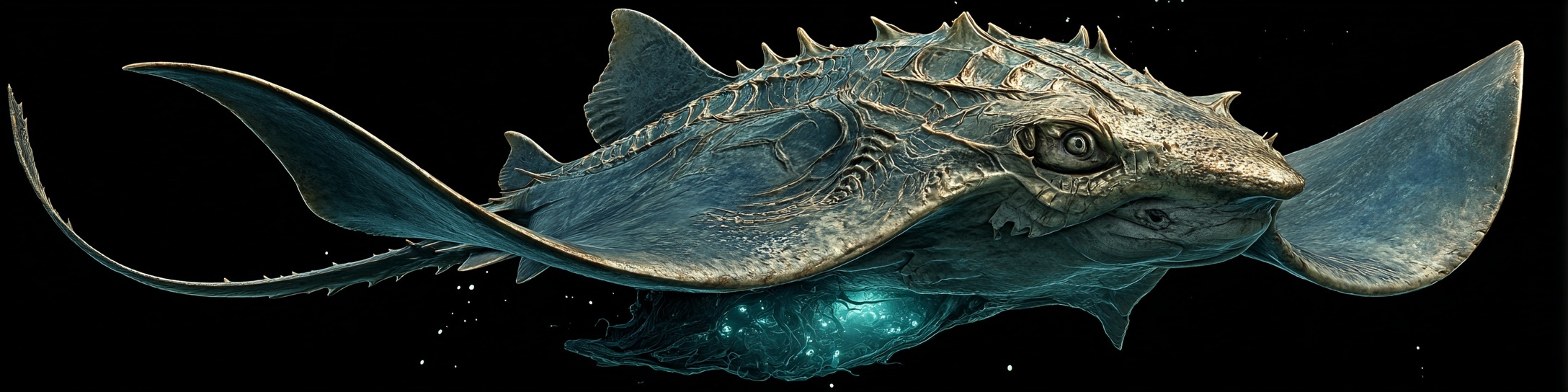
Hushback Rays
Hushback Rays glide through the deep waters of the Godslost Sea with a silence so complete that even seasoned Triton patrols sometimes fail to notice them until they pass overhead. These broad, elegant rays take their name from the distinctive muffling field that surrounds them, a natural defense mechanism that dampens vibration and sound within a short radius. In the crushing dark of the trenches this silence is startling, creating pockets of stillness where the surrounding water seems to hold its breath. Their bodies are marked by pale streaks that resemble flowing script, patterns said to shift subtly with age or mood. Though gentle by temperament, Hushback Rays are treated with a mix of respect and caution by the Tritons. Their presence often signals stable waters and calm currents, but their silence can also mask the approach of predators or distort patrol signals, making them at once welcome neighbors and unpredictable companions in the abyss.
Basic Information
Anatomy
Hushback Rays possess wide, sweeping pectoral fins that taper into long, trailing edges, giving them the appearance of drifting banners silhouetted against the darkness of the deep. Their dorsal surface is smooth and matte, colored in gradients of slate blue, charcoal, and pale silver streaks that resemble flowing current-lines. These streaks are not static. They shift subtly over time with the ray’s movements and emotional state, creating a faint rippling pattern that Triton scholars believe aids in communication. The underside of the ray is paler and marked by soft, luminescent patches that glow faintly during feeding or courtship displays.
Their most distinctive feature is a raised, slightly ridged structure along the spine known as the hushback crest. This organ contains layers of densely packed cartilage and vibration-dampening tissue that absorb motion and disrupt acoustic waves around the ray. As it swims, the crest creates a sphere of suppressed sound, muffling everything within a short radius. This adaptation is extremely effective in the deep sea where predators rely heavily on vibration and echolocation. The ray’s tail is long and flexible, ending in a broad paddle rather than a stinger, which allows for precise maneuverability in tight or unstable waters. Their gills, unusually large for their size, enable slow, energy-efficient swimming, while their eyes are adapted to low light with a reflective layer that catches even the faintest glimmer of bioluminescence. Altogether, the Hushback Ray’s morphology makes it an effortless traveler through the abyss, a creature built for stillness, silence, and survival.
Additional Information
Uses, Products & Exploitation
Because of their gentle nature and the protective silence that surrounds them, Hushback Rays have long been objects of interest among deep-sea cultures. Tritons in particular handle them with care, regarding them as creatures of the deep that should not be hunted casually. Still, certain materials harvested from naturally deceased rays hold significant value. The hushback crest, once dried and treated, retains a faint vibration-dampening quality and can be worked into ceremonial armor or used to line meditation chambers where silence is prized. Small slivers of the crest are also incorporated into tuning devices for Triton sonar-tools, allowing more precise calibration in unstable waters.
Their skin, though rarely harvested, is prized for its unique matte texture. When reinforced with elemental binding techniques, it becomes resistant to sound-based magic and pressure disturbances. Pearl Elves occasionally trade for such pieces, using them to craft gloves or bindings worn during delicate coral work. The luminescent patches from the ray’s underside can be brewed into a faintly glowing ink used in deep-water cartography and ritual inscriptions, though this practice is controversial and strictly limited to materials collected after natural deaths.
Exploitation of live Hushback Rays is taboo among most Tritons. Capturing or restraining them is considered both dangerous and disrespectful, as the stress often causes the ray’s silence field to collapse abruptly, disorienting nearby swimmers and sometimes attracting predators. Rogue scavengers from the Barrens have occasionally attempted to poach them, hoping to sell hushback crests on the surface as curios, but these operations are rare and swiftly dealt with. For those who live in the depths, the rays’ greatest value lies not in harvestable parts, but in the calm pockets of stillness they bring to a sea that seldom rests.

Comments
Author's Notes
Image created with MidJourney
WorldEmber2025 submission