
Stoneborne
Stoneborne are remnants of the Isendir Empire’s age of arcane tyranny—stone-bodied sentinels carved as guardians, laborers, and wardens of imperial vaults. Rather than true automata, most Stoneborne carry a bound mortal soul—a soldier, debtor, political prisoner, or “volunteer” whose spirit was sealed into sculpted stone through lost Isendir rites.
When Isendir collapsed and the Arcane Purge followed, Stoneborne became liabilities: too recognizable as imperial relics to be allowed to walk freely. Many were entombed in sealed sanctums, inert in forgotten halls, or literally repurposed as “statues” in reclaimed fortresses. In the last three centuries—especially as sanctioned arcane practice returned under the Edicts Arcanum—Stoneborne have begun to wake again, often with fractured memories and no loyalty to the long-dead commands once written into their bodies.
Modern Stoneborne don’t reproduce, and few (if any) know how to create more. Each destroyed Stoneborne is a permanent loss—one less soul reclaimed from stone.
A purpose chosen, not assigned.
And maybe — if they’re brave — the truth of who they used to be.
Size: Medium (about 4–8 feet tall) or Small (about 2–4 feet tall), chosen when you select this species
Speed: 30 feet
As a Stoneborne, you have these special traits.
Not Born, But Made
Stoneborne are one of the most unsettling surviving legacies of the Isendir Empire, a regime that subjugated the world beneath mage-kings and their arcane institutions. In the Age of the Empire, Isendir did not merely build monuments — it built servants. Some were golems and ward-constructs; others were more ambitious: a “people” shaped from living rock and tasked to guard what the Empire would never trust to flesh. Stoneborne are not born. They do not breed. There are no women among their kind, and no childhood stories passed from parent to child — because there are no parents, and there is no “next generation.” Each Stoneborne is a finite miracle and a finite crime: a sculpted body of stone, a spark of will, and (most unsettling of all) a soul. Isendir records rarely agree on what Stoneborne are. Some documents describe them as “Imperial Sentinels,” property assigned to vaults, bridges, prisons, and noble estates. Others describe them as “Oath-Statues,” living contracts forged into stone. And then there are forbidden fragments that insist Stoneborne are neither automatons nor simple constructs — but bound spirits housed in carved stone shells. Most Stoneborne don’t remember the moment they were made. In fact, most don’t remember their first life at all. But enough evidence exists — and enough Stoneborne have suffered half-recalled dreams, flashes of names, or phantom sensations of lungs that no longer exist — to suggest the Isendir did something far worse than “invent” a species. They repurposed people. Who were those souls? No surviving authority can prove a single answer. Theories vary by region and faith:- Some believe Stoneborne were made from elite volunteers: soldiers “promoted” into immortality as reward.
- Others argue they were crafted from criminals, debtors, and political dissidents — bodies disposed of, souls pressed into service.
- A darker theory says Stoneborne were made from conquered peoples chosen precisely because their identity would be erased: no lineage, no burial rites, no return to ancestors.
The Long Silence
When the Isendir Empire fell, its relics became targets. The collapse wasn’t gentle: rebellions, magical disasters, and the rise of the Church of the All-Father tore imperial infrastructure apart. Not long after came the Arcane Purge, when zealots and “heroes” hunted down arcane practitioners, artifacts, and magical creatures. Anything that smelled like Isendir was destroyed without mercy. Stoneborne should have been wiped out. Many nearly were. But Stoneborne had one advantage that most relics lacked: they could pretend to be dead. In that era of witch-hunts and sanctifications, countless Stoneborne survived by going inert — collapsing into an unmoving, statue-like stillness. Some were sealed into vaults by fleeing mages. Some were entombed by fearful towns. Some were claimed by the faithful and placed in halls as trophies of a defeated tyranny. In ruined keeps and reclaimed citadels, Stoneborne stood for generations as décor: silent guardians mistaken for stone art. Disagreements over the Purge hardened into doctrine and schism, and the Order of the Sacred Flame rose to enforce vigilance through fire and steel. To the Sacred Flame, a Stoneborne is not merely suspicious. It is an Isendir artifact that walks. And yet… the world changes even when the faithful refuse it. Surviving practitioners gathered in secret, and later emerged under strict oversight through new laws and oaths meant to leash arcane power. And since then — especially as sealed places have been reopened and old wards have begun to fail — Stoneborne have started to wake. Some awaken because bindings degrade. Some awaken because vaults are breached. Some awaken because the world is saturated again with sanctioned spellwork, and whatever dormant command-sigils were etched into their bones can’t help but stir. Most awakenings are not clean. A newly awakened Stoneborne might remember nothing but a single word, a taste of iron, or the sensation of kneeling. Many awaken with a blank slate so complete it’s like a second birth — but without innocence. Their bodies are ancient; their spirits are heavy; their instincts are often shaped around duty even when they no longer know to whom. The result is the defining contradiction of modern Stoneborne: they were built to obey — but they woke up with free will.Stoneborne as a People
Stoneborne are among the most recognizable beings in Duskfall. They resemble humanoids — usually broad, thick-limbed, and carved with deliberate anatomy — but the resemblance ends quickly under scrutiny. Their bodies are not “stone skin” over flesh. They are stone all the way through. Stoneborne vary wildly in composition: ebon shale, gray granite, pale marble, basalt, sandstone, speckled quartzite — each with unique tone, grain, and fracture pattern. Some have bodies shot through with glittering mineral seams, as if the earth itself tried to write a story into them. Their eyes are gemstones: not just decorative, but genuinely luminous and alive with perception. They do not age. No Stoneborne looks “elderly.” But they do weather. Cracks form across shoulders like lightning scars. Chips break from knuckles. Corners of features erode. Some Stoneborne repair themselves with careful masonry and mortared patches; others refuse repair and wear damage like medals. Among Stoneborne, a crack is not ugliness — it is proof of having endured. They do not need food or drink. They do not sleep the way mortals do. But most Stoneborne still practice periods of inert stillness — partly for rest, partly because their minds become noisy without pauses, and partly because sometimes, in stillness, memory returns. And for all their stone, they are not emotionless. Stoneborne feel deeply — but in ways that can be hard for fleshfolk to recognize. Their joy tends to be quiet and enduring. Their anger tends to be slow and volcanic. They rarely “banter,” and most humor slides off them like rain on granite. But they sing. Stoneborne sing while working, while marching, while sharpening tools, and sometimes even while fighting — resonant, rhythmic chants that sound like hammers on stone. Those who’ve fought beside them say it isn’t bravado. It’s focus. A way to keep the world ordered.Stoneborne Ways
Stoneborne have no nation. They form enclaves, brotherhoods, work-circles, or “holds” adopted into the communities of others — most commonly dwarfholds, mountain towns, or places with strong traditions of stonecraft and endurance. Dwarves in Duskfall follow The Stone, an ancient faith that teaches that dwarves were shaped from living rock by a divine presence within the mountains. That creates an immediate cultural friction and an immediate cultural bridge. Many dwarves look at Stoneborne and see a blasphemous imitation of their creation myth — Isendir mages playing god with the very substance of dwarven origin. Others see something stranger: a living proof that the Stone’s breath can cling even to atrocities, that life can be coaxed from rock even when done for wicked ends. Stoneborne often find a place among them, whether as honored guardians or uneasy reminders. Stoneborne leadership tends to be practical. Many enclaves select a Thane by merit and consensus: a warrior when threats rise, a builder when the hold expands, a negotiator when dealing with outsiders. Councils are common, and debates can be loud — not because Stoneborne are chaotic, but because when they disagree, they do it with their whole chest. Stoneborne don’t hint. They don’t politic. They declare. Stoneborne rivalry is typically competitive rather than violent:- who can quarry the cleanest stone
- who can hold a gate the longest
- who can finish a bridge first
- who bears the most cracks and still stands proud
The Compulsion of Purpose
Stoneborne often have a near-physical need to complete tasks. In Duskfall, that compulsion is explained in different ways, depending on who you ask:- The simplest explanation: Isendir built them for duty, and duty lingers like muscle memory.
- A theological explanation from the Stone faith: the earth does not rush, but it always finishes its work — mountains rise, rivers carve, stone endures.
- A darker explanation: the bound souls inside them were conditioned by ritual geasa, and the work-drive is the last surviving shackle.
Stoneborne Age
Stoneborne generally measure “age” by time since awakening, because it’s the only meaningful timeline they share. The Empire is distant history. The Purge is a cultural scar. But personal memory starts at awakening. No one knows how long a Stoneborne can last. They don’t die of old age. They can be destroyed, shattered, ground down — but time alone doesn’t seem to end them.Stoneborne Names
Stoneborne naming practices vary by enclave and adopted culture, but two trends are common:- A chosen “first name” often borrowed from the culture that raised them after awakening (dwarven, human, etc.).
- A stone-name tied to their material, either as a surname, title, or honorific.
How Stoneborne Fit the Modern World
In present-day Duskfall, Stoneborne are a walking argument everyone wants to “solve”:- The Church of the All-Father may treat them as relics to sanctify, threats to contain, or souls in need of redemption.
- The Order of the Sacred Flame is likely to view them as arcane contamination by default — especially if a Stoneborne is tied to a confirmed Isendir site.
- The Order of Magi may see them as priceless proof of lost imperial methods — ethically horrifying, academically irresistible.
- Dwarven Stonekeepers may debate whether Stoneborne are cousins, crimes, or omens — but either way, they matter to the faith, because they are living rock shaped into personhood.
A purpose chosen, not assigned.
And maybe — if they’re brave — the truth of who they used to be.
Stoneborne Traits
Creature Type: ConstructSize: Medium (about 4–8 feet tall) or Small (about 2–4 feet tall), chosen when you select this species
Speed: 30 feet
As a Stoneborne, you have these special traits.
Ageless Sentry
You are immune to magical effects that would age you. You don’t need to sleep, and magic can’t put you to sleep. You can finish a Long Rest in 6 hours if you spend those hours in an inactive, motionless state. During this time, you appear inert but remain conscious.Darkvision
You have Darkvision out to 60 feet.Masonry Protection
Your body is living stone shaped into a humanoid form. While you aren’t wearing armor, your Armor Class is determined by your density (see the Masonry Protection table). You can use a Shield and still gain this benefit. If you have another feature that calculates your Armor Class (such as Unarmored Defense), you choose which calculation to use; they don’t stack. You can change your chosen density at the end of a Long Rest by spending 2 hours of that rest actively performing a ritual of carving, mortaring, and reshaping your body.- Decreasing Density. You shed excess stone as loose rubble in your space or an adjacent space.
- Increasing Density. You must be within 5 feet of a source of nonmagical stone such as rubble, loose rock, an exposed stone surface, or a stone wall. During the ritual, you draw stone into yourself, and the source is visibly worn, chipped, or reduced by the amount taken (the DM determines any structural consequences).
Density |
Prerequisite |
Base Armor Class |
|---|---|---|
Basic |
None |
11 + your Dexterity modifier |
Light* |
Light armor proficiency |
11 + your Dexterity modifier + half your Proficiency Bonus (rounded down) |
Medium* |
Medium armor proficiency |
13 + your Dexterity modifier (maximum of 2) + half your Proficiency Bonus (rounded up) |
Heavy |
Heavy armor proficiency and Strength 15 |
14 + your Proficiency Bonus; you have Disadvantage on Dexterity (Stealth) checks |
Design Note: Light and Medium density AC can’t be automated in D&D Beyond, so you’ll need to manually override your AC for those densities (and update it when your Proficiency Bonus changes).
Powerful Build
You have Advantage on any ability check you make to end the Grappled condition. You also count as one size larger when determining your carrying capacity.Stonework Resilience
You have Resistance to Poison damage. You also have Advantage on saving throws to avoid or end the Poisoned condition.Tireless
You don’t gain Exhaustion levels from Dehydration, Malnutrition, or Suffocation.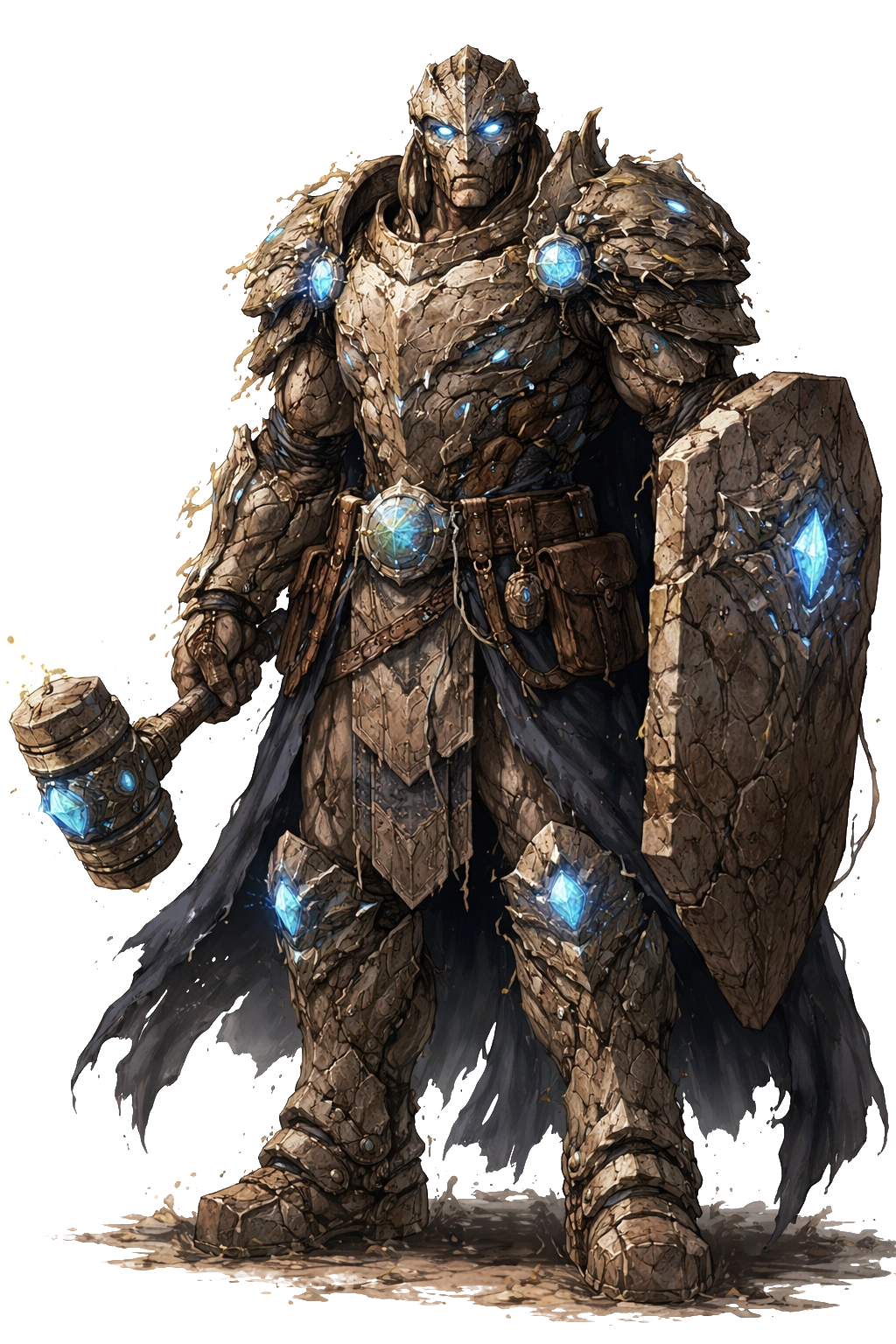
Lifespan
Indefinite (Ageless; don’t die of old age)
Average Height
2–8 feet (most 5–7 feet)
Average Weight
150–550 lbs (denser Stoneborne trend heavier)

Comments