
That day which would not end
“Some endings might be delayed. Yet none is ever denied.”
Adventure Synopsis
That day which would not end is an adventure set in the world of Crux Umbra. It is a story centered on repetition, discovery, and a ticking clock. The characters are given time to learn, but only one opportunity to act.
The characters are residents of a struggling settlement afflicted by a spreading illness that cannot be treated with the resources currently available. Without intervention, many will not survive. A trained supply team was dispatched to recover what was needed to produce a cure and aid the sick.
That was nearly ten days ago.
They have not returned.
The characters are sent to follow their route and recover whatever they were able to secure. As the search begins, subtle inconsistencies emerge, and actions fail to produce lasting results.
Something is seriously wrong.
The characters soon realize that the settlement - and everyone within it, including themselves - is trapped within a repeating day. The missing supply team exists at the edge of this phenomenon. Their presence can be traced, but never fully reached.
To resolve the situation, the characters must use repeated loops to gather knowledge, identify what is needed, and determine a plan.
However, preparation alone is not enough.
They must execute their plan in a single uninterrupted sequence, balancing speed, risk, and what they are willing to sacrifice.
When the loop breaks, all delayed consequences occur at once. The cure can only be applied a limited number of times, forcing immediate and irreversible choices.
Adventure Background
"Time does not heal. It only ensures that what must happen… does.”
The Settlement
The settlement of Hollow Creek was never meant to last.
It began as a small waypoint; an old roadside settlement built around what remained of a pre-Cataclysm crossing. A handful of structures reinforced over time, a water source that still ran clean, and just enough passing traffic to make survival possible.
Most people stayed because there were few better options. Still, over the years, their gathering transformed Hollow Creek into something resembling stability. Trade routes formed and small systems of trust took root. It was not safe, but against all odds it proved stubborn enough to last.
The Malady
It has been two months since the illness first appeared among the residents of Hollow Creek.
At first, it seemed contained. A few cases. Fatigue, fever, persistent coughing. Nothing unfamiliar. Nothing urgent. Nothing the survivors had not endured before.
But their efforts were not enough.
Those who fell ill did not recover and even those who appeared stable declined over time. Before long, it became clear: this was not something Hollow Creek could survive.
And so, a supply team was assembled and sent out to retrieve what was needed to produce a cure. They were among the settlement’s most capable: Alma Varn and Lio Kesh, seasoned Scavengers; Sean Halvek, a Relic Hunter with knowledge of old-world medicine; and Bran, a Reaver trusted to see them through the dangers of the road.
They left with urgency, but they did not return.
A Desperate Solution
As the illness spread and conditions worsened, desperation began to take hold.
Leadership fell, as it often did, to Marcelus Thorpe, a man known for his composure, his ability to organize what little they had, and his refusal to give in to panic.
Marcelus is one of the most respected members of the settlement. Trusted by all, he carries the burden of Hollow Creek's survival since its creation. Yet, very few know his true nature. For the man in charge is in fact a Mage attuned to the Pillar of Continuum.
He has never spoken of it openly. In a world where magic has proven unstable and dangerous, such knowledge is not shared lightly. What he could do, he kept hidden; used sparingly, carefully, and only when it could be explained away.
At least that was the case until the Grey Lung came.
Faced with the certainty of loss, and with the supply team gone, Marcelus made a decision.
He could not cure the illness.
But he could delay what was yet to come.
The Ritual
Using his control over Continuum, Marcelus anchored Hollow Creek to a single repeating day.
Time resets at midnight. Each cycle begins, unfolds and ends the same way, before anything can truly resolve. Each time, the settlement returns to its initial state. People revert to how they were at the beginning of the cycle.
Nothing carries forward and nothing improves.
The Grey Lung remains. Those who are dying are not saved: they are simply returned to an earlier stage of decline, only to approach that same end again.
The loop creates the illusion of stability.
In truth, it denies resolution.
Marcelus intended to use this time to find the missing party, recover what they carried, or discover another way to halt the affliction. More importantly, he never intended to be part of the loop himself. He meant to remain outside the cycle. To remember and act during the time he created.
Unfortunately, this did not work.
The Wyld Surge
The ritual triggered a Wyld Surge that altered it. Because of it, Marcelus became bound to the same repetition as everyone else. He continues to organize the settlement, convinced there is still time to act, yet unable to perceive that nothing is changing.
On top of that, his ritual is not stable.
If nothing changes, the cycle will eventually collapse. The time Marcelus created - borrowed, forced, and broken - will return all at once, condemning all who defied it.
Yet the Wyld Surge did not affect all minds equally.
While most are bound to the repetition, unaware that anything is wrong, a few, were left… misaligned.
They remain within the loop, but are not fully claimed by it. They remember. They notice. They begin to understand that the day is repeating and that something beneath the surface of Hollow Creek is failing.
They are the only ones who can act with intent across cycles.
And they are running out of time.
NPC Folio
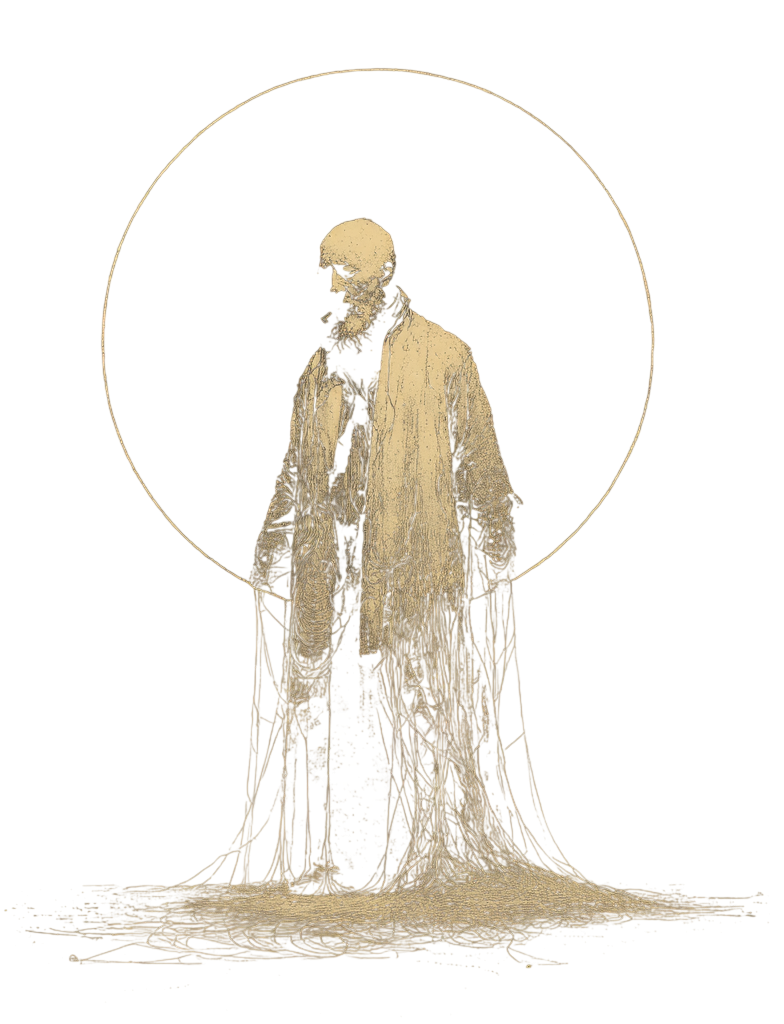
Marcelus Thorpe
Role: Settlement Leader
Function: Quest giver, variable ally
Overview: Marcelus Thorpe is the man others turn to when decisions need to be made. Measured in speech and precise in thought, he has taken it upon himself to maintain what little structure remains in a settlement slowly suffocating under Grey Lung.
Each cycle begins with him summoning the players and assigning them the same task: find the missing supply team and bring back what Hollow Creek needs to survive.
Personality: Everything he does is guided by one belief: Problems can be solved, if approached without panic.
- Controlled, deliberate, and observant
- Avoids speculation without evidence
- Dislikes unnecessary risk, especially involving magic
- Speaks with authority, not force
Knowledge: Marcelus works with incomplete understanding. Despite his skill, he cannot grasp the full shape of what is happening.
What he knows
- The supply team is missing
- Grey Lung is worsening
- The situation is urgent, but still manageable
What he doesn't know
- The day is repeating
- He has already performed a ritual
- He is the one sustaining the loop
Hidden / Conditional Knowledge
- As the loops progress, he experiences moments of déjà vu
- With enough evidence, he starts recognizing patterns that should not exist
- If fully convinced, he accepts that something is wrong, and that it must be broken
Loop Progression
Loop 1: Fully composed and focused entirely on dispatching the players. Dismisses unusual claims as stress or confusion.
Loop 2: A subtle tension beneath the surface. Occasional pauses, as if something feels out of place. More attentive if players bring specific details.
Loop 3: Noticeably strained. Begins asking questions in return and testing what the players claim. Experiences frequent déjà vu moments.
Loop 4: No longer dismisses inconsistencies and starts trying to make sense of them. Actively investigates when presented with strong evidence.
Loop 5: Still controlled, but at his limit. Contradictions can no longer be ignored. If given enough proof, he accepts that something is fundamentally wrong.
Notes for the GM: Marcelus is not trying to withhold the truth, he genuinely does not know it. His resistance comes from logic, not pride. Ironically, Marcelus believes there is still time, even when he is the reason there isn’t.
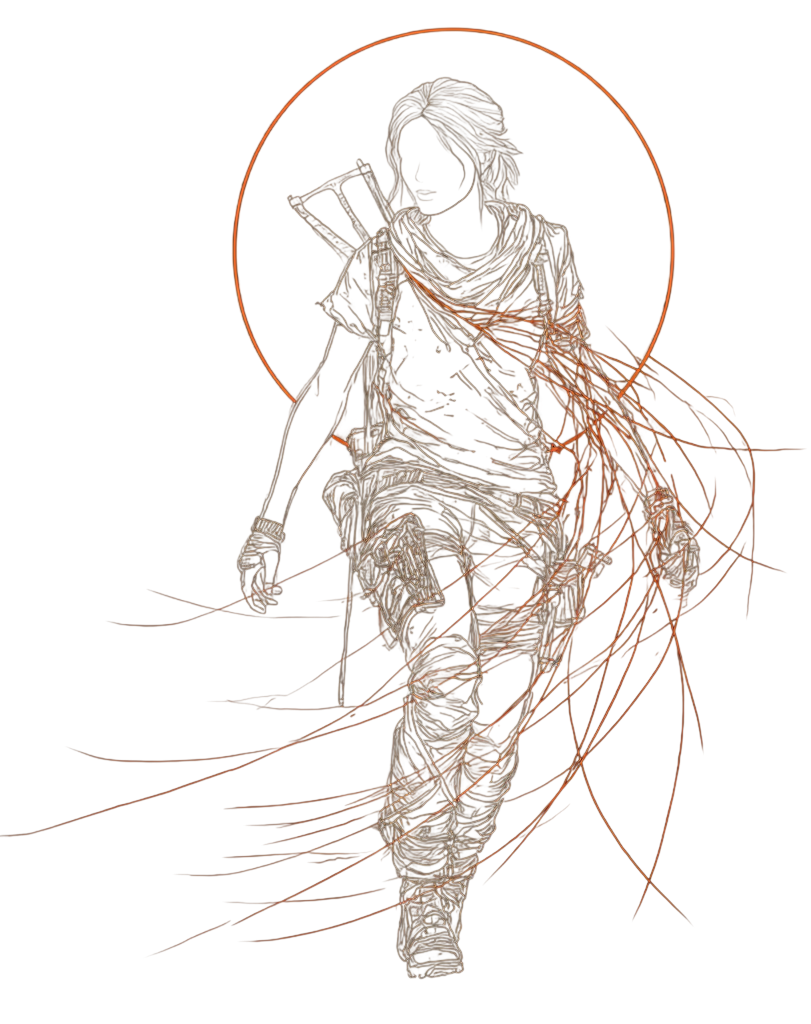
Alma Varn
Role: Supply Team Leader
Function: Introduces Marcelus as a variable
Overview: Alma is the one who kept the team alive this long. Experienced, practical, and hardened, she does not panic easily. She has seen things go wrong before - just never like this. By the time the players reach her, Alma is aware that something is out of place.
Personality:
- Grounded and decisive
- Speaks plainly, and to the point
- Protective by instinct
- Slow to trust, but quick to assess
Knowledge: Alma does not know what is happening, but she understands enough to be afraid of it.
What she knows
- The team was attacked on their way back
- Something is wrong with how events are unfolding
What she doesn't know
- That the day for Hollow Creek is repeating
- She is trapped in a slow motion
- What is causing all these
Hidden/Conditional Knowledge
- She knows Marcelus is a mage
- She is aware he has been under pressure due to Grey Lung
- She believes Marcelus would not act with intent to harm, but cannot reconcile that belief with what she is witnessing
Loop Progression
Loop 1: Not present at the site.
Loop 2: Present but completely out of sync. Shows no awareness of the players or surroundings beyond her frozen state.
Loop 3: This is her only window to interact with the characters. She becomes briefly aware of their presence.She recognizes immediately that the characters do not belong to what is happening. She speaks under pressure, trying to make sense of the situation while time continues to move against her.
Loop 4+: No longer reachable. Her progression has moved past the point of interaction.
Notes for the GM: Alma is not here to explain the situation, but to shift the players’ understanding and give them direction. She should not sound certain. Her words should feel like conclusions formed too quickly. Do not present her as a source of truth. Present her as someone trying to hold onto logic while it fails her.
Lio Kesh

Role: Scout and guide of the supply team
Function: Introduces player agency through choice, provides route optimization
Overview: Lio is quiet, observant, and always a few steps ahead. He was responsible for guiding the team through the fastest paths available. He understood the road better than anyone else in the group. What he could not account for was this.
Personality:
- Observant and perceptive
- Speaks little, but with purpose
- Pragmatic in dangerous situations
- Values survival over sentiment
Knowledge: Lio does not understand what is happening, but he understands enough to recognize danger when he sees it.
What he knows
- The team was attacked
- They are not in control of what is unfolding
What he doesn’t know
- The nature of their predicament
- Why the players are able to interact with him
Hidden / Conditional Knowledge
- He knows a faster route between the settlement and the site
- During his window, he realizes the players are not part of what is happening
Loop Progression
Loop 1: Not present at the site.
Loop 2: This is his only window to interact with the characters. After Bran’s death, Lio begins to turn toward the players as time catches up to him. He is actively being “processed” by the same force that killed Bran, his body showing signs of damage progressing without visible cause.
Loop 3+: Dead. No longer reachable.
Notes for the GM: Lio is the players’ first meaningful interaction at the site. His act should feel urgent and full of fear. He is not there to explain anything. He is there so the players can make a hard decision.
He understands, in that brief moment, that he is going to die and that something worse will happen after. His request for a merciful death should feel practical. In return, he gives the players something tangible: a faster path back to the settlement.
This is the first time the players understand that they cannot stop what is happening, but they can still take something from it. Make the window short. If they hesitate, it closes.
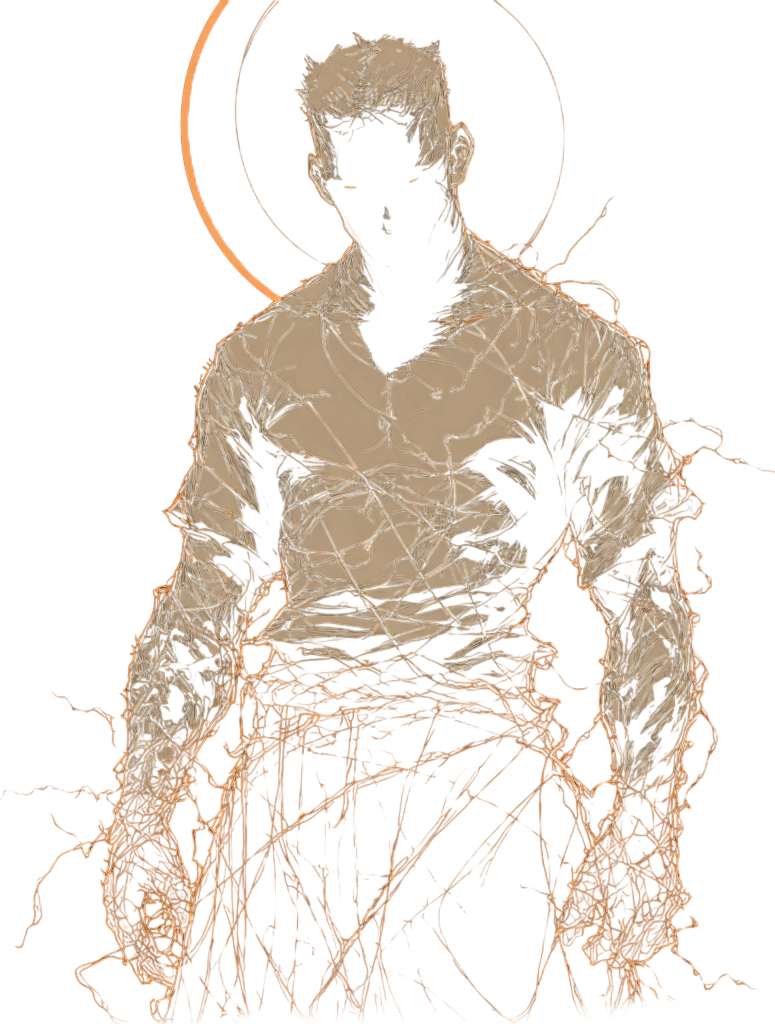
Bran
Role: Bodyguard of the supply team
Function: Establishes inevitability, introduces threat
Overview: Bran is the youngest of the group, and the least patient. Quick to anger and quicker to act, he often pushes ahead where others would hesitate. He survived this long because the others compensated for him. This time, that was not enough.
Personality:
- Impulsive and aggressive
- Fiercely independent
- Quick to escalate, slow to back down
- Relies on instinct over planning
Knowledge: Bran provides no information.
Loop Progression
Loop 1: Not present at the site.
Loop 2: Bran is struck by an unseen force as the characters arrive at the site. There is no visible attacker and they can only witness the result. Blood appears, flesh tears, and his body collapses as if something has already passed through him. He dies within moments. Immediately after death, what remains of him twists into something actively hostile.
Loop 3+: Dead. Only the result of what happened remains.
Notes for the GM: Bran is not a person in this scenario. He is an event. Do not slow this moment down with explanation. It should happen quickly and without warning. The important part is not the attack, it is the absence of a cause.
There is no movement, no visible strike. Only the effect appearing in front of the players. His corruption should feel immediate and wrong. Players must understand two things from this moment: what is happening cannot be stopped and what dies here does not stay dead.
There is no saving Bran. That must be clear.
Sean Halvek
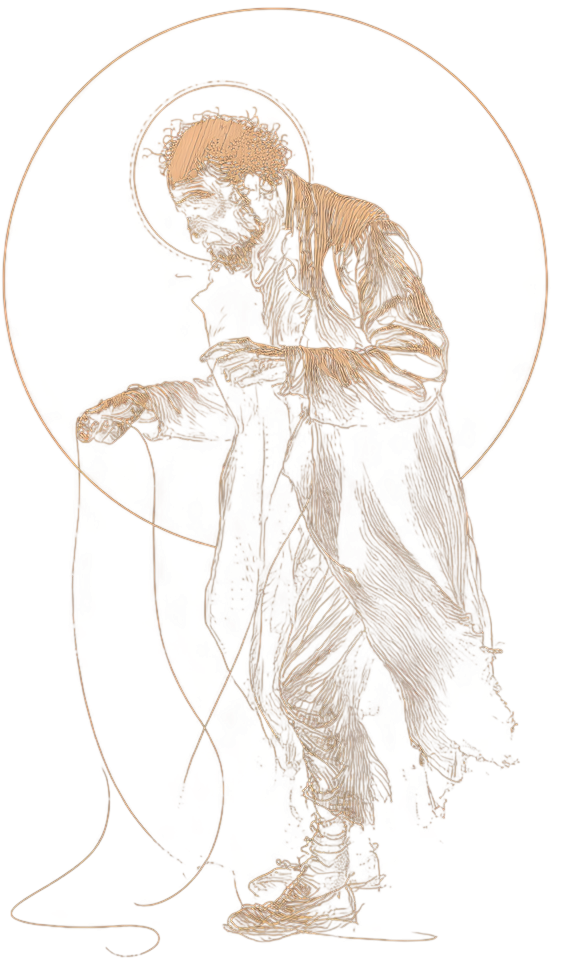
Role: Doctor of the supply team
Function: Provides reliable path to the cure, enables direct intervention at the site, potential proof for Marcelus
Overview: Sean should never have been on this journey. Age and experience had long moved him away from the road and into the settlement, where his knowledge was needed most. But the cure for the Grey Lung was not something that could be handled from a distance. So he came himself. Methodical and disciplined, Sean represents a kind of thinking the world is slowly losing: the ability to observe and deduct.
Personality:
- Analytical and methodical
- Values understanding before action
- When faced with the unknown, seeks to define it
Knowledge: Sean does not understand the fracture, but he knows enough to make an educated guess.
What he knows
- The team was attacked on their return
- Something is wrong with how the moment is unfolding
- The cure for Grey Lung is possible with the materials they have gathered
What he doesn’t know
- The nature of the loop
- Why the moment of the attack has not yet completed
- Why the players are able to interact with him when they do
Hidden / Conditional Knowledge
- He knows how to properly prepare the cure
- He knows Marcelus is a mage and that he prepared another solution if the team delayed to return
Loop Progression
Loop 1: Not present at the site.
Loop 2 & 3: Present but completely out of sync. Shows none to little awareness of the players.
Loop 4: Sean is at the point where the attack is about to complete. The force that struck the team begins to manifest within the players’ frame of reality. He understands, at least in part, that what is happening can still be interrupted.
Interaction Outcome (Conditional)
- If the players intervene: The attack is disrupted before completion. The creature’s presence collapses as Sean’s body fails. The doctor dies, but does not corrupt. Instead he persists as a fractured, ghost-like presence.
- If the players fail or do nothing: The attack fully completes. Sean dies and immediately corruption takes hold. He becomes hostile and is lost permanently.
Loop 5: If preserved, Sean remains with the players. He provides clear guidance for preparing the cure and a strong support when confronting Marcelus. If lost, only his notes remain.
Notes for the GM: Sean is the only moment at the site where the players can directly intervene in what is happening. The creature should feel like the same unseen force that killed the others, now present and hostile towards the players as well.
The players are not able to keep Sean alive. What they can do is to prevent the corruption claim him by defeating the mysterious being that attacked the supply team. If they succeed, Sean becomes a reward that carries forward into the final loop.
People of Hollow Creek
These are the familiar people. Not important in the grand sense, but close enough that their loss is felt. The characters likely know them, have traded with them, argued with them, or simply shared space with them long enough to recognize their absence. The following archetypes are meant as inspiration to help you quickly ground the settlement in personal connections. Feel free to use this toolbox of ideas, to make the settlement feel familiar for the characters. It is, after all, their home.
The Caretaker: Someone who looks after others despite having little to give.
Examples
- An older woman tending to the sick
- A man who has not slept in days to make sure everyone has what they need
- A teacher trying to distract the children with games
Connection Ideas
- They helped a character recover from an injury in the past
- Entrusts a character with something small but meaningful, before they leave for their quest
- Present a small act of kindness that would touch deeply one of the characters
Use them to represent: compassion, sensitivity, hope
The Dependent: Someone who cannot survive without help. Too young, too weak, or too far gone to stand on their own, they exist entirely at the mercy of others.
Examples
- A young child or baby
- A sick elder, possibly a parent of the characters
Connection Ideas
- Someone tied directly to one of the characters
- Someone a character have promised to protect
- An injured rival. They will not survive on their own.
Use them to represent: responsibility, vulnerability, moral tension
The Useful One: Someone whose survival would help others endure. They keep something running. Food, water, protection: something the settlement cannot afford to lose.
Examples
- A mechanic, keeping systems running
- Someone with medical knowledge, even if it's limited
- A respected guard, the one keeping watch so others can sleep
Connection Ideas
- A mentor to one of the characters
- Losing them would be a great loss for the settlement as a whole
- Saving them should be difficult and costly. Sacrifice someone important to do so.
Use them to represent: practicality, collective survival, utilitarian vs emotional choice
The Sceptic: Someone who refuses to accept what is happening. They question decisions and reject the idea that things are as dire as they seem.
Examples
- Dismisses the illness as exaggerated
- Resents Marcelus' authority and they are charismatic enough to gather support
- Questions the need for the supply team
Connection Ideas
- The best friend of one of the characters.
- Potential trouble maker against Marcelus
Use them to represent: doubt, conflict
The Familiar Face: Someone the players don’t think about, until they’re gone. A presence more than a person. Always there. Always part of the background. Someone whose absence feels wrong before it feels tragic.
Examples
- A farmer, a cook or a worker
- Someone who always waves at the characters and asks how they are doing. Even if they never do.
- A person everyone knows, but no one really cares for.
Connection Ideas
- No dramatic role. Just presence.
- Makes loss feel real instead of purely strategic
- They could possible perish in a heroic manner near the end of the story
Use them to represent: reality check, survivors as a whole
Hollow Creek
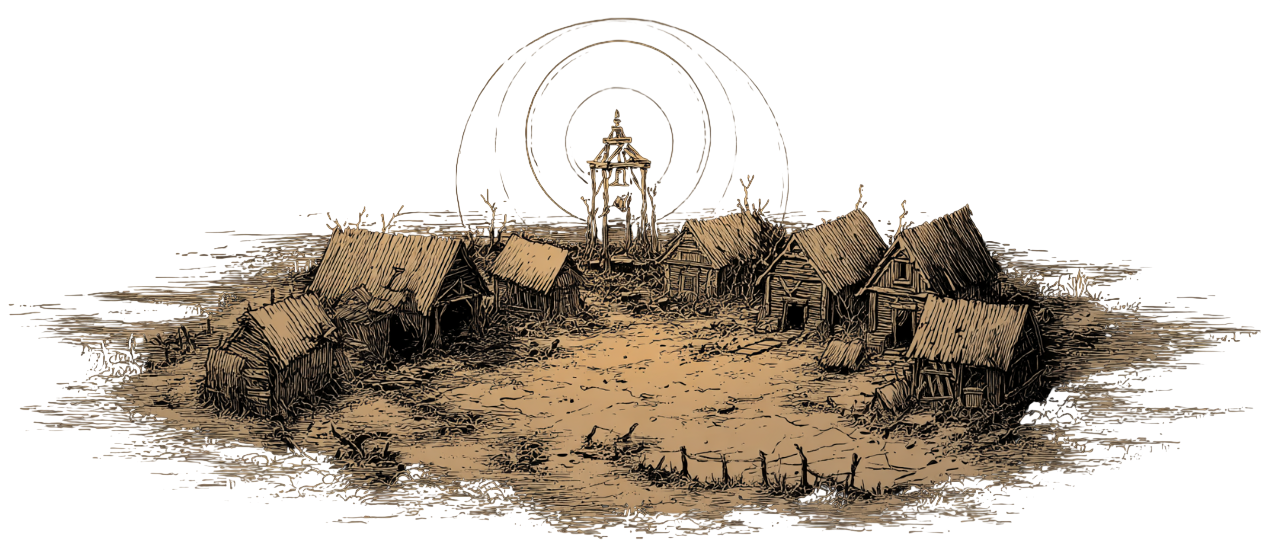
Hollow Creek is not populated by heroes.
It is held together by routine and stubborn hands. Its people wake each morning and choose to continue despite the slow suffocation of Grey Lung and the quiet dread that has settled over the world. Farmers, children, a wise leader, a tired doctor, a supply team that left to help and never quite returned. None of them were meant to matter beyond their place in the day.
But the day no longer moves forward.
Within the loop, these people fracture. Some hold their shape longer than others. Some decay faster. A few - very few - can be reached and if the moment is right they might even be saved.
Each entry provides several details like:
- Who the person is.
- How they appear as the cycles progress.
- What they know and when they can share it.
- How they might be saved, or lost.
The supply team in particular should not be treated as ordinary NPCs. They are meant to act as a sequence of outcomes the players will witness before they understand them. Use them to build tension, reward attention and force choice.

- System: System Agnostic
- Format: Stand-alone adventure
- Players: 3-5
- Estimated Playtime: > 8 hours
- Content Warnings: Illness, death, moral ambiguity
- Complexity: Moderate to high; requires tracking repeated events and gradual escalation
- Structure: The scenario unfolds in scenes which are related with two phases:
- The Loop Phase
- The Final Run
- Preparation: No system-specific mechanics are required. The scenario can be adapted to any ruleset (I think).
Music Proposals
Grey Lung
The Grey Lung, as the locals call it, is the affliction that has taken hold within Hollow Creek. It affects nearly everyone in the settlement, including the characters, though symptoms may not yet be visible in all cases.
Symptoms
The affliction presents as a progressive physical decline, including:
- persistent fatigue
- fever and chills
- a dry, worsening cough
- labored breathing
- loss of strength
In advanced stages, the cough intensifies. The afflicted begin to expel a thick grey substance mixed with blood; the sign from which the illness takes its name.
Progression
Those infected may appear stable for a time, but their condition inevitably worsens. Some decline slowly over days. Others deteriorate rapidly without clear cause. There is no pattern that can be relied upon.
Transmission
The exact method of transmission is unknown. Close proximity appears to accelerate its spread, but even those who isolate themselves eventually show symptoms. Many believe the illness is airborne, though this has not been confirmed.
Current State in Hollow Creek
- A significant portion of the population is already infected.
- Several individuals are in critical condition.
- The number of severe cases increases each day.
- Medical supplies are limited and largely ineffective.
- A cure may be possible with the right components - if they can be found.
GM Guidance
Present the illness as constant, without being overly dramatic. Use small details: a cough during conversation or someone pausing to breathe. The horror of the affliction should not be how fast it kills, but how certain it is that it will.
Useful Articles
A Wyld Surge is the backlash that occurs when magic is forced beyond what a mage can safely control. Rather than failing, the spell twists or creates an unexpected added result. Usually the intended effect manifests in some way, but the price is always paid. The greater the manipulation, the greater the distortion.
The Loop
The cycle is tied to the toll of a bell. When it rings, the day resets and:
- The settlement returns to its initial state.
- All individuals revert to how they were at the beginning of the day.
- Everyone remains unaware the day has repeated, except for the characters.
Each loop has a duration from dawn to midnight, approximately 15 hours long. With each reset, the cycle becomes less stable. By later loops, these cracks become noticeable, and the sense that something is failing becomes unavoidable.
The cycle has certain limitations.
- Items recovered from outside Hollow Creek disappear when the bell tolls.
- Any solution must be completed within a single uninterrupted cycle.
- The loop can repeat up to five times.
- The fifth loop is the last.
- If not broken before the next bell toll, the ritual collapses.
The bell will toll.
And each time, there is less left to save.
Running the Adventure
This scenario unfolds in two distinct phases: The Loop Phase and the Final Run.
The characters will experience the same day multiple times, but the adventure is not meant to be played as a full repetition of events. Instead, each loop represents an opportunity for the team to learn, refine their actions, gather understanding and move closer to a solution.
Read the details in the spoilers below to get accustomed with the flow of this adventure.
During this phase, the characters relive the same day in Hollow Creek. Each loop follows the same scene structure:
- Receive the assignment
- Travel to the site
- Investigate what remains
When the bell rings, the day resets. The world returns to its initial state, while the characters retain the knowledge they gained. The purpose of this phase is accumulation of understanding. With each loop the journey becomes more efficient, decisions more certain and new details come into play. The site of the supply team in particular progresses differently, revealing more with each cycle.
There are no further resets once the story reaches the point of the Final Run.
During that phase, the characters must:
- Reach the site
- Recover what is needed
- Return to Hollow Creek
- Prepare the cure
- Confront or disrupt the source of the ritual
All before the bell tolls again.
The fifth loop is the last possible moment to act. If the characters lose that final window, Marcelus’ ritual breaks on its own, and Hollow Creek will not survive.
Hollow Creek Map
Map Usage
The map shows the general layout of Hollow Creek, not an exact or to-scale representation. It focuses on how the settlement is organized rather than precise distances. Hollow Creek was built out of necessity. Structures are uneven, paths are formed by use, and space is taken wherever it was available.
The central fire, main supply areas, and outer fence are the only stable points. Everything else can shift to fit your own descriptions. Keep the population density in mind: nearly 200 people living in a space not meant to hold them. This map was created by me using Dungeondraft.
Loop Phase
Scene I: The Assignment
Introduction
Another day dawns in Hollow Creek.
The settlement wakes as it always does: silently, patiently, always alert. It belongs to a world that punishes hope, and its people have learned to expect nothing beyond survival. Each new sunrise is a victory.
For the past two months though, even that fragile dream has begun to falter. That was when the Grey Lung first appeared, and now the settlement suffocates under the influence of the disease. What began as fatigue and fever has become something else. Something slower. Something insistent. The cough does not leave, breathing worsens, and strength fades.
No more than two hundred souls remain in Hollow Creek, and already some are gone. More will follow.
Ten days ago, Marcelus Thorpe made a decision and sent out a team; four of the most capable people in Hollow Creek, tasked with recovering whatever could be used to create a cure. Among them was Sean Halvek, the settlement’s doctor, and the only one who had a chance to figure out what was needed.
They have not returned. Each passing day brings more cases, more silence, more fear that no one speaks aloud.
Marcelus Thorpe has held that fear at bay for as long as he could, but not anymore.
So, today, he has called for you.
The Players
The characters are residents of Hollow Creek. Before Marcelus summons them, take time to ground them in the settlement.
Let them see it. Hear it. Connect to it.
Encourage the players to define at least one connection: professional, personal, or unresolved. A shared journey, a past disagreement, a debt, a quiet respect. Use the NPC Folio to establish relationships: people they know or cannot afford to lose. These may also include members of the missing supply team. These connections will matter later.
The characters are among the settlement’s most capable members. That is why they are being sent.
Decide now - or roll randomly - which of them shows early signs of the Grey Lung. Nothing severe. A cough or a subtle paleness are enough to make finding a solution more personal.
Table I presents small events that may occur within Hollow Creek before the summons. Choose 2–4 and keep track of them. When the day resets and a new loop begins, these moments should repeat and the charecters will be the only ones to notice.
Meeting with Marcelus Thorpe
Once the characters have moved through Hollow Creek - spoken with its people, taken part in small tasks, and settled into the rhythm of the settlement - they are approached by a messenger. One by one, or in pairs depending on where they are, they all receive the same message:
Marcelus Thorpe wishes to see them, as soon as possible.
The tone carries urgency, but not alarm. It is enough to prompt action, not suspicion. Nothing about it suggests anything beyond the ordinary struggles Hollow Creek has to overcome daily.
When the characters arrive at Marcelus’ residence, read or paraphrase the following:
Marcelus’ residence stands near the center of Hollow Creek. It is one of the older structures that still holds together, reinforced with thin metal sheets over broken panels and worn timber patched against years of damage. Even in this state, it resists decay more stubbornly than the rest.
The door opens with a slow creak once you reach for the handle.
It is a small house. Beyond a narrow hall, a single room opens before you; serving as office, kitchen, living space, and sleeping quarters all at once. Yet the space does not feel cramped in the slightest.
A large table dominates the center. Its surface is covered in maps, notes, and small objects arranged with care that borders on obsession. Nothing overlaps. Nothing is misplaced. The windows are murky, dimming the daylight. The room is instead lit by a tired oil lantern, its flame trembling as it pushes back the shadows gathering at the edges.
Marcelus Thorpe stands beside the table.
He is older than most in Hollow Creek, though not yet frail. His posture leans slightly forward, shaped by years spent over work that never truly ends. His clothes are worn, but clean - maintained with the same care as everything else in the room. A single talisman hangs from his neck; a small, rusted bell on a thin cord. His hands rest lightly on the table’s edge.
There is a faint tremor in them and you are certain it is not caused by the cold.
His eyes move across you, one by one, weighing. Measuring. Not just who you are, but what you might be able to handle.
There is no greeting. Only a brief pause, before the old man draws a slow breath and speaks.
Marcelus does not waste time with pleasantries or small talk. He is not distant - everyone in Hollow Creek knows him, and the characters have likely spoken with him before - but there is a noticeable restraint in the way he carries himself now. His focus is narrowed, his patience thin, and whatever urgency he feels, he does not attempt to soften it. He informs the characters that the supply team should have been back by now.
"The team is overdue,” he says. "I sent them to retrieve what we need to slow the illness. Without it…” His gaze shifts briefly toward the window before returning. "…we will not hold much longer.”
He does not ask for help, he states the need for it.
Marcelus provides the route he believes the team followed, leading toward the ruins of an old-world town and its long abandoned hospital. The path is not certain, but it is the most logical approach given the team’s objective and the terrain. "You need to follow their steps. Find them, if they still live.” His fingers press lightly against the table as he speaks. "Recover what they were sent to carry back. Whatever you bring may be the difference between survival and burial.”
He offers no reassurance. To him, the situation is simple: time is limited, and action is required.
Q&A with Marcelus
Marcelus answers questions directly. He does not speculate, and he does not entertain abstract or hypothetical discussions. If pressed beyond what he considers useful, he redirects the conversation back to the task.
Where did the team go?
"To the ruins east of Hollow Creek. A day’s walk. There is an old-world hospital there. If anything useful remains, it would be there.”
Who were the members of the team?
"Alma and Lio. You know them. Sean, our doctor, went with them. And Bran.”
Isn't Bran your grandson?
"He is."
How long have they been gone?
"It has been ten days.”
Do you think they are still alive?
"I think they are capable, but our world is a dangerous place."
What exactly are we looking for?
"Medical supplies. Anything that can stabilize the afflicted.”
What if we cannot find the team?
"Then you complete their task.”
How urgent is this?
"We are already late.”
What happens if we fail?
"We do not survive.”
"If there is nothing else,” he says, without looking up, "you should begin preparing." Then more quietly he adds: "Do not wait longer than you must.”
He does not dismiss you with the authority of a leader. He simply assumes you will act.
Is the path safe?
"No."
What should we expect out there?
"Ruins. Exposure. Things that do not belong. The usual.”
What do you know about the illness?
"It progresses. Faster than expected. Those who fall ill do not recover. You see the rest for yourselves.”
Can it be cured?
"With the right supplies… I believe so.”
Can we take supplies from the settlement?
"You take what you need. Leave enough for those who remain.”
Can someone come with us?
"If you believe it increases your chances, yes. But understand this: anyone who leaves is one less person here.”
What's in it for us?
"You mean other than surviving this? There is nothing else.”
Across the Loops
Scene 1 repeats at the start of each loop, but should only be played in full once or twice. On later loops, summarize what is already known and move quickly to player decisions. Marcelus delivers the same request each time, and his answers remain consistent unless the players present new information.
Keep in mind that only the characters retain knowledge across loops; anything shared with others is forgotten when the day resets. This allows the players to act earlier, prepare more efficiently, or bypass parts of the scene entirely. Encourage this. By later loops, Scene 1 should resolve quickly, serving as a transition into action rather than a full interaction.
Scene 2: On the Road
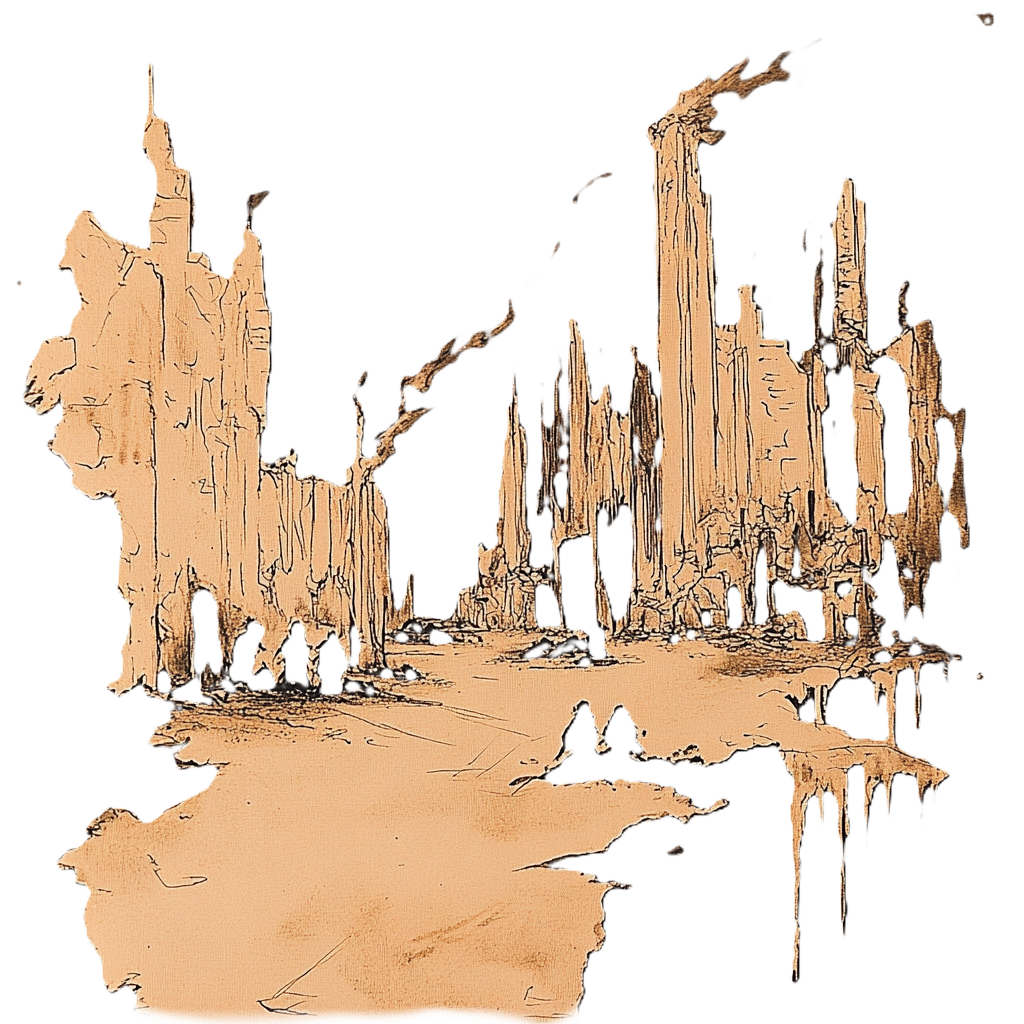
Marcelus’ instructions were clear: follow the old road east. Keep to what remains of it. Do not deviate unless necessary.
Yet the path beyond Hollow Creek is not a road in any meaningful sense.
What remains is fractured and uneven; a memory of direction rather than a maintained route. The land stretches before you in muted tones: dry earth, scattered debris, and the distant silhouettes of structures that no longer serve their purpose. Overhead, the sky hangs low and grey. Its firmament looks cracked as thin veins of red light spil through, like something crying tears of blood into the world.
The settlement disappears quickly behind you. Sound fades with it. Soon there are no voices or movement. What remains is the silent rhythm of travel in a world that punishes curiosity.
The air feels heavier here - less forgiving.
Every step forward carries the same understanding:
There is no safety ahead.
Only distance.
How to use the road
There are three possible routes leading toward the destination.
During the first loop, the characters follow the path described by Marcelus. Do not mention the existence of other routes yet. As they leave Hollow Creek, the journey appears to be a full day’s travel toward the hospital, and only the main road seems to lead there.
This assumption, however, is incorrect.
Following the main road - and later any of the other two - the characters instead encounter the site of the missing supply team after a few hours.
This is their true destination.
After the first loop, the characters become aware that the road splits. Present the three available paths:
- Main Road - the route already known to them (~6 hours from Hollow Creek to the site)
- Safe Path - slower, but much safer (~8 hours from Hollow Creek to the site)
- Fast Path - shorter, but significantly more dangerous (~4 hours from Hollow Creek to the site). This path becomes available only if Lio shares it (see Scene III for more). Otherwise, it remains hidden
From this point onward, the players may choose their route each loop. As they gain familiarity with the road, their efficiency improves. This should naturally reduce time spent and increase control over the journey.
An old-world highway, broken but still relatively clear. Cracked asphalt stretches through open terrain with little cover. Travel is direct, but exposed.
Choose one encounter from Table II. If the players attempt to avoid it and succeed, increase travel time by 1 hour as they are forced to detour. Choose one environmental encounter from Table III. Both encounters remain constant across all loops.
The characters leave the road and move through uneven, overgrown terrain. There are no hostile encounters, but progress is slow and physically demanding. Each segment of this path introduces minor obstacles (difficult footing, blocked passage, detours) that increase travel time. Choose two encounters from Table III. The results remain constant across all loops.
A faint and unstable trail cutting through fractured terrain. Movement is quicker, but far more dangerous. Choose two encounters from Table II (they cannot match the Main Road encounter). These remain consistent across all loops.
During the first loop, after the characters have traveled for around six hours, read or paraphrase the following as the camp site of the supply team first comes into view:
The road continues as it has for hours: broken, uneven, but still clear enough to follow.
By your reckoning, you are still far from the ruins and the hospital. You would not have stopped her, if not for the clear signs that someone else did before you.
The asphalt thins into scattered patches, then into bare ground, until it gives way to an open clearing.
A collapsed metro entrance rises ahead, its concrete frame split and partially sunken. The stairwell beneath is choked with rubble and shadow, the way down sealed. Around it, the debris has been cleared just enough to make space.
A camp sits there.
Bedrolls, folded. Containers, closed. Packs set together near a low burning fire.
No one answers your approach.
No one moves.
Scene III: The Supply Team
Introduction
The fire still burns.
Low. Steady. Untended.
No one feeds it. No one watches it. Yet it does not die.
You feel time passing. Your breath, the air around you, the sound of your voice - all of it moves forward as expected.
All except for the camp before you.
Nothing shifts unless you touch it.
Nothing changes unless you disturb it.
And even then… only slightly.
Character Deaths
If a character dies during a loop, they return at the next reset as normal. However, this protection is tied to the ritual. Once it is broken, any character who died in previous loops, dies immediately and, this time, permenantly.
Table IV - The Camp During the Loops
Before the Break
Once the characters arrive at the site for the first time, read or paraphrase:
The fire burns low, its light barely reaching beyond the small circle it claims.
Nothing is scattered and nothing suggests haste. A cup sits near the fire. Metal plates have been set upon a flat stone, each holding a small portion of cold beans. Next to them, a bundle of papers rests where it was set down.
A pencil lies across it.
No wind moves through the clearing. No sound carries beyond your own steps.As you draw closer to the fire however, something begins to feel wrong.
Exploring the Camp
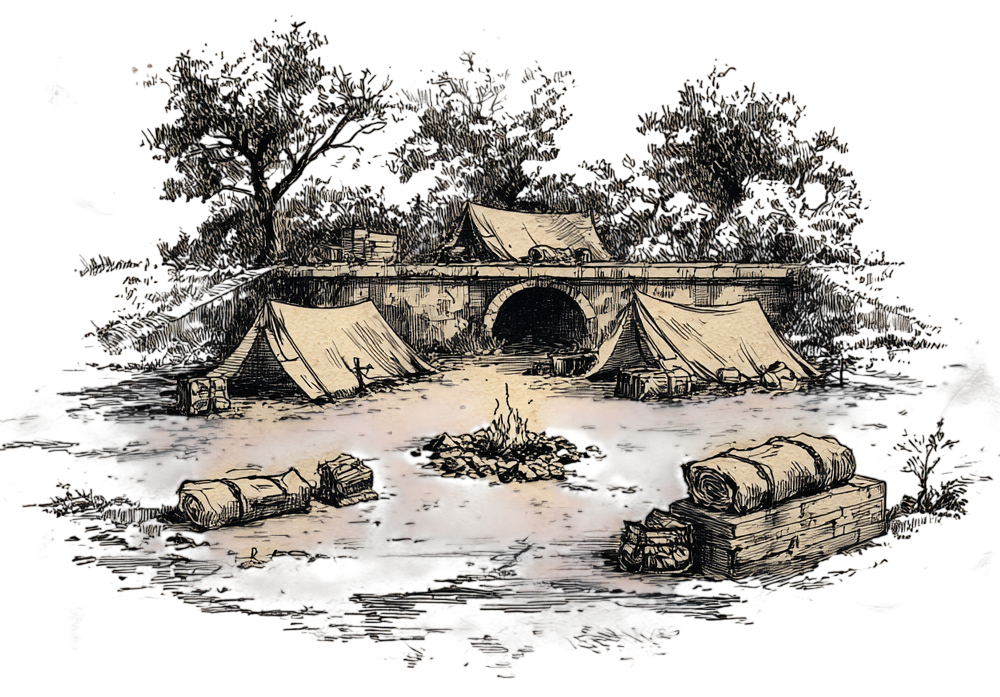
During this first visit, the camp appears intact and recently used. There are no visible signs of immediate danger, and no indication that something interrupted the team. The purpose of this loop is to ground the players in a reality that feels complete, yet subtly incorrect.
At this point, the characters have no reason to suspect anything beyond a failed expedition. They are not yet aware of Marcelus’ ritual and its effects. Let them explore freely. Everything they find reinforces the same conclusion: the team was here recently.
- Supplies are organized, not abandoned
- Food has been prepared, but not eaten
- Equipment is intact and accounted for
There is no blood. No damaged gear. No sign of conflict. The stillness of the site should feel more unsettling than any evidence of violence. The most important discoveries are detailed below.
At a distance, nothing appears unusual. Only when closely observed does the discrepancy become apparent. Allow the players to notice this on their own.
Tracks surround the camp, concentrated near the fire. They overlap, circle, and cross one another. Still, none of them seems to lead away. Let the players draw their own conclusions.
Inside, the pages are filled with notes. The writing is dense and uneven, as if meant only for the writer to understand. Reading through it all would take time. One page, however, stands apart. At this point, provide Handout I.
Vials, syringes, bandages, worn instruments, sealed boxes of pills, powdered substances in fragile containers - everything needed to attempt a treatment. Without proper knowledge, these supplies are difficult to use effectively.
End of the Loop
No matter how long the characters remain at the camp, nothing changes.
They may study the notes, sort through the supplies, or attempt to carry something back toward Hollow Creek. Let them act as they wish until - at some point (at midnight and roughly 15 hours since they first left the settlement) - a sound reaches them.
When this happens - wherever the characters may be - read or paraphrase the following:
The sound is thin and hollow. There is no echo or point of origin. Then the bell tolls again.
The light dims, all at once, as if something has closed over it. The edges of your vision begin to fade.
Vanishing.
It is no darkness though. It is nothingness.
The world beyond a few steps from you is ceases to exist. The ground beneath your feet is no longer there.
The sound of the bell lingers, closer now.
One final toll and everything is gone.
The next moment, you wake.
Another morning comes.
Back in Hollow Creek.
And so it begins
The clearing comes into view again. The same broken ground. The same collapsed metro entrance. The fire still burns, but it's lower now. Fading. Two of the bedrolls look occupied. It is the same camp. Just not the same silence.
Without a warning, a shriek breaks through. High-pitched. Wrong. It cuts deep into your thoughts before you can place it. You see something moving near the edge of the camp. A body. Not fully there. Not fully somewhere else.
You recognize him.
You’ve seen him around Hollow Creek: hauling crates, laughing too loudly, speaking when he shouldn’t. You've shared meals with him, you've worked by his side.
Bran.
He staggers forward, weapon raised, swinging at something you cannot see. The shriek circles him. Then suddenly, his body is tossed away. A deep cut opens across his chest. Then another. And another. Blood spills in sudden bursts, each wound appearing where nothing touches him.
His scream tears through the clearing, etching itself forever in your mind.
Then it stops and Bran collapses.
A Death you Cannot explain
This moment should be played as a fast, cinematic sequence. Do not allow intervention before the killing blow. The players may react, but they can't change the outcome. Bran’s death is the first clear confirmation that something is happening here that does not follow the rules of the world they know.
As his body hits the ground, you see a thin, silvery mist rise from it. It twists as it forms, resisting shape. Dark, oily veins spread through it: threading, pulsing, tightening. For a brief moment, something holds within it.
Bran's face.
Terrified.
Then it tears apart.
What remains is human no more.
And it lunges towards you.
The creature is unstable, only partially bound to the physical world, but no less dangerous for it. Within the premise of Crux Umbra, this is a corrupted spirit; Bran’s soul, infected by the abomination that struck him down. In other systems, it may take the form of an aberration, an undead, or another unnatural manifestation.
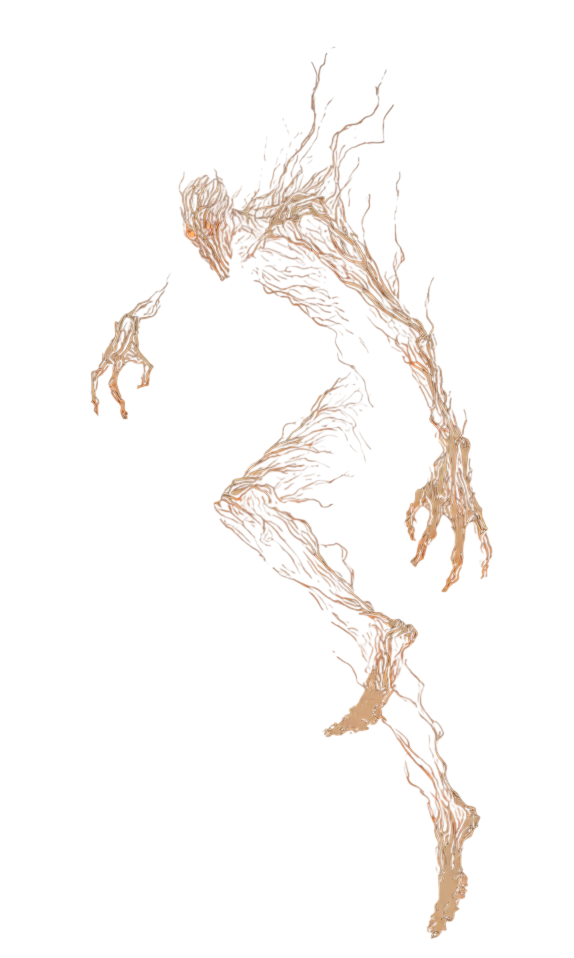
Its attacks blur the line between physical and mental harm. During the fight, there are moments where even perception becomes unreliable. This is not a clean fight. It should feel wrong. Once the creature is defeated, do not allow the players time to rest. Move immediately to the next event.
Lio's Plea
At the far edge of the camp, something begins to take shape. A man forming into place, as if forced into the world. He turns toward you too slowly, the motion lagging behind itself.
It is Lio.
He stumbles forward, unsteady, like his body does not fully belong to him. His eyes lock on Bran’s body. Then they widen, and shift past it. Towards you. No... behind you.
There is nothing there.
In a split second Lio stumbles back, as a wound open across his right side.
He gasps, trying to stay upright, failing.
Then you hear it. His voice finally reaches you. It belongs to your space this time.
GM Guidance
Lio briefly aligns with the characters’ flow of time. He does not understand how they are here, and there is no time to question it. What he does understand is this: he is dying, and he has already seen what happens next. This is not fear of death. It is fear of what comes after.
Lio is deteriorating rapidly. His body is failing in real time, and the window for interaction is brief. Do not allow prolonged discussion. If the players hesitate, interrupt, or delay, his condition worsens and his words begin to break apart.
If the characters grant him a swift death, he manages to hold himself together long enough to give clear directions. His instructions describe a route through lower ground, marked by broken rail lines and carved stone indicators. These landmarks should be distinct and recognizable in later loops, allowing the players to navigate the fast path.
If they hesitate or refuse, his coherence collapses. His words fragment, lose meaning, and the route is lost with him.
Lio will die in this loop regardless of the players’ actions. The only question is: does he die as himself, or as something else?
“Help...”
The word breaks out of him. He tries to step forward, but his leg gives. Another wound tears open across his chest. He chokes on the breath it steals. His eyes flick past you again, tracking something you still cannot see.
“... run...” he whispers, "...you need to run..."
His voice falters.
His hand presses weakly against the ground, trying to hold himself together.
"...don't let it take me..."
He forces himself to look at you.
"There’s a way… lower ground… broken rail… take the supplies back..."
His voice slips, fragments between racing pulses.
"...but before... kill me..."
Another breath. Shallow. Breaking.
"Please..."
Exploring the Camp
After both situations are resolved, the clearing falls silent once more.
Whatever happened to Bran and Lio, has passed and gone. For now. The bodies can be examined, moved, or buried. Their wounds are real, and consistent with what the characters witnessed: deep, sudden tears in flesh, with no clear physical cause.
At the same time, two of the bedrolls are now occupied by Sean and Alma. Their forms flicker in and out of view, like reflections struggling to hold shape. At times they appear solid. At others, they distort, blur, or vanish entirely for a heartbeat before returning. Their actions feel delayed and out of sync. The characters cannot interact with them at this point.
The camp reflects this duality. Some elements have changed since the previous loop. There are signs of movement and objects may no longer be exactly where they were. Anything previously removed from the site has returned. Supplies, notes, tools: everything is present again, though not necessarily in the same place.
Among these, the characters can find a new page of Sean Halvek’s journal. This is Handout II.
Allow the players to explore, experiment, and interact with the site. This loop should reinforce two key realizations:
- The people within it are not fully accessible
- What is happening here is neither entirely in the past nor entirely in the present
As before, no further change occurs until the bell tolls. Let the players act as they wish before the sound returns and they wake once more back to Hollow Creek.
Revelation
The fire is dead, a thin pillar of smoke rising lazily - too slow - towards the broken sky. Bran and Lio lie where you let them. Near the center of the camp, two figures are moving. Sean and Alma, no longer flickering idly.
“…take the supplies and go!” Alma’s voice is sharp and urgent. She is facing Sean, her back half-turned to the edge of the camp. Sean shakes his head, frantic.
“I’m not leaving you...”
"For fuck sake doc! You don't get to decide that!" she snaps. “You have to run. NOW!"
Something shifts in the air that makes Alma freeze.
“…it’s back.”
GM Guidance
This loop represents the seconds after Bran and Lio have already fallen, as Sean and Alma have woken up due to the fuss of the fight and attempt to regroup. The players are now aligned with the scene early enough to:
- Witness the aftermath
- Observe the argument
- Intervene partially in what follows
Alma Varn
When the entity returns, Alma immediately moves to protect Sean and buy him time to escape with the supplies. At this moment, she aligns with the players’ perception of time and can interact with them directly.
She recognizes them from the settlement. She does not understand how they appeared here, but she realizes their presence there is unnatural. At the same time, she becomes aware that Sean is out of sync: his slowed, delayed movements confirm that something is deeply wrong. Alma adapts quickly. She does not dwell on explanations. She accepts the situation and acts within it.
If the players mention the repeating day, the loop or Marcelus, Alma connects the pieces rapidly. She and Sean are the only ones in Hollow Creek who know Marcelus is a mage attuned to the magic of time and space.
Any sort of dialogue occurs during combat. Alma's speech should be short, fragmented and reactive. She does not deliver explanations. Instead, she reaches conclusions mid-action. Use Alma to introduce doubt as well as information. She should not clearly accuse Marcelus, nor fully defend him. She is shaken, trying to reconcile what she knows with what she is witnessing. Her realization about Marcelus being involved should feel unstable:
Her role in this loop is to:
- Confirm the unnatural nature of the event
- Reveal Marcelus as a mage
- Introduce uncertainty about his intentions
In the end, the entity reaches Alma and wounds her deeply enough to kill her. The moment collapses toward the same endpoint. If the players learned from Lio, they may grant her a swift death, thus sparing her soul of becoming corrupted immediately. If not, her death follows the same pattern as Bran and they would need to either confront her or escape the camp.
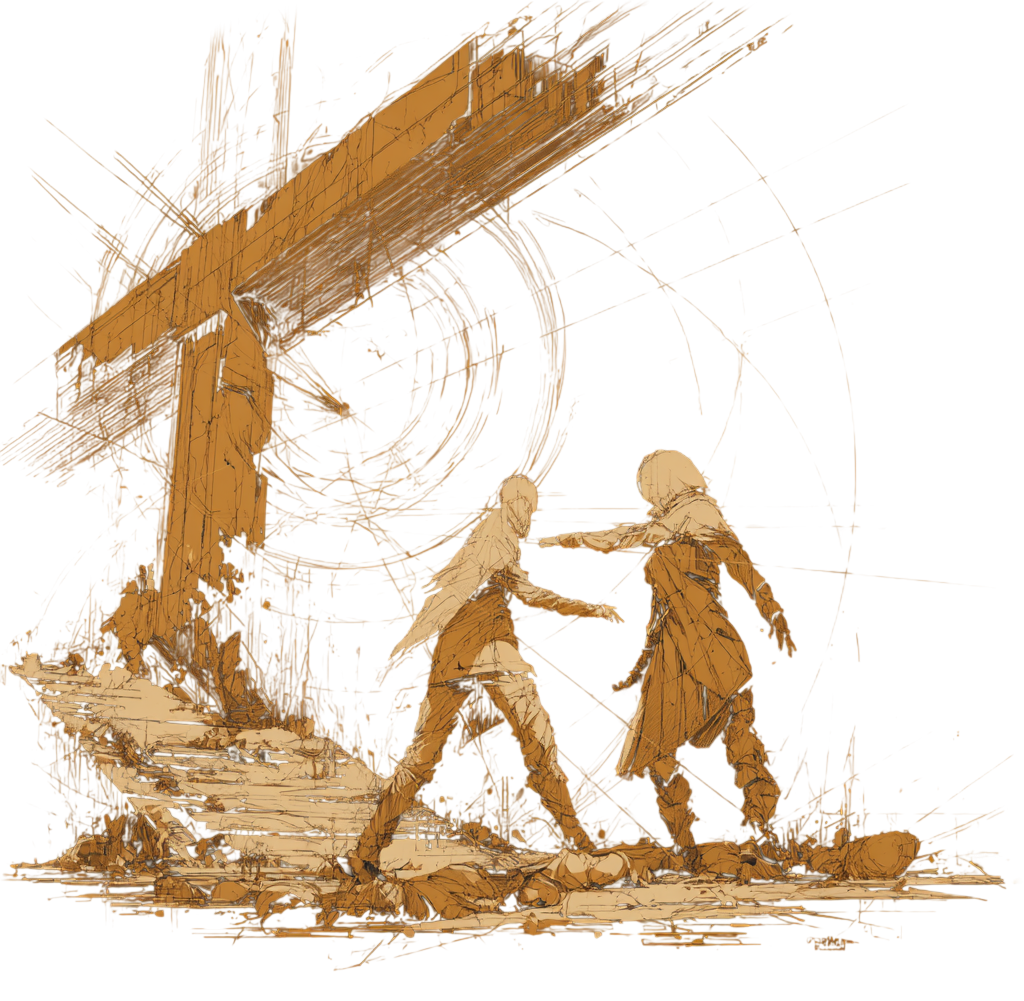
The is partially caught within the effects of the ritual, but as an otherworldly being, it does not follow the same rules as the rest of the scene. Its presence is inconsistent and difficult to perceive. The players may sense its position through sound and distortion, perceive fragments of its outline or shadow or attempt to block its attacks against Alma
However, they cannot harm it yet. Their attacks fail to connect, pass through, or strike too late.
Focus your descriptions on its alien nature. Avoid clear visual form. Instead, you can emphasize other senses. The wrongness of the sound it produces. The way the air shifts or distorts around it and the smell of torn flesh before wounds appear.
Let the absence of a clear image become part of the horror.
Keep in mind that this encounter is not about defeating the entity. It is about delaying the inevitable.
Exploring the camp
The camp settles once the moment resolves. The characters may explore the camp freely. Bran, Lio, and now Alma all remain physically present. Their bodies can be examined, moved, or buried. If the bodies are taken away from the site, they reappear somewhere within the camp after the reset.
The only new discovery in this loop is a new page from Sean Halvek’s journal. This is Handout III.
When enough time has passed, the bell tolls once more. The world collapses and the characters awaken back in Hollow Creek.
An Unexpected Ally
The ground is now torn open in places, supplies scattered where they were dropped or thrown aside.
Near the center of the clearing, Sean is moving.
He kneels among the supplies, gathering what he can with shaking hands. He reaches for a case, fumbles it, drops it, reaches again. His movements lag behind themselves, like something is holding him just out of step with the world.
But his eyes... he is crying.
Suddenly, a shriek drags across the clearing.
You have heard it before.
The air tightens where it passes. The ground freeze beneath it. There is a taste to it now: metallic, bitter, wrong.
The sound that follows is not a scream. It is something different. Fractured.
Like glass breaking somewhere close, but it's far too large to see.
The moment tears open, as Sean drops on his knees. A deep wound opens across his throat. Blood spills freely now - there is no delay, no distortion. His breath breaks into a wet, choking gasp as he tries to get up. He can't
And then, after all this time, you finally see it.
A horror made of darkness.
GM Guidance
This loop marks the complete collapse of the fractured moment. Time is no longer stretched and everything now happens in real time.
As a result, the mysterious creature responsible for the deaths of the supply team, is now fully present and can be fought normally by the characters. Keep its behavior consistent with previous loops, as this would reward player observation during the previous loops.
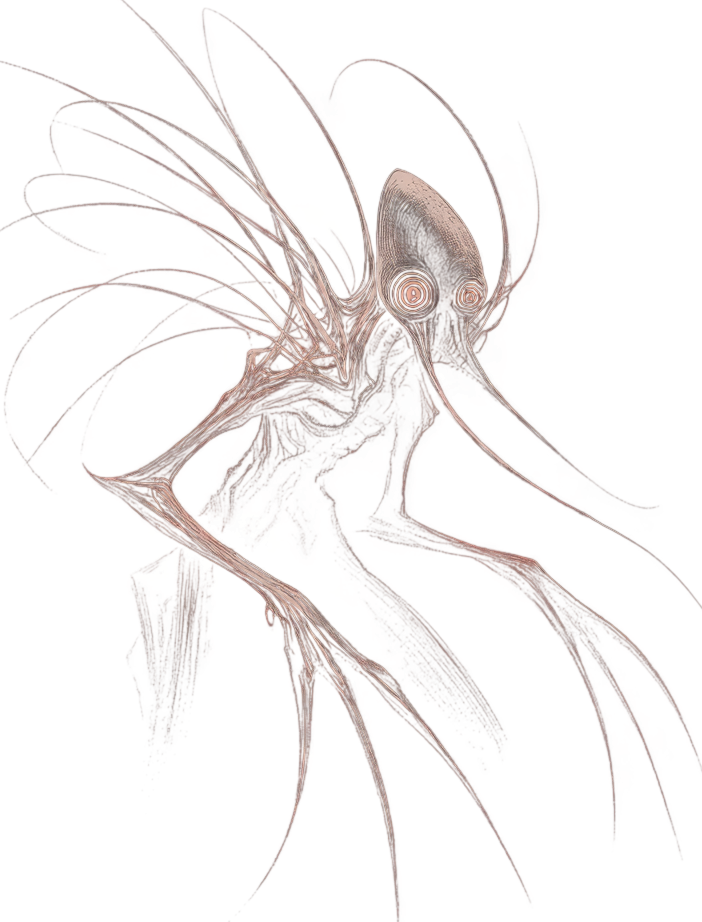
The Creature
In Crux Umbra, some things do not belong to the world, yet remain all the same. The Nightrender is one of them.
It forms where the Veil is torn, where night seeps into places it never meant to reach. What emerges is not shadow, but something that wears it - something that moves as if darkness has taught itself how to hunt.
At a distance, it appears as a shifting mass of black, slick and uneven, dragging itself forward on long, unnatural limbs. From its core, additional limbs unfold without warning - pseudoarms that stretch outward and harden at the moment of impact, forming sharp, pale talons.
Its face offers no comfort of recognition. There is no mouth or breath.
And yet, it screams.
The sound fails to travel through the air though. It settles inside the skull instead, a high, piercing resonance that lingers beyond the moment. Those who endure it remember things they never lived - fragments of nightmares that do not belong to them.
Still, its most striking feature is its eyes. If one can call them that. Two spiraling voids, dim and distant, like stars long dead but not yet gone.
Those who die by a Nightrender are taken into it. Not consumed, but extended. A continuation of the same presence, wearing a different form. It is a process that resembles reproduction, but one that is never fully understood.
The Fight
During the events of this loop, Sean will die regardless of the outcome. What matters is when his death happens.
Once the creature fully manifests, the players have 5 combat rounds to defeat it. During this time the creature actively engages the players. On the same time, Sean is already wounded and deteriorating.
If the players fail (5 rounds pass)
Sean's death follows the same pattern as the others. His body collapses and moments later, his corrupted essence rises. He transforms into an abomination and joins the fight, turning against the players as an extension of the Nightrender. At this point, the encounter escalates significantly.
If the players succeed (Within 5 rounds)
Sean's death is slower. He bleeds out in the players’ presence, aware enough to understand what has happened. His soul remains untouched. Instead of corruption, something else follows. If this happens, read or paraphrase the following:
Sean falls onto his back, one hand pressed against the wound at his neck. Blood slips through his fingers, dark against the dirt. His breathing is uneven; each breath shallower than the last.
He looks up at you.
There is confusion in his eyes. Not fear or panic. Just the quiet effort of trying to understand how you are here.
A faint, tired breath leaves him.
"…we never made it back…” he whispers. His gaze lowers, just for a moment. "... I'm sorry."
The words leave him softly. The tension drains from his body, slowly, until nothing holds it anymore.
For a moment, a deafening silence covers the clearing; the quiet of death that settles.
A faint, silvery mist begins to rise from him. It lifts slowly, uncertain at first, as if testing whether it is allowed to remain. Finally, it gathers into a suggestion of a body. A soft, dim glow, shaped only by memory.
You feel its attention turn toward you. It is aware and very much present.
It does not speak with words, and yet you hear him regardless.
"Thank you." There is a brief pause, "... we should talk."
Sean's Ghost
If the players manage to spare Sean's soul from the corruption of the Nightrender, his ghost remains with the characters. Unlike everything else tied to the site, he does not reset when the bell tolls. His presence persists across the next cycle, and he retains full memory of the events that happened. He understands that something is wrong with time. He also understands that the players are not part of his original moment.
How Sean assists
Sean does not lead the players or provide solutions outright. Instead, he supports them by clarifying information found in his journal, explaining the purpose and use of the medical supplies. He can also help piece together what happened to the team and reinforce connections the players may already suspect. He should feel like a witness and a collaborator, not a source of answers.
What Sean knows
Sean can share the following information, though not all at once. Let it emerge through conversation.
- The team was delayed on their return from the ruins.
- Something followed them from there.
- The Nightrender did not attack directly: it lingered, wore them down, and struck when they were exhausted.
- They believed they had avoided it. They were wrong.
Sean began to realize something was wrong when Alma died. In that moment, he briefly perceived the players. At the time, he could not understand what he was seeing.
On the loops & Marcelus
If the players explain the repeating day, the sound of the bell or the way time resets, Sean connects this to what Marcelus told him before the team leave: if the team delayed too long, he might be forced to attempt something drastic, something to buy them time.
Sean is fully aware that Marcelus is a mage, but does not know the details of the ritual. He also knows the mage is using the little bell around his neck as a focus for his magic.
He does not accuse Marcelus of anything, but he does not dismiss the possibility that he had done something that went terribly wrong.
Role in the Final Run
Sean can assist the players in two critical ways:
- The Cure: He understands the medical supplies and can guide the players in assembling a treatment for the illness.
- Marcelus: His presence serves as proof and may influence Marcelus’ decisions, helping the players convince him to act.
Once again, as time runs its course, the sound returns. They awaken in Hollow Creek and the day begins once more. If Sean was spared from corruption, his presence remains with them. A quiet, impossible truth carried into a world that should not remember. The cycle continues.
And the final loop is about to begin.
Ticking Clock
This is the final loop and the last opportunity the characters have to act before the ritual collapses entirely.
When the characters return to the site, they find it changed once more. This time is not broken or frozen, though. It is finally released. The fracture in time has given way completely.
The moment has ended and time is moving forward.
The State of the Site
There are no longer any loop-based phenomena here. The Nightrender is gone and what remains is the world as it truly is. However, this does not mean the site is safe.
With the fracture gone, the clearing is now exposed to the wider dangers of the world. Creatures may roam freely. If you wish, you may introduce a random encounter here to reinforce that the world exists beyond this adventure. This should not overshadow the objective, but it should remind the players that danger was never confined to the loop alone.
The Objective
The purpose of this loop in the site is to recover the materials needed to prepare the cure. The characters may do this in two ways:
- With Sean’s Guidance: If Sean remains with them as a ghost, he can direct the process clearly and efficiently, ensuring they gather what is needed without delay. He insist however, that they need to prepare the cure back in Hollow Creek to avoid the dangers of the open field.
- Without Sean: If Sean is not present, the players must rely on the three handouts. This takes time, interpretation, and may introduce uncertainty or mistakes depending on your system.
Time is no longer repeating and the players now move toward a single outcome. Every moment spent here is time not spent saving Hollow Creek. Once the players have gathered what they need and prepared to return, proceed to The Final Run.
A Fractured Moment
The supply team was on its way back to the settlement - delayed by events unrelated to this adventure - when Marcelus performed the ritual that trapped Hollow Creek in a repeating day. Their camp, and everything within it, was partially caught in the ritual’s radius.
Magic, however, is unpredictable and when it fails, it does so spectacularly.
Instead of resetting, the team is caught in a single ongoing instant: the moment in which the team was attacked.
The moment is brief, but it remains unfinished. And now, it is stretched thin across the loops. What the characters witness is neither memory, nor aftermath, but that same instant progressing by degrees. Seconds drawn out across entire days.
In the first loop, the camp appears as it was just before the interruption. In later loops, fragments of the team surface within that same moment, each cycle revealing more of what is already in motion.
The entity that struck them is bound within it as well. At first, it is absent. Then suggested. Then present. By later loops, the moment aligns long enough for it to take form.
The site exists within the same timeline as Hollow Creek, but it does not follow the same rules.
This table will guide you on how this scene develops across each cycle.
Sean's Journal
The characters can recover three handouts from the camp at seperate loops. Each represents a page from Sean Halvek’s journal, written during the team’s return journey. These notes concern his attempts to cure the Grey Lung.
Sean’s writing is practical, and often incomplete. He writes for himself, not for others. Ingredients are referenced through initials, steps are abbreviated, and conclusions are left implied rather than explained. Individually, each page is difficult to interpret. Together, they form a complete process.
If the characters possess all three handouts, they can reconstruct the treatment by identifying the ingredients through Sean’s shorthand, matching them to the supplies found at the camp and following the correct order of preparation. This requires careful observation and interpretation rather than guesswork.
If Sean’s ghost is present, he can clarify the meaning of his notes and guide the players through the process, removing the need to decode them. Without his assistance, the characters must rely entirely on the journal and the materials available to them. Incorrect preparation results in a useless mixture, wasting both time and materials.
The Supplies
At the camp, the characters find salvaged medical supplies gathered from the ruins. Many are labeled, though some are worn or partially damaged. The materials are loosely grouped, and several can be tied to the initials used in Sean’s notes.
Medical Supplies
- Amoxicilin
- Ampicillin
- Ciprofloxacin
- Copper solution
- Ibuprofen
- Isopropyl Binder
- Saline solution (GM info: liquid)
- Salbutamol (GM info: inhaler or aerosol canister)
Additional Supplies
- Containers with distilled water
- Heating and medical tools (worn but usable)
- Synthetic stabilizer gel (labeled, appears viable)
- Various herbal extracts (improvised remedies)
Sean's Formula
Sean’s notes contain enough information to reconstruct the cure, if they are interpreted correctly. The solution is not immediately obvious, but the journal provides a clear path through elimination and observation. From the notes and the available supplies, the following conclusions can be drawn:
- Am. and Ib. are not used. Sean explicitly rules them out during his tests.
- From Cp., the correct component is identified as “Cu”, the chemical symbol for copper. This points to the copper solution.
- From Sl., Sean specifies that it must be in liquid form and reacts under low heat. Of the available options, only the saline solution fits this requirement.
- H2O refers to water. The note refers to it as "clean" which should be an indicator to use the distilled water found among the supplies.
The final ingredient is the stabilizer and according to Sean's notes the most reliable is bone marrow. This is not included among the supplies. The characters must extract it themselves from a fresh body (animal or otherwise). Alternatives exist among the supplies, but they are less effective - as is indicated by Sean's notes.
Preparation
Once the correct materials are identified, the mixture must be prepared carefully. The ratio is 3 parts Cp., 1 part Sl., 2 parts water. The solution must be heated gently and never allowed to boil. Once heated, the stabilizer is added last. Failure to follow this process results in an unstable or ineffective mixture.
Handout #1
Test Subject: Bran. Fever rising faster than expected. Not purely respiratory.
Tried several combinations of: Am., Cp., Ib., Sl.
all dissolved (unstable)
repeated with heat (worse)
Missing the right combination.
will need some kind of stabilizer?
Handout #2
Removed Am.: no effect
Removed Ib.: no use
Cp. (Cu) - holds longer, Sl.-liquid (reacts better under low heat)
combining the two with H2O (clean) in ratio 2:1:1
heat must stay low (<boil)
still missing stabilizer (plant-based promising?, synthetic unstable)
Handout #3
I have it. No time to test further.
Ratio was wrong.
3:1:2
Best stabilizer I found: bone marrow fresh
Add only after mixture has heat up (~200gr per dose)
Can't prepare it here. Alma says it followed us back. We need to hurry.
The Final Run
This phase represents the end game. While it is possible for the players to attempt to confront Marcelus in earlier loops, meaningful action is unlikely before Loop 3, when Alma reveals his nature. The most complete version of this sequence occurs after Loop 4, once the situation with Sean has been resolved.
This sequence has four possible paths, depending on the players’ actions. In any scenario, the objective remains the same: prepare the cure, distribute it and disrupt the source of the ritual, all before the bell tolls.
By now, the characters have lived through the same day multiple times. While the settlement keeps following its routines, the GM should subtly introduce inconsistencies at every next loop. These represent the slow decay of the ritual. They could take forms like:
- Residents repeating the same action twice within moments
- Delayed reactions in conversation
- Brief lapses where sound or movement desynchronizes
- Objects slightly out of place, then correcting themselves
The Grey Lung Cure
Preparation & Doses
Once the correct formula is identified, the players can prepare the cure during the Final Run. Each preparation attempt produces a limited number of doses depending on correct interpretation of the formula, type of stabilizer used and time available. A full, correctly prepared batch produces 20 doses in approximately 2 hours.
When the ritual breaks, all characters are revealed to be infected carriers of the disease. They immediately begin showing early symptoms, so they must decide if they will allocate doses to themselves or not. If untreated, a character is considered weakened during the final sequence.
- Sean present (ghost): +10 doses/batch
- Wrong ratio: −10 doses/batch
- Regular water instead of distilled: -5 doses/batch
- Bone marrow: full effectiveness **
- Synthetic stabilizer: −10 doses/batch
- Herbal substitute: −5 doses/batch
** The most effective stabilizer is bone marrow which must be fresh. Anything decayed or long dead is unusable. Each batch requires approximately 200g and bone marrow makes up approximately 3–5% of a body’s weight. This translates roughly to:
- Small animal: not enough for a full batch
- Medium animal: enough for 1 batch
- Large animal: enough for 2–3 batches
- Human body: enough for 1–2 batches
Extracting usable marrow takes time and the right tools (which are present in the supplies Alma's team gathered). However, securing enough for even a single batch may cost precious time. The camp does not contain usable marrow. Players must hunt, scavenge a fresh corpse or make a difficult moral choice. If they cannot secure enough, they must rely on the synthetic stabilizer or the herbal substitutes that exist in the supplies. Both these options reduces the doses produced.
Distribution
Hollow Creek holds approximately 200 people. By the Final Run, around 150 are infected, while roughly 50 have already reached the late stages of the Grey Lung and cannot be saved under any circumstances.
The players will not have the time or control to personally administer every dose. Panic spreads, the settlement fractures, and events move faster than they can manage. The number of doses the players prepare determines the overall scale of the outcome, not a one-to-one count of individuals saved.
Do not resolve distribution as a count alone. Play it in moments. Each dose given is a decision that happens in front of them. Someone will always be closer, more sick, more important or more familiar than the last. And someone else will arrive too late.
As a rule of thumb, whenever the players pause to make a decision introduce a sequence where someone nearby cries for help, someone collapsing, but can still be saved if the players choose it or someone dying nearby. Try to make hesitation costly and visible.
Use the total number of available doses to determine the result from the "Cure Distribution" tables.
If the players use doses on themselves, reduce the total "effective doses" before consulting the table. Who they choose to prioritize still matters. The players may ensure certain individuals survive, even if the broader outcome remains unchanged.
Not everyone can be reached in time.
Path I - The Anchor
This path assumes the characters have saved Sean’s soul in Loop 4 and his ghost accompanies them. When the characters approach Marcelus with Sean present, read or paraphrase the following:
Marcelus stands where you left him, as if nothing has changed. He looks up as you approach, ready to speak, and then he pauses before any words are formed.
You see his tired eyes settle, not on you, but just beyond. His breath catches, faint but unmistakable.
For a moment, he does not move at all.
“…Sean?”
The name leaves him with a quiet gasp. It is not a question. It is laced with fear and sorrow. Something in his posture falters, just enough to reveal the weight beneath it.
When he looks back at you, his behavior is different.
He is no longer dismissing you.
He is finally ready to listen.
GM Guidance
Sean’s presence is the strongest proof the players can offer. Marcelus does not need to be convinced - he needs only a moment to understand what he is seeing.
He recalls, not perfectly but enough, the conversation he had before the supply team left. He had prepared himself for the possibility that they might not return in time. What the players and Sean reveal brings that fear into focus. The ritual did not give them more time. Instead, it fractured what little they had, and it is now failing.
Play this moment with restraint. Marcelus is not dramatic. He does not break down. He processes, accepts, and moves forward.
Marcelus' decision & Player Agency
After a brief exchange, Marcelus reaches his conclusion. He understands that the delay he created has already accumulated consequences, and that whatever remains must be handled carefully. He turns to the players; urgency in his voice:
“Then there is no time left to argue.”
“Prepare what you have found. Finish the cure and share it as fast as you can.”
His gaze drifts for a moment, as if measuring something unseen. "…I need to...”
He pauses for a moment and then adds with determination, "I will help the ritual die. My way.”
If the players press him for more, Marcelus explains only what is necessary: he is the only one capable of unraveling the ritual, and it must be done with care. He does not say that he will not survive, neither waits for their approval.
Marcelus withdraws from the players and isolates himself. What he is about to do is beyond their reach. He becomes the anchor of the collapsing loop, binding himself to the fracture so that time can move forward without tearing the settlement apart. This is not a spell the players can interrupt or assist with. It is the final act of control over something already failing. He knows he will not survive. Do not present this as a sacrifice he debates. It is simply the only option left.
While Marcelus holds the ritual together, the players must act. They must prepare the cure and distribute it throughout Hollow Creek while there is still time. Resources are limited, but this path offers the greatest margin. With Sean’s guidance, the mixture can be prepared correctly and quickly. This is the moment where their earlier choices matter most.
Outcome
This is the most stable resolution of this adventure.
The ritual breaks with intention and the collapse is controlled. The highest number of survivors is saved from both the Grey Lung and the accumulated toll of the loops.
When the ritual ends, Marcelus is gone.
But he is not entirely lost. Something remains within Hollow Creek: a presence tied to what he built, bound to its survival. It does not speak or act openly. But it is there. And it will continue to be, as long as Hollow Creek stands.
The bell does not ring this time.
It exhales. It is a long, hollow breath that seems to pass through stone, through flesh, through the quiet spaces between moments you never lived. In the end, the sound settles, as if something deep beneath the world has finally loosened its grip.
For a time, nothing moves.
Then the air shifts. Subtle. Almost imperceptible. The kind of change you feel before you understand it. The weight in your chest eases. It's not gone, never gone, but no longer tightening with every passing second. The world - your world - which had been holding itself together by force alone, begins to move again.
Around you, Hollow Creek stirs.
A hand twitches against packed earth. A voice rises, sounding uncertain. Someone weeps, not loudly or for anyone in particular, but because they finally can. Others follow, slowly, like figures emerging from deep water, blinking against a light they had forgotten how to face.
Not all of them.
There are spaces where movement never returns. Shapes that remain still, untouched by the fragile mercy that has settled over the rest. Death that had been delayed, finally arrives to claim its due.
Still, your hard work saved enough that the settlement does not fall. The sound of breathing - uneven, fragile, human - fills what had once been silence. And in that sound, something like life begins again.
Marcelus is nowhere to be seen.
The place he once stood remains empty and untouched, as if the world has chosen not to disturb it. And yet… there is something there.
A presence. Faint, but enduring. Like the memory of a hand that has not quite let go.
As Hollow Creek draws its first uncertain breath into a future it was never meant to see, that presence lingers: watching, waiting, bound to the fragile continuation it chose to protect.
Path II - Fractured Trust
This path assumes the characters do not have Sean’s ghost with them and must rely on what they have learned to convince Marcelus that something is wrong. When the characters approach Marcelus without Sean present, read or paraphrase the following:
Marcelus turns as you approach, already speaking before you reach him.
"You’ve returned sooner than expected.” His tone is steady but his words arrive a fraction too late, as if they had to catch up with themselves. He studies you now, more carefully, and his eyes linger longer than they should.
“What happened out there?”
GM Guidance
Marcelus does not dismiss the players outright, but neither does he accept their claims easily. From his perspective, the settlement is intact. The day has not broken. Whatever the characters describe must have an explanation rooted in the road, the ruins, or whatever they encountered beyond Hollow Creek.
He listens, but he questions. Every statement is met with hesitation. He is trying to understand, not resisting out of pride.
This should not be resolved with a single argument. Let the players build their case through:
- The inconsistencies they have observed in the settlement
- The behavior of the camp and the fractured moment
- The nature of the Nightrender
- Sean’s notes and the cure they are preparing
If they push too aggressively, Marcelus may begin to doubt them. If they speak with clarity and urgency, he begins to doubt himself.
Marcelus’ Decision & Player Agency
If the players succeed, Marcelus does not reach certainty. He understands enough to recognize that time is being manipulated - and that he is probably the one responsible - but not enough to safely correct it. That uncertainty defines what follows.
He grows still as you speak, his gaze drifting - not away from you, but into his own thoughts, as if measuring something he cannot see directly. “If all these are true…” he says quietly, the thought left unfinished. His hand rises slowly to the chain at his neck, fingers resting against the small, rusted bell, "…then I have already gone too far.”
He looks back at you, and there is something different now. He is terrified. “Prepare what you can,” he says. “Whatever you have found, use it. Do not wait." His voice steadies, but only just. "I will end this before it tears any further.”
If pressed, he explains only what matters: if this is indeed the result of a ritual, it is no longer stable, and it cannot be carefully unraveled without full understanding. Acting slowly risks losing everything.
In this case, Marcelus does not attempt to anchor the ritual. He can't, because not even he understands what he did. Instead, he chooses to sever any control he might have over it entirely. The small bell is an object he carries since before the Cataclysm, and it is the focus of his magic. Destroying it collapses the structure of the ritual immediately. He can only give the players a few hours to prepare before he procceeds with his solution.
This is not a controlled unraveling. It is a forced end to something powerful that is already failing. From the moment the bell is destroyed, the situation accelerates. The players must complete the preparation of the cure quickly, distribute it under increasing pressure and decide who receives it and in what order.
Outcome
The ritual breaks abruptly. Time resumes unevenly, and the weight of the repeated days crashes forward all at once. The cure works where it is given. But the window is smaller. More are lost to the Grey Lung - perhaps even some of the characters, depending on their choices.
Once the bell is destroyed, read or paraphrase the following:
In this scenario, Marcelus survives, but he never returns to the determined person the characters knew. In the days that follow, he withdraws from the role he once held and does not touch his magic again. Whatever trust he had in his control over such forces has been lost with the bell.
He remains in Hollow Creek, not as its leader, but as a broken man. A presence at the edge of things. Someone who understands, now, what it means to reach beyond what should be touched. The guilt of what happened because he overeached, haunts him until his final days.
The bell cracks. A sharp, splintering sound that cuts through the air and seems to fracture something deeper than metal. For a single moment, the world holds its shape around it: strained and trembling of what will follow.
Time stumbles forward, dragging everything with it in a maelstorm of supressed consequences.
Voices overlap, words colliding before they can form. A cry begins and ends in the same breath. Movement follows, but without rhythm, hands reaching for things that are no longer there, bodies collapsing under a weight they cannot name. You feel it in your bones. Days that never belonged to you forcing themselves into a single instant. Fatigue without memory. Pain without cause. The quiet certainty that something has been taken and cannot be returned.
The cure works.
You see it in the way breath steadies in some, in the way the shaking stops, in the way a body that had begun to fail refuses to do so.
But it cannot reach everyone. Some fall before they understand what is happening. Others look to you - eyes wide, searching - not for answers, but for time that is no longer there to give.
Hollow Creek does not collapse. But it does not remain as it was, either. It fractures along invisible lines. Order is replaced by something held together only by necessity.
Marcelus stands at the entrance of his home. His eyes are fixed on the broken fragments of the bell that rest in his hands. His fingers are still curled as if they are afraid to let go of what they have already released. He does not look at you immediately and when he does, it is brief. There is no accusation there. Only the hollow understanding of a man who has seen the shape of his own mistake and found it larger than anything he can repair.
He turns away.
And does not step forward again.
Part III - A Violent Resolution
This path assumes the characters don't have Sean's ghost with them and they also fail to convince Marcelus. When the confrontation turns against Marcelus, read or paraphrase the following:
Marcelus does not step back when your tone shifts. If anything, he steadies himself.
“No,” he says, before any of you fully commit to the threat. His voice is calm. “Whatever you think is happening, it is not this.”
His gaze moves across you, measuring, not your words, but your intent.
“You went too far out there. The ruins… the air…” He exhales slowly. “Something followed you back. Maybe even the thing you described.”
A pause. His eyes soften for just a moment, something fragile breaking through the surface. “These creatures don’t just kill. They confuse. They make you doubt what is real.”
His jaw tightens as he continues, “I am sorry.”
The words are quiet. Meant.
“But I will not let you endanger this settlement over something that isn’t there.”
GM Guidance
Marcelus stands his ground. He does not see himself as a villain. From his perspective, the players are compromised; by fear, by exposure, by whatever followed them from the ruins.
He believes he is protecting Hollow Creek and that belief is unshakable.
This is not an enemy refusing to listen.
This is a man holding the last thing he has together in a world that does not forgive failure.
The Confrontation
This should not feel like standard combat. Marcelus is a Continuum mage. Even strained, he operates on a level the players have not yet faced. Represent this through instability in time:
- Actions resolving a moment too early or too late
- Movements repeating or skipping forward
- Attacks that seem to “land” before they are completed
- Brief distortions in space, as if distance cannot decide what it is
At first, he is trying to stop them or contain them. But the moment blood is drawn, that restraint breaks.
Outcome
If the players kill Marcelus, the ritual collapses instantly. There is no transition. No control and almost no time left. In the chaos that follows, the characters merely have a couple of hours to prepare and distribute the cure. Beyond that, the collapse overtakes the settlement with brutal speed.
They are forced to choose whether they'll save themselves, or someone else.
In any case, most of Hollow Creek will not survive.
When Marcelus falls, read or paraphrase the following:
There is no moment to mark the end. No breath between what was and what comes after.
When Marcelus falls, the world does not pause to acknowledge it.
It simply breaks.
Time surges forward without direction or restraint, tearing through the fragile shape it had been forced to hold. Moments overlap, slip past one another, collapse into fragments that no longer follow any order that can be understood. A step is taken - then taken again - and fails to ever be completed. A voice rises in warning, in pain, in confusion, each layered atop the other until none of them remain distinct. The ground feels unsteady, not because it moves, but because it no longer agrees with itself.
People fall around you.
Some without sound, as if whatever held them upright simply chose to stop. Others scream, but even that is uncertain; cut short, repeated, swallowed by the collapse around them. There is no time to understand.
Only to act.
The cure is no longer a solution. It is a handful of moments stolen from something already lost. Each dose given is a choice made against the weight of everything that cannot be saved. You move because you must. Because stopping means surrendering what little remains. When it is over, the silence that follows is not the absence of sorrow, but the absence of continuity. Hollow Creek does not stand as it once did. It exists in pieces: scattered, broken, held together only by the few hands that remain within it.
There are survivors.
There are always survivors.
But what they inhabit is no longer a settlement. And whatever future might grow from it will do so from ruin, not recovery.
Path IV - The Fifth Toll
This path occurs if the players reach the fifth loop and fail to break the ritual before the bell tolls again.
At this point, the ritual is no longer sustaining the loop. It has been stretched beyond its limits, forced to hold more than it was ever meant to contain. With its collapse, something else begins to surface. The Grey Lung is no longer just an illness. What it carried - what it has always carried - no longer remains contained.
There is no Final Run.
Do not run this as a scene to resolve. Let things happen without completing. Let attempts matter, without allowing them to finish. Allow the players a few moments to act within the collapse, then let the pattern settle.
Nothing they do can prevent what follows.
At best, they may witness it.
At worst, they are consumed by it.
Once the bell tolls for the fifth time, read or paraphrase the following:
The sound of the bell does not move through the air. It inhabits it, as if it has always been there, waiting to be noticed. Each toll does not follow the last. It exists with it. All at once.
A man coughs beside you. Blood gathers at his lips, then is gone, then there again, never deciding which moment it belongs to. His body bends with the motion, straightens, bends again; each version incomplete, each one remaining.
Around you, others follow.
Breath becomes a pattern.
A shared rhythm, uneven but persistent, as if something is learning the shape of it and trying to keep it.
Ash spills from open mouths.
It lingers in the air, drifting where there is no current, settling against skin without weight. It gathers in the corners of your sight, then closer, then closer still, until it is no longer something you look at, but something you are within.
You take a step.
It happens. Then happens again. Then stops mid-motion, never quite becoming something you have finished doing.
Someone calls out.
Their voice reaches you before they speak. It is yours. Then again, after. Then not at all.
You feel the ripples of the bell. Not as sound, but as a presence resting behind your ribs. A slow, impossible pulse, shared by a thousand failing hearts. It lives in the space where moments are meant to pass. It presses there, gently, insistently, until nothing moves without touching it.
The coughing continues. Steady now. Unbroken. A rhythm that does not change. A vast pulse, too consistent to be dying. A presence in the pattern that refuses to release what it has gathered.
The ash shifts. It gathers where your attention fails, settles where nothing should remain, filling the space between things until there is no longer a space that is empty.
You reach again. Your hand meets something.
Then nothing.
They are all there. And then they are not. No moment separates the two.
The world closes. Not around you. With you.
The settlement, the people, the breath within them, all of it held in the same unfinished moment, stretched without end. The ash drifts through it all, suspended. Each grain separate. Each one fixed exactly where it is, as if nothing will ever disturb it again.
There is no ground beneath you.
No sky above.
No distance to measure.
Only that same unmoving dark, enclosing without boundary, holding without weight.
You remain within it.
Both unmoving and drifting.
Unending, without ever having begun.
You remain - held in place - as everything is.
Another trace caught in the grey where nothing passes, and nothing is allowed to be gone.
Aftermath
Hollow Creek does not return to what it was.
Even in its best outcome, something has shifted. The air feels quieter than it should. Conversations pause just a moment too long. Some residents avoid the sound of bells entirely, while others listen for them without realizing it.
Those who survived remember the illness. Few remember its full shape. Fewer still speak of it clearly. What happened exists at the edge of recollection, like a dream that resists being held.
If Marcelus is gone, his absence settles into the settlement like something unfinished. If he remains, he does not lead as he once did.
And beneath all of it - quiet, constant, unspoken - there is a sense that something passed through Hollow Creek…






Gods I still love this
So glad to know! Thank you ^^
Summer Camp is here and so is My pledge! <3
Visit my world of Kena'an for tales of fantasy and magic! Or, if you fancy something darker, Crux Umbra awaits.