

Threadwarding
At the south-eastern edge of the Center Reach is the border region known as the Viralande Wetlands. This isolated area is of little interest to anyone except apothecaries, amphibian enthusiasts, and folklorists, for the three villages and the surrounding farms that comprise the Viralandes have some very unique folk customs. The practice of Threadwarding is one of its most notable.
Threadwarding is an embroidered sigil language for stitching blessings and prayers inside the hems of clothing. Various symbols are added or combined together to create meaning. Each blessing is separated from the next by a decorative border. Traditionally, one does not stitch blessings for oneself, but this is not always followed. It is primarily used with children's clothes. Prayers for safe return and protection against harm are standard.
The vocabulary for this thread language draws heavily from folk religion and older myths. Various primal deities and the forces they represent can be invoked, pleaded with, or warded against. Its structure is primarily spatial, with meaning derived from the placement of sigils in relation to one another. Some areas even use color to further refine meaning or denote emphasis.
Threadwarding is not taught through any sort of formal instruction, but rather through observation of parents and others stitching similar blessings. There are many beliefs and superstitions surrounding these symbols. For instance, second hand clothing must have the blessings picked out, and new ones sewn in place. Another belief is that no article of clothing should have more than three blessings stitched inside, lest one tempt fate. Customs and styles vary from town to town and even household to household, but blessings are still mutually intelligible in form.
Threadwarding is an embroidered sigil language for stitching blessings and prayers inside the hems of clothing. Various symbols are added or combined together to create meaning. Each blessing is separated from the next by a decorative border. Traditionally, one does not stitch blessings for oneself, but this is not always followed. It is primarily used with children's clothes. Prayers for safe return and protection against harm are standard.
The vocabulary for this thread language draws heavily from folk religion and older myths. Various primal deities and the forces they represent can be invoked, pleaded with, or warded against. Its structure is primarily spatial, with meaning derived from the placement of sigils in relation to one another. Some areas even use color to further refine meaning or denote emphasis.
Threadwarding is not taught through any sort of formal instruction, but rather through observation of parents and others stitching similar blessings. There are many beliefs and superstitions surrounding these symbols. For instance, second hand clothing must have the blessings picked out, and new ones sewn in place. Another belief is that no article of clothing should have more than three blessings stitched inside, lest one tempt fate. Customs and styles vary from town to town and even household to household, but blessings are still mutually intelligible in form.
Syntax
The structure of Threadwarding is understood spatially rather than verbally. Meaning is constructed through careful placement in a cross-like pattern. The center sigil or sigils indicate the target of the blessing, commonly a single circle to indicate the wearer. Symbols above that center indicate the outcome desired, while the symbols below are for the deity invoked to grant the blessing. The left and right symbols show transition from one thing to another, for instance a flame on the left to water on the right, indicating safety from burns.
There are a few other modifications to meaning within the lexicon. A bar stitched across a sigil will negate it. Two or more symbols can touch or entwine to allow greater combinations of meaning, for example a sickle and three wavy lines combined could indicate an ending to grief. A doubled line for a sigil design is often used to indicate the referenced deity, themselves, and not the abstract concept.
There are a few other modifications to meaning within the lexicon. A bar stitched across a sigil will negate it. Two or more symbols can touch or entwine to allow greater combinations of meaning, for example a sickle and three wavy lines combined could indicate an ending to grief. A doubled line for a sigil design is often used to indicate the referenced deity, themselves, and not the abstract concept.
Vocabulary
- Simple Circle - the wearer, the one being blessed
- Peaked Roof - home, dwelling, family
- Hand - work, craft, trade
- Single Knot - promise, oath, tie
- Sheaf of Wheat - food, prosperity, harvest
- Frog - rain, change, good fortune
- Two Horizontal Lines - road, journey, movement
- Leaf - growth, youth
- Shield - protection
- Left Half Circle - the god Maion, light, good, creation
- Right Half Circle Voided - Zolgar , darkness, evil, destruction
- Two Halves Combined and Encircled - the primal force Vaelin, balance, equality
- Flower - the Goddess Briallen, spring, beginnings, blossoming
- Sun - the God Velior, summer, bounty
- Sickle - the God Messandor, fall, endings
- Bare Tree - the Goddess Friselle, winter, scarcity
- Rising Sun - the God Auralen, sun, day, bright
- Crescent Moon - the Goddess Elarin, moon, change
- Star - the God Astrevin, stars, night, dark
- Two Equal Lines with Dots - the Gods Thirien & Zharien, dusk, dawn, trickery, transitions
- Stylized Flame - the God Cindrel, fire, burns, anger
- Three Wavy Lines - the Goddess Marisel, water, drowning, grief
- Sword - the God Isadrel, truth, clarity
Common Phrases
by Nightflyer0ne via ChatGPT
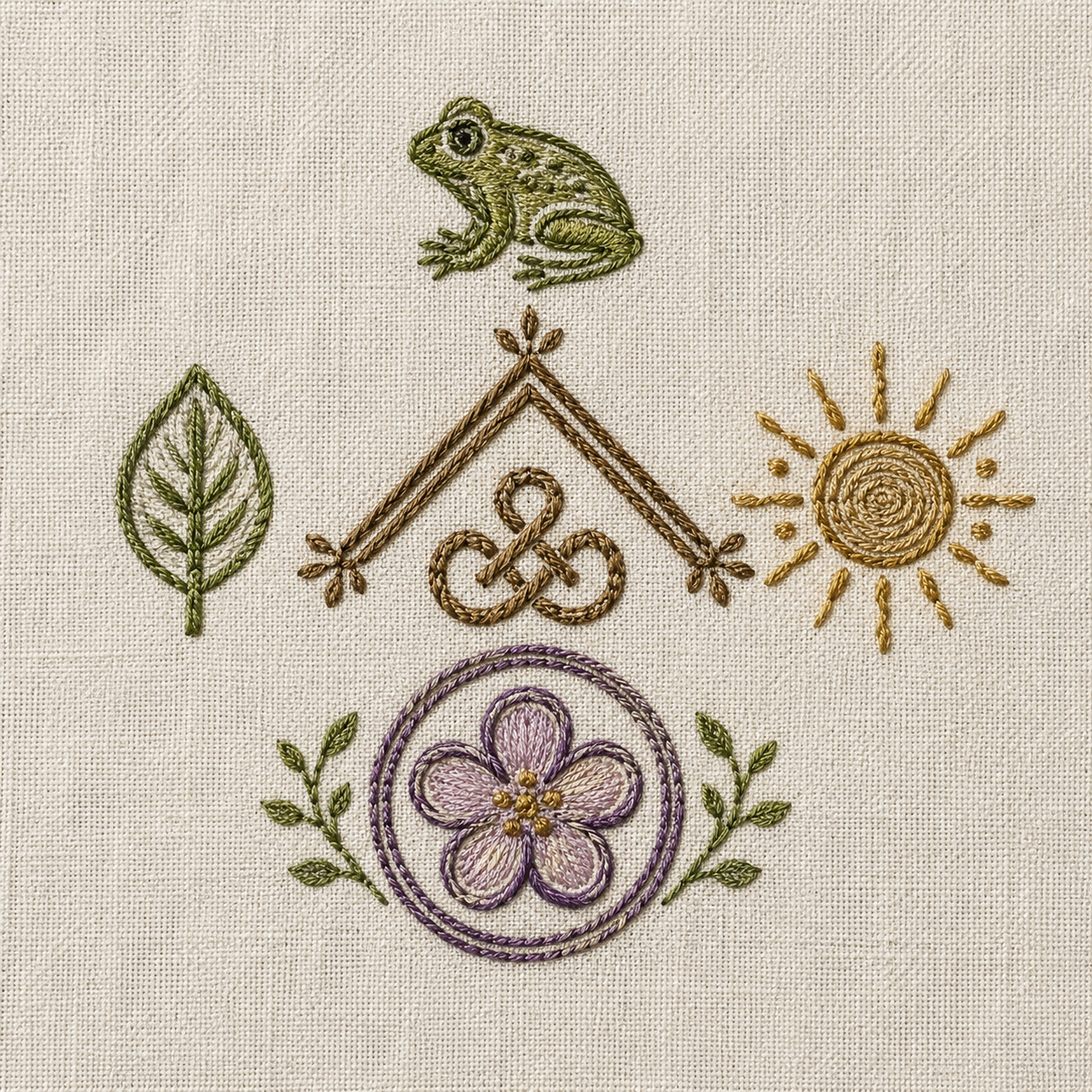
A variation on a common marriage blessing, good fortune on the marriage (family, tie) from sprouting to fullness, under blessing from the Goddess Briallen
by Nightflyer0ne via ChatGPT
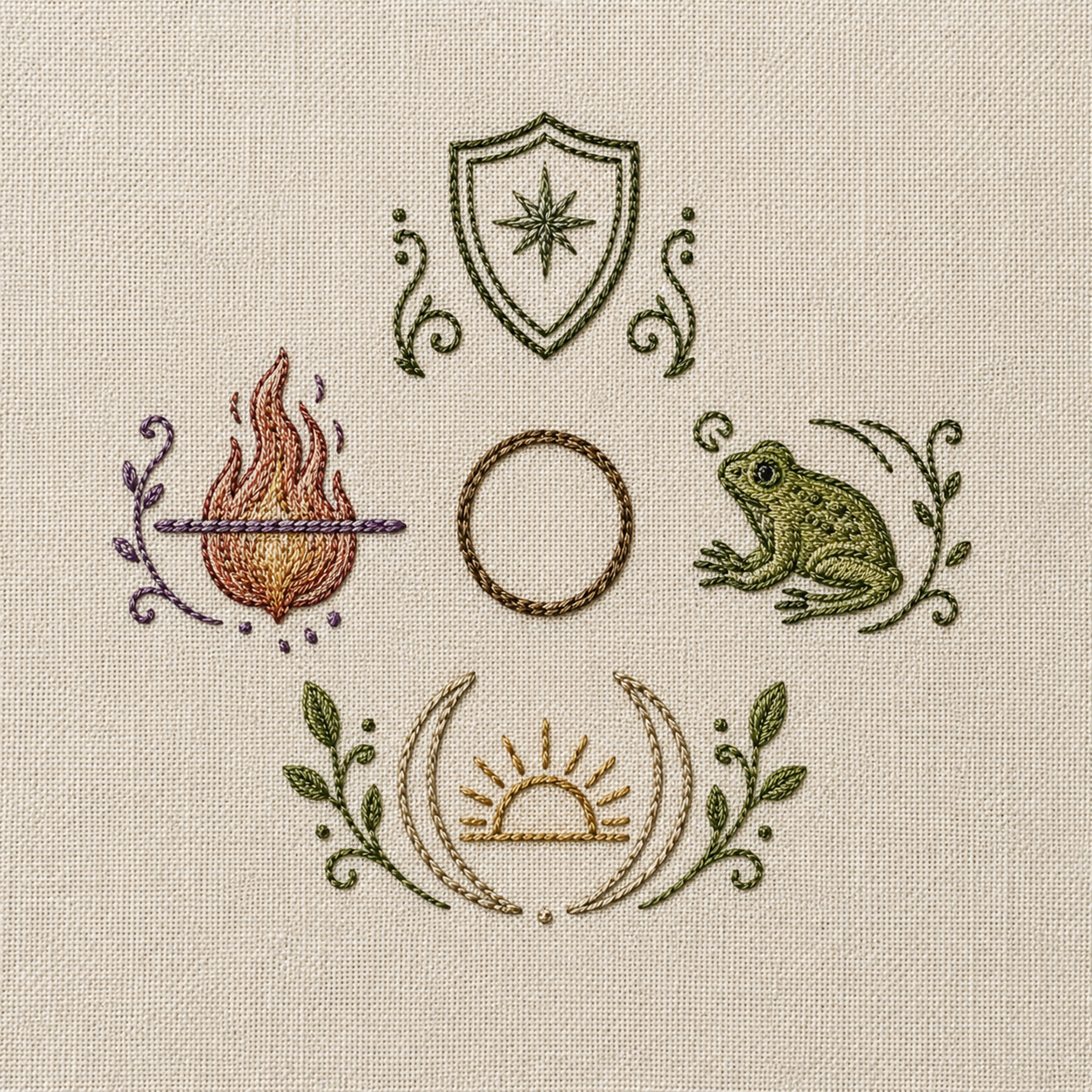
A typical blessing for a child's garment, wishing protection and good fortune against fire.
Okay I love this take on this prompt, this is fantastic. Any sort of art turned into a language of sorts just scratches some primal spot in my brain and always puts a smile on my face. This is wonderful article, I greatly enjoyed reading about it. I find the superstition about the number of blessings on any one garment interesting cause such superstitions usually have an interesting origin. Well written :)