

Mara
Some of the most beautiful textiles come from outside of Tabeshi. Along the channels and waterways that crisscross the Teshuran Delta grows an unassuming reed known as Kalamba. It is the source of the elegant fabric known as Mara.
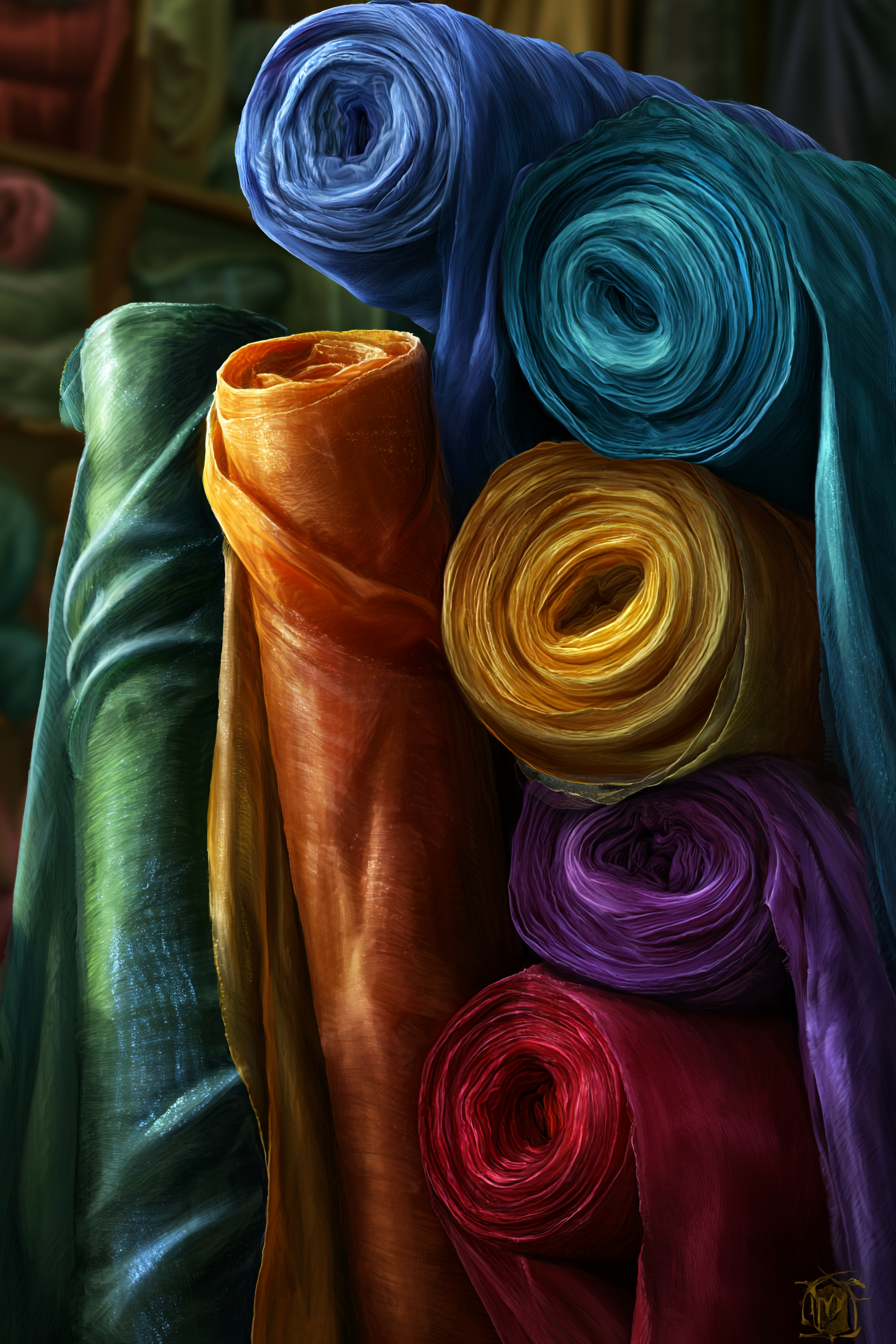
Breathable and cool, Mara falls with a soft and structured drape to it. The texture is not shiny, but rather it glows with an inner luster. The difficult to produce fabric is easy to dye, and is prized for the deep jewel tones it produces.
Kalamba is used in all degrees of textile, from the rough and rugged to the sublime, but it is only the finest heart-strings of the plant, the long Sava fibers, that can be used to make Mara.
Kalamba is harvested during a small window after the autumn floods, when the soil is rich in nutrients. The trick is to harvest the plants at peak maturity. Too young, and the fibers will be too weak and break. Too old, and the fibers become tough and coarse.
The tough green stalks are then sold to the Sava Workers' Guild to begin the long process of extracting the Sava fibers. Bundles of stalks are placed in special retting pools, shallow basins with a slow moving current through them. This keeps the water from stagnating as the fibers are broken down. It takes years of experience to know when the reeds have soaked enough but not too much.
The workers then use special Kalamba breakers to separate the fibers from the woody stems. These are grooved holders that secure the reed, and a hinged wooden wedge that comes down to break the outer shell. Each reed is rotated and cracked several times to loosen the outside.
Next, the reeds are combed across a grooved board to separate out the Sava fibers from the rest of the material. The excess goes on to be used in baskets, sacks, and rope fibers, but the longest and smoothest of the fine inner strands are sent to the Mara Weavers' Guild to be spun into Mara thread and then woven into cloth.
The finished bolts of creamy, lustrous fabric are then distributed to dyers and merchants alike to be exported across the land. Almost one in three people in the Kalunde region has a hand in producing this magnificent cloth. There has been many an attempt to produce Mara elsewhere, but without the guilds' secrets, such endeavors are doomed to failure.
Breathable and cool, Mara falls with a soft and structured drape to it. The texture is not shiny, but rather it glows with an inner luster. The difficult to produce fabric is easy to dye, and is prized for the deep jewel tones it produces.
Kalamba is used in all degrees of textile, from the rough and rugged to the sublime, but it is only the finest heart-strings of the plant, the long Sava fibers, that can be used to make Mara.
Kalamba is harvested during a small window after the autumn floods, when the soil is rich in nutrients. The trick is to harvest the plants at peak maturity. Too young, and the fibers will be too weak and break. Too old, and the fibers become tough and coarse.
The tough green stalks are then sold to the Sava Workers' Guild to begin the long process of extracting the Sava fibers. Bundles of stalks are placed in special retting pools, shallow basins with a slow moving current through them. This keeps the water from stagnating as the fibers are broken down. It takes years of experience to know when the reeds have soaked enough but not too much.
The workers then use special Kalamba breakers to separate the fibers from the woody stems. These are grooved holders that secure the reed, and a hinged wooden wedge that comes down to break the outer shell. Each reed is rotated and cracked several times to loosen the outside.
Next, the reeds are combed across a grooved board to separate out the Sava fibers from the rest of the material. The excess goes on to be used in baskets, sacks, and rope fibers, but the longest and smoothest of the fine inner strands are sent to the Mara Weavers' Guild to be spun into Mara thread and then woven into cloth.
The finished bolts of creamy, lustrous fabric are then distributed to dyers and merchants alike to be exported across the land. Almost one in three people in the Kalunde region has a hand in producing this magnificent cloth. There has been many an attempt to produce Mara elsewhere, but without the guilds' secrets, such endeavors are doomed to failure.
Type
Organic
Value
5 gold per yard, undyed
Rarity
Rare
Color
Creamy white
Related Locations
Not surprised that the guild guards its secrets on how to create the fabric. Best to have a monopoly. :D
Explore Etrea | Summer Camp 2026