

Rhythm Ooze
Rhythm Oozes are considered the most fundamental and widespread of all ooze species. Their bodies are simple in structure but uniquely adapted for sound-based communication and perception, setting them apart from other common oozes. They can generate, read, and react to sound waves with surprising accuracy, though their magical abilities remain basic and they are relatively easy to defeat individually.
What makes Rhythm Oozes truly dangerous is their pack behavior. They rarely travel alone and will swarm perceived threats with coordinated movement and shared rhythmic signals.
Despite this, many people appreciate the strange, musical vibrations these creatures produce sometimes soothing, sometimes irritating. But one rule always applies:
If you hear the sound of a single Rhythm Ooze, there are always more nearby. Listen carefully.
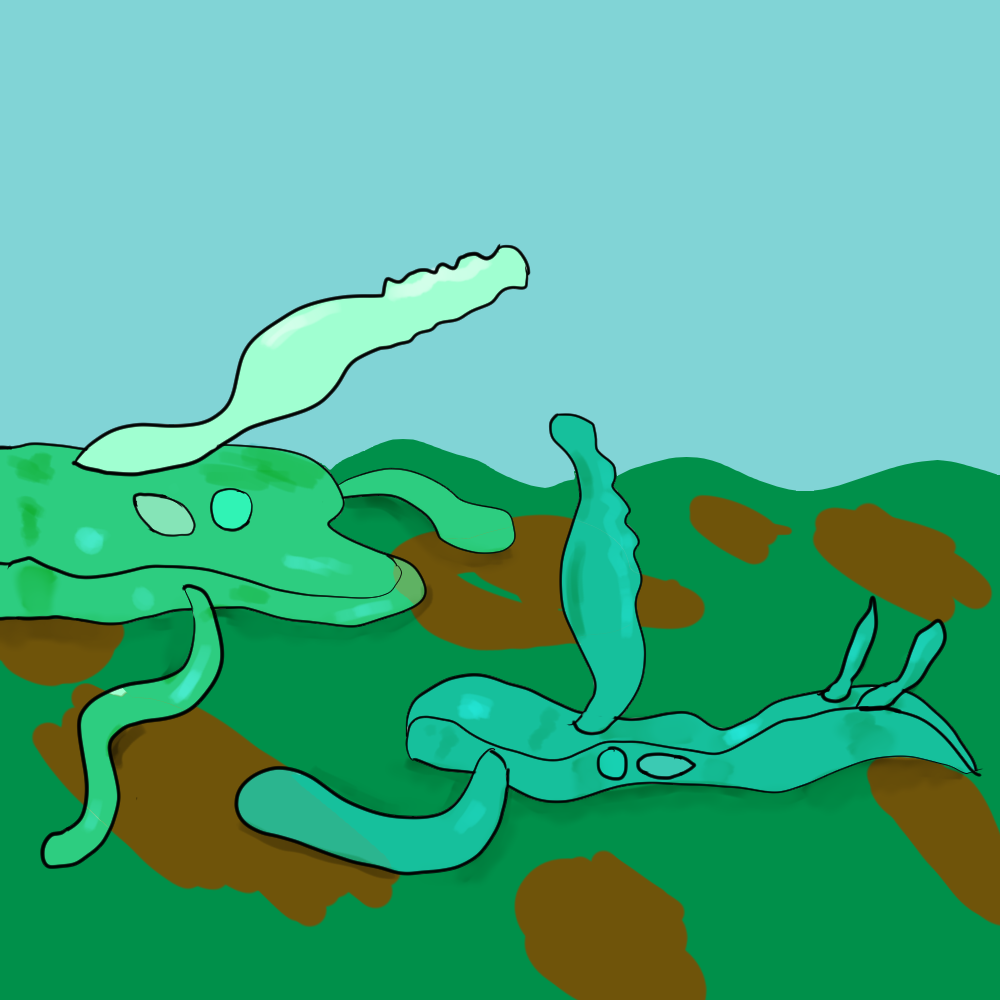
by Valcin (Marc Zipper)
Basic Information
Anatomy
The bodies of Rhythm Oozes are gelatinous, maintaining a roughly linear shape despite their fluid nature. Several tentacles sprout from various points along their form, and these appendages can shift position freely as they move. While a Rhythm Ooze can alter the size and length of its tentacles, the main structure of its body cannot change shape.
Within their semi-transparent bodies flows a self-generated internal fluid. Suspended inside this fluid are two critical components: a manacore, which fuels their movement and magical functions, and a soft skull-like structure that houses a brain-like organ.
Biological Traits
- Immunity to Temperature Rhythm Oozes show no reaction to cold or heat, whether from natural environments or magical sources.
- Immunity to Toxins and Poisons Any toxin or poison is effectively useless against them—their bodies simply absorb and neutralize it.
- Adhesive Movement Their semi-gelatinous bodies can naturally cling to almost any surface, giving them the ability to move along walls, ceilings, and steep terrain with ease.
- Tentacle Adaptability They can change the size and shape of their tentacles, though not the number. The number of tentacles increases as they age and consume more material—most juveniles begin with just two.
- Sticky Liquid They expel a thick, adhesive fluid capable of trapping anything caught in it. This spell produces a remarkably strong binding substance.
- Acidic Splash Fires a concentrated blast of acid at a target. The acid inflicts increasingly severe burns the longer it remains on the surface, capable of eating through tough materials.
- Hardened Shell For a brief duration, the outer layer of their body solidifies into a tough, protective shell. This grants notable defense against basic attacks and strengthens the impact of their tentacle strikes.
Genetics and Reproduction
Despite being an extremely social species, Rhythm Oozes reproduce asexually. In early spring, an adult will begin consuming far more food than usual, storing excess energy within its internal fluid. By mid-spring, observers can often tell which individuals are preparing to produce offspring two small secondary manacores and tiny cranium-like structures become visible floating within their bodies.
During the height of summer, the adult’s entire form begins to vibrate, producing an extraordinary array of sounds. The event has been described as a blend between a powerful drumline procession and a dramatic, echoing piano performance strange yet mesmerizing.
After roughly half an hour of this resonant display, a portion of the parent’s body separates, carrying the two miniature manacores and developing cranium. This split-off mass stabilizes and forms into a fully independent young Rhythm Ooze.
Growth Rate & Stages
Rhythm Oozes can technically live almost anywhere. Their bodies are unaffected by heat or cold, and their ability to digest nearly any material means they are not tied to specific food sources. However, their preferred habitats share one defining feature: the way sound carries through the environment.
They are most commonly found in locations with natural acoustic resonance caves, canyons, valleys, and even vast sand dunes where vibrations travel easily. These environments complement both their communication methods and their perceptive abilities.
When establishing a den, Rhythm Oozes prioritize two key features:
- Echo-heavy chambers that amplify sound.
- A single primary entrance that is easy to monitor though they can traverse walls and ceilings effortlessly, making the entire space accessible to them.
Dietary Needs and Habits
Rhythm Oozes can consume and absorb virtually anything they draw into their bodies. However, they prefer to feed on plants and living creatures (alive or dead), as these sources provide far more usable energy both physical nutrients and concentrated mana.
While they can survive on almost any material, their ideal food is anything rich in mana. Such meals sustain them longer, enhance their internal fluid’s vitality, and support their more energy-intensive abilities.
Once food is pulled past the outer layer of the Rhythm Ooze’s body, it becomes suspended within the internal fluid. Tiny nerve-like filaments immediately attach to the food source, holding it in place while the surrounding liquid begins breaking it down.
The fluid gradually softens and dissolves the material, while the attached nerves absorb the nutrients and mana directly into the Rhythm Ooze’s system. This slow, controlled digestion allows them to process even tough or unusual materials with ease.
Behaviour
Rhythm Oozes are highly social creatures, rarely—if ever—found alone. They live in large communal groups, and their dens are typically located in caves, deep crevices, or any place where sound naturally echoes. While not yet confirmed, researchers believe these echo-rich environments enhance both their communication and their unique perceptive abilities.
Even when a single Rhythm Ooze is spotted, several more are almost always nearby. They scout and explore in small groups, and while they do not actively hunt in the traditional sense, they will gather together if a large food source—such as a dead creature—is found. When danger approaches, they emit a deep, resonant warning tone. This sound vibrates through the air and ground, strong enough to be felt in the bodies of nearby creatures, alerting all Rhythm Oozes in the area to the threat.
Inside the den, their communication often takes on a playful nature. They create a variety of sounds, rhythms, and vibrations that echo off one another and the surrounding stone, turning the entire den into a lively, resonant soundscape. Young Rhythm Oozes are typically kept deeper inside, protected by the adults.
Additional Information
Uses, Products & Exploitation
Rhythm Oozes are frequently hunted, primarily for their Mana Core. A single den can provide several small cores an efficient way for adventurers or harvesters to resupply a settlement’s magical resources.
Their internal liquid is also highly valuable and can be refined into two notable products:
Ooze Glue
A powerful adhesive produced from the raw internal fluid.- Commonly used for sealing masonry, pipes, and structural repairs.
- Easy to spread and work with when fresh.
- Once it solidifies, it becomes extremely difficult to remove.
Nectar of Rhymes
A sweet, sticky syrup derived from purified Rhythm Ooze fluid.- Usually appears in light green or light blue varieties.
- Tastes like a blend of grapes and honey.
- Despite their different colors, the natural versions taste identical—though people still argue over which is “better.”
- Green versions often emphasize a fruitier taste.
- Blue versions are crafted to be lighter and gentler in sweetness.
Average Intelligence
Rhythm Oozes are considered fairly intelligent for non-sentient creatures. While they do not use tools or create complex structures, they demonstrate strong communication skills, situational awareness, and coordinated group behavior.
For example, one documented encounter describes a party of adventurers being surrounded by a swarm of Rhythm Oozes. After exchanging several rhythmic signals, the oozes split into three distinct groups mirroring the adventurers’ own formation and pursued them with surprising tactical precision.
Despite this level of awareness, Rhythm Oozes show little interest in anything outside of their group, food sources, and sound-based interaction. They remain focused on their communal rhythms and survival habits rather than exploring or manipulating the broader world.
Perception and Sensory Capabilities
Rhythm Oozes possess a uniquely intricate set of perceptive abilities. Their entire body its liquid mass and the countless micro-nerves suspended within can detect even the faintest movement or vibration. Land tremors, wind currents, sound waves, mana fluctuations, and even the pressure of solid matter all register the moment they contact the ooze’s surface. The internal fluid responds by vibrating or shifting, carrying information through the body to be interpreted by the creature’s sensory core.
Their second method of perception comes from a subtle form of mana sense. As the internal liquid constantly circulates and interacts with ambient mana, Rhythm Oozes can read the flow of living energy around them. They are able to recognize life forms, emotional intent, and environmental conditions in layered detail though the exact mechanism remains a mystery.
According to Doctor Arlya Windfell, a renowned Slime Folk researcher who shares similar perceptive traits:
“It’s like waves of energy and color spreading out and returning. You don’t just sense shapes you feel emotion, origin, intention. It’s synergy and echolocation combined, painted in dozens of colors and spectrums that describe the whole world at once.”
Communication
The way Rhythm Oozes communicate is particularly fascinating. By vibrating their tentacles and the liquid within their bodies, they generate sound. These sounds are shaped into deliberate patterns—rhythms, pulses, and tones—resembling music more than speech. The sound then resonates across their semi-gelatinous bodies, amplifying or altering the tones as needed. To outside listeners, their communication can vary wildly. At times it resembles a chaotic jumble of clashing melodies, like several songs or instruments playing the wrong notes all at once. Other times, it is hauntingly beautiful, evoking the harmony of a full orchestra drifting through the forest or a pair of soft melodies humming in sync. Researchers have documented many of these rhythmic “dialects,” noting that they are geographically distinct. While Rhythm Oozes across regions share a common musical structure, local resources and environments influence subtle variations—key changes, tonal shifts, and unique motifs. To trained ears, each regional rhythm is instantly recognizable: similar enough to be familiar, yet distinct in its pattern and emotional texture.
Scientific Name
Ooze
Lifespan
10 Years
Average Height
1ft
Average Weight
10lb to 20lb
Average Length
2FT to 4 FT
Body Tint, Colouring and Marking
Rhythm Oozes Body colors are mint green or teal blue with slight variance

Comments