

Hydraclaw Terrapin
Hydraclaw Terrapins are enormous, heavily armored turtle-like predators, renowned for their overwhelming strength and near-impossible defenses. Encountering one is rarely survivable; if you see a Hydraclaw Terrapin, hiding or fleeing is often the only sensible choice. These creatures are not easily slain, and anything that fails to escape risks being seized by their regenerating claws and dragged into their crushing jaws.
They are infamous for these claws if one is severed, it will regrow quickly, often returning faster than before. Attempts to weaken a Hydraclaw Terrapin through dismemberment frequently make the situation worse rather than better.
Despite their terrifying reputation, Hydraclaw Terrapins are not mindless destroyers. They are apex predators, but they do not seek conflict unless food or territory is involved. Those who respect their domain and avoid provoking them may live to tell the tale. Those who do not are simply added to the menu.
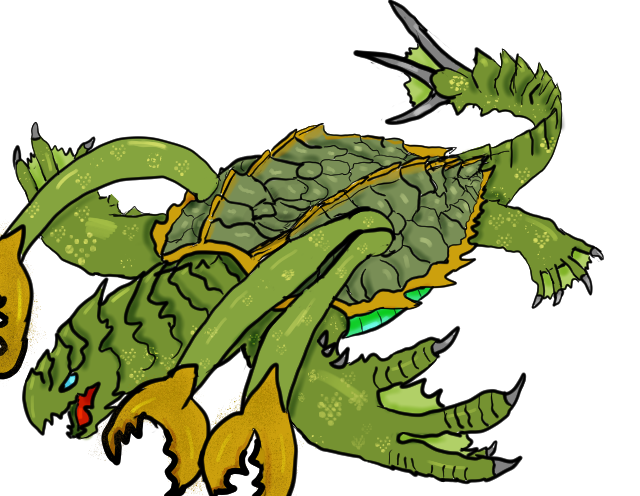
by Valcin (Marc Zipper)
Basic Information
Anatomy
The Hydraclaw Terrapin is a massive, heavily armored turtle-like creature distinguished by its regenerative claw tentacles and predatory adaptations. Its body is covered in thick, scale-like skin that runs continuously from head to tail, forming hard, overlapping plates reinforced with sharp, jagged ridges. These ridges give the creature a serrated profile, making direct attacks along its spine or flanks extremely dangerous. The terrapin possesses powerful, oversized legs, each ending in four thick fingers with pronounced webbing between them. From these digits extend rigid, hooked claws, capable of tearing through wood, stone, and some armor alike. Its jaws are equally formidable, delivering a crushing bite supported by reinforced skull plating. The creature’s eyes glow a cold blue, standing out starkly against its otherwise earthy tones.
Its skin is primarily olive green, while the shell is a darker, deeper green, with scale like design on the top. The underbelly is a muted sea-green, protected by dense plating rather than softer flesh. Along the shell’s sides and upper surface grow orange ridge-spikes, thick and horn-like, which protrude outward and upward as both armor and deterrent.
The tail is long and muscular, tapering into a trident-like, spiked structure. The tail spikes angle sideways, with tough webbing stretched between them, allowing the tail to function as both a bludgeoning weapon and a stabilizer when swimming.
Most distinctively, the Hydraclaw Terrapin normally bears two massive clawed tentacles emerging from openings in its shell. These appendages resemble elongated, Tough limbs rather than soft tentacles. Due to the terrapin’s extraordinary regenerative ability, severing one of these limbs does not permanently weaken it. Instead, the detached limb will regrow into a two smaller but fully functional claw.
Biological Traits
Respiration and Pressure Resistance
Hydraclaw Terrapins are capable of holding their breath underwater for up to five hours. Combined with their powerful swimming ability, this allows them to reach even the deepest regions of the ocean. Their skin, shell, and internal structure possess natural resistance to crushing water pressure, preventing damage that would normally cripple most creatures at such depths. Their shell is exceptionally durable, comparable to the toughness of dragon-scale plating. Striking it directly is extremely difficult, often requiring focused attacks, specialized weapons, or enhanced magic to penetrate. Their skin, while slightly less durable than the shell, is still as hard as basilisk hide, offering formidable protection against conventional attacks.Claws and Regenerative Limbs
Hydraclaw Terrapins possess massive clawed limbs capable of crushing boulders and pulverizing armored opponents. When one of these primary claws is severed, two smaller claws regenerate in its place. These replacement claws are shorter and faster, though individually less powerful. This process can continue until a maximum of six claws per side is reached. While this increases the terrapin’s defensive coverage and striking speed, it comes at a cost: once fragmented, the claws lose their ability to grip large objects or exert maximum crushing force. Over time, excess claws may remerge, restoring fewer but more powerful limbs.Tail Weapon
The Hydraclaw Terrapin’s tail ends in a trident-like cluster of spiked blades, reinforced with thick webbing. This structure provides a significant boost to swimming speed and maneuverability. In combat, the tail functions as a devastating piercing weapon, capable of impaling enemies both on land and underwater.Sharp nail
In addition to their Hydraclaw Terrapins possess sharp nail on the feet structures primarily used for digging, reshaping terrain, and carving nesting chambers in rock and gravel. These nail are not intended for combat, though accidental crushing of smaller creatures does occur due to the terrapin’s immense mass.Jaw Strength
The Hydraclaw Terrapin’s jaws are its most destructive natural weapon, surpassing even its claws in raw power. A successful bite can crush armor, shatter bone, and reduce prey to consumable fragments within seconds. The jaw strength is sufficient to break solid stone and penetrate the toughest hides of large monsters.Magical Capabilities
Hydraclaw Terrapins possess limited but highly destructive magic, primarily focused on offensive techniques and sensory enhancement.- Hydro Cannon The terrapin opens its jaws and releases a high-pressure blast of water that travels up to 20 feet, capable of injuring, knocking back, or destabilizing multiple creatures at once. This ability is often used against large targets or clustered foes, weakening or scattering groups.
- Water Bubble Onslaught A rapid barrage of mana-infused bubbles launched from the claws. Each bubble inflicts minor damage, but the sheer number makes the attack effective at wearing down enemies and disrupting movement.
- Mana Wave Plus By stomping the ground, the Hydraclaw Terrapin releases a mana-infused shockwave that spreads outward in a 60-foot radius. When the wave encounters a living creature, it subtly vibrates upon contact with the target’s aura. This ability does not provide exact positioning, but allows the terrapin to sense general direction and presence, making it ideal for hunting or confirming nearby threats.
- Hydro Vortex The terrapin generates a pulling vortex extending 30 feet from one of its claws. Underwater, this ability manifests as a powerful current capable of dragging creatures toward it. On land, the effect is weaker, functioning more like a localized wind pull with a reduced range of approximately 10 feet.
Internal Vulnerability
While the Hydraclaw Terrapin’s exterior—its shell and skin—is extraordinarily durable, its internal tissues are no more resilient than those of an ordinary turtle. Once its outer defenses are breached, the creature’s body is soft, vulnerable, and fluid-rich, making internal damage highly effective. Wounds that penetrate past the shell or armored skin tend to result in rapid bleeding and severe trauma.Lightning Susceptibility
Hydraclaw Terrapins possess a pronounced weakness to lightning and electrical magic. Their internal structure is highly conductive due to its soft, moist, and malleable composition, allowing electricity to travel efficiently through their body. As a result, lightning-based attacks inflict significantly increased damage, often disrupting muscle control and regenerative processes.Low Cunning and Overconsumption
Hydraclaw Terrapins are powerful but not especially intelligent. They will attempt to consume almost anything they perceive as edible or threatening. This behavior has led to a dangerous but effective tactic: luring them into swallowing volatile or explosive objects. While their stomach lining is slightly tougher than their internal organs, it is still far less resilient than their external shell, allowing internal detonations to cause serious harm. Such methods require substantial force or preparation and are extremely risky, but they remain one of the few alternatives available to hunters or adventurers lacking electrical magic.Genetics and Reproduction
Hydraclaw Terrapins enter their mating season during the summer months, when coastal waters are warm and tidal activity is at its peak. During this time, they migrate toward regions rich in tide pools, often gathering just outside or beneath the edges of submerged coastal formations and natural ruins shaped by the tides.
Male Hydraclaw Terrapins perform a distinctive courtship display. They bob their heads and extend their clawed tentacles, deliberately striking the water’s surface to create rhythmic ripples. These movements are infused with faint traces of mana, causing the ripples to shimmer subtly as they spread outward. The display emphasizes both control and power, advertising the male’s vitality.
Females closely observe these performances, judging the pattern and strength of the ripples, the mana flow within them, and most importantly the size and condition of the male’s claws. Because of the species’ regenerative abilities, males that have allowed all excess limbs to remerge back into their shell returning to the standard two massive claws are often favored, as this results in significantly larger and more imposing appendages.
Once a female has chosen a mate, she signals acceptance by snapping at the male’s tail, a brief but unmistakable gesture. The pair then seek a suitable nesting site near or between active tide pools.
The female digs a deep nesting hollow, where she lays her eggs around 3 to 6. The male then fertilizes them, after which both parents bury the clutch beneath layers of sand, stone, and shell fragments. Despite the adults’ heavily armored bodies, Hydraclaw Terrapin eggs possess comparatively fragile shells, making concealment essential.
To protect their young from predators and wandering creatures, nests are often hidden in dangerous or unstable environments, such as areas affected by strong currents, whirlpools, shifting tides, or other natural hazards. The terrapins’ powerful swimming ability and natural resistance to these phenomena allow them to access and defend these locations, while most other creatures are unwilling or unable to follow.
Growth Rate & Stages
Upon hatching, Hydraclaw Terrapins are already immense, each roughly the size of a small wagon wheel. Almost immediately, the hatchlings must swim to the surface, as the oxygen within their eggs quickly dissipates once the shells break. This first ascent is one of the most dangerous moments of their lives.
Many hatchlings perish during this stage, either drowning from exhaustion or being caught in the whirlpools and violent currents that once served to protect their nests. Only those strong or fortunate enough to escape these hazards manage to reach the shoreline.
For the next twenty years, young Hydraclaw Terrapins remain primarily land-bound, venturing into shallow waters only when necessary. During this prolonged juvenile stage, their shells and limb plating gradually harden, and their bodies steadily grow toward adult proportions. By the end of this period, they reach an impressive adult size of 8 to 10 feet in width and approximately 7 feet in height.
Upon reaching adulthood, Hydraclaw Terrapins begin a nomadic lifestyle, traveling widely across coastlines, fjords, and nearshore waters. Despite their wandering nature, they instinctively return to their traditional mating grounds each summer.
Hydraclaw Terrapins establish broad territorial ranges that encompass both land and sea, treating beaches, rocky outcroppings, tidal flats, coastal shallows, and deeps of Ocean as a single interconnected domain. They are slow-moving but persistent wanderers, following food sources and favorable resting sites rather than fixed paths.
At rest, Hydraclaw Terrapins often pull fully into their shells and remain motionless for long periods. In these moments, they have been mistaken for massive boulders or natural rock formations, a trait that has led to more than one ill-advised attempt at climbing or mining what was assumed to be inert stone.
Ecology and Habitats
Hydraclaw Terrapin Tend to wander and live anyway around also close to the line they tend to favor mountain ranges tadpoles cliffs because they are able to camouflage in a bit of a way why they sleep. Other parses that they just wanna travel a certain area that they have decided that is their home territory and between the Ocean's depths and the coastal land t you could find these creatures just wondering. The only place you probably won't find them is in thinck forces
While some Hydraclaw Terrapins roam freely over vast distances, others establish a loosely defined home territory, moving back and forth between the ocean depths and the adjacent coastal land they have claimed. Within these ranges, they may be encountered slowly traveling along beaches, resting on rocky outcroppings, or moving through shallow waters near the shore.
The one environment they almost never inhabit is dense forest terrain. Thick vegetation restricts their movement and offers little advantage to their size and aquatic adaptations, making forests an unsuitable habitat for the species.
Dietary Needs and Habits
Hydraclaw Terrapins are strict carnivores, capable of consuming an astonishing range of prey. In the ocean, they have been known to hunt and kill large sharks and even small whales. On land, they will attack and consume large terrestrial animals such as buffalo, deer, and similarly sized creatures that are bold or desperate enough to challenge them.
As apex predators, Hydraclaw Terrapins rely heavily on ambush tactics. They frequently remain motionless, resembling massive boulders or reef formations, waiting patiently for prey to wander within striking distance. When the moment comes, they strike with overwhelming force impaling prey with their spiked tail, seizing it with their clawed tentacles erupting from the shell, or finishing the kill through raw strength enhanced by magic.
On land, their slow movement can make active hunting difficult. To compensate, Hydraclaw Terrapins often deliberately provoke territorial animals, wandering into claimed territory and allowing themselves to be attacked. Once the opponent commits, the terrapin counters with sudden, lethal force.
In the water, however, Hydraclaw Terrapins are surprisingly fast and agile swimmers. Combined with their highly developed sensory systems, this makes aquatic hunting far easier. They can track prey through vibration, pressure changes, and movement, allowing them to pursue, ambush, and overpower most creatures that share their domain. These same abilities also enable them to defend themselves effectively against rival predators, reinforcing their status as dominant hunters of both sea and shore
Additional Information
Perception and Sensory Capabilities
Vision
Hydraclaw Terrapins possess exceptional eyesight, capable of perceiving across a broad spectrum that includes ultraviolet ranges. This allows them to see clearly both underwater and on land, where they can easily distinguish vibrant colors, motion, and contrast. Through this heightened vision, they are able to identify potential prey, threats, or unusual disturbances in the water and along the shoreline with remarkable accuracy.Hearing
Their hearing is highly specialized for aquatic environments. Underwater, Hydraclaw Terrapins can detect low-frequency sounds, vibrations, and rhythmic disturbances, allowing them to track movement over considerable distances. On land, however, their hearing is far less refined adequate but unremarkable. As a result, a creature that stays outside of the terrapin’s direct line of sight may be able to approach quietly, provided it avoids creating heavy ground vibrations.Olfaction and Chemosense
While not capable of precise scent tracking like some predators, Hydraclaw Terrapins possess a well-developed chemosensory system, particularly in aquatic environments. This sense allows them to detect the presence of organic matter, blood, or potential food sources nearby in the water. On land, this ability is reduced but still effective enough to alert the terrapin when edible material is close, even if it cannot pinpoint the exact source.Vibration and Pressure Sense
For long-distance awareness and navigation, Hydraclaw Terrapins rely heavily on an advanced vibration and pressure-sensing ability. In water, this sense allows them to detect shifts caused by approaching creatures, ships, or large movements, compensating for their immense size and slow turning speed. They also use their claws to probe and feel along the seabed, locating food or hidden threats beneath sand, silt, or stone. This vibration sense translates well onto land, where the terrapin’s feet and claws can detect subtle ground movements, enabling it to sense nearby creatures even without direct visual confirmation.
Lifespan
80 years
Average Height
7 feet
Average Length
8 to 10 feet

Comments