
Jezero City
Jezero City
Official Name: Jezero Arcology Metropolitan Authority
Common Names: Jezero, The Silk City, The Crater of Cloth, Mars' Oldest Arcology
Location: Jezero Crater, Mars
Population: Approximately 1.08 million permanent residents
Founded: 2353 CE
Government: Arcology Governor with an elected Metropolitan Assembly
Current Governor: Argus Parvin
Overview
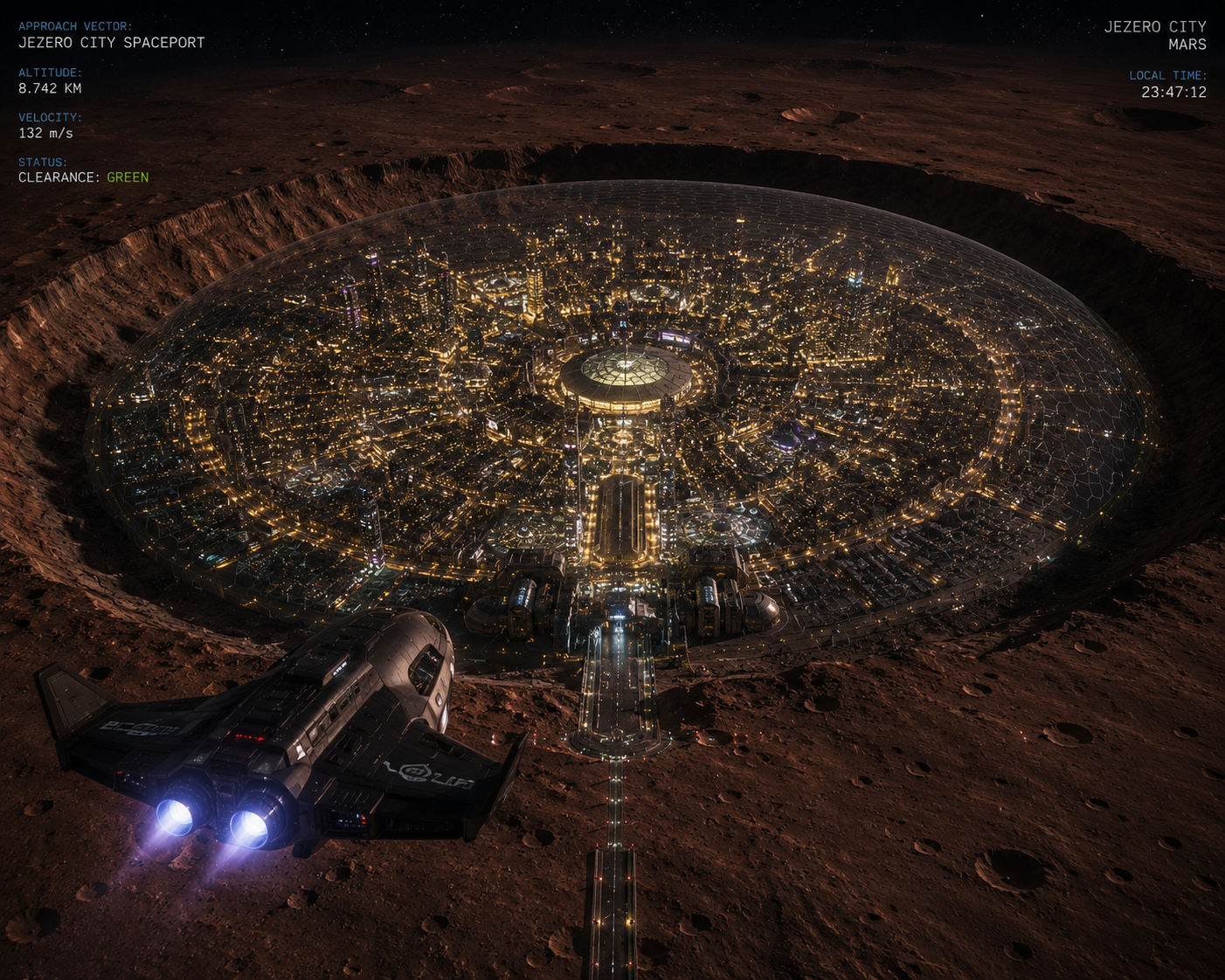
Nestled entirely within the ancient walls of Jezero Crater, Jezero City is the oldest surviving surface arcology on Mars and, despite being one of the smallest, remains among its most culturally influential.
If New Geneva is Mars' financial heart and Orcus Patera its industrial engine, Jezero is its atelier. The city is synonymous with fashion, couture, textile science, and luxury craftsmanship. Designers across Human space dream of debuting a collection during Jezero Fashion Month, while merchants prize garments bearing the city's hallmark.
Although much of the original settlement was destroyed during the City-State Wars, the rebuilt city deliberately incorporated echoes of its predecessor. Wide pedestrian boulevards, landscaped plazas beneath vast cryspoly domes, and preserved First Wave monuments coexist with innovative architecture. Jezero has become a city where daily life incorporates history, rather than erasing it.
Founding
Jezero City traces its origins to the Third Wave of Martian colonization.
Unlike many settlements established to exploit mineral deposits, Jezero was founded as an agricultural and biological research colony. Jezero Crater had long attracted scientists because geological evidence suggested it once held an ancient lake. While the search for extinct Martian microbial life captured public attention, the practical appeal lay in the crater itself.
Its steep walls provided natural protection from dust storms, and the basin offered an ideal location for constructing one of the first fully enclosed surface arcologies.
The founders envisioned a city dedicated to biological sciences, controlled-environment agriculture, and high-value manufacturing rather than heavy industry.
The Mars City-State Wars
Jezero's prosperity made it a target.
During the City-State Wars, rival governments sought control of its biological laboratories and textile production facilities.
In 2358 CE, after weeks of siege, precision orbital strikes breached portions of the dome network.
Rather than surrender, defenders evacuated civilians into deep shelters while engineers collapsed selected dome sections to deny attackers entry.
The battle lasted nearly two months.
When it ended, nearly seventy percent of the city lay in ruins.
Only the crater itself remained unchanged.
The reconstruction that followed became a defining moment in Martian history.
Reconstruction
Rather than recreate the old city exactly, architects adopted a philosophy known as Living Continuity.
Historic streets were preserved wherever possible.
Fragments of damaged buildings were incorporated into new structures.
Many public squares contain exposed sections of the original arcology, protected beneath transparent flooring.
Residents often joke that Jezero is "two cities stacked on top of one another."
Government
Jezero is governed by the Jezero Metropolitan Assembly, headed by a Governor elected every six years.
The city enjoys broad autonomy while remaining subject to Martian federal law.
Governor Argus Parvin
Age: 82
Governor Parvin, of Chinese-African ancestry, previously served as Lieutenant Governor before assuming office following the retirement of Governor Isabelle Laurent.
Known for his calm demeanor and pragmatic leadership, Parvin has focused on preserving Jezero's artistic heritage while expanding advanced textile manufacturing and supporting small artisan workshops.
He is frequently seen walking through the Garment District without a security entourage, much to the concern of his staff and security team.
Economy
Although Jezero possesses comparatively little heavy industry, it is one of Mars' wealthiest cities per capita.
Major industries include:
Luxury fashion
Textile engineering
Silk production
Advanced wearable electronics
Smart fabrics
Medical textiles
High-end tailoring
Designer cyberwear
Jewelry
Museum tourism
Education
The Garment District
The Garment District is the beating heart of Jezero.
Thousands of workshops produce everything from inexpensive everyday clothing, nearly indestructible vacuum rated suits to bespoke garments worth millions of credits.
Entire streets specialize in individual trades:
embroiderers
pattern designers
fabric dyers
smart-textile engineers
tailors
button makers
traditional artisans
Many businesses remain family-owned after centuries.
Martian Silkworms
Perhaps Jezero's greatest claim to fame is the Martian Silkworm Program.
Originally descended from Earth's Bombyx mori, the insects have undergone centuries of selective breeding and genetic engineering.
The resulting silk possesses remarkable characteristics:
greater tensile strength
excellent flexibility
high thermal stability
superior dye retention
compatibility with embedded conductive fibers
Luxury garments often combine Martian silk with graphene threads and cryspoly microfilaments, producing clothing that is elegant, durable, and capable of integrating personal electronics without compromising comfort.
Martian silk is widely regarded as the finest natural fiber produced anywhere in human space.
Tourism
Jezero welcomes millions of visitors annually.
Popular attractions include:
The First Dome Memorial
The Jezero Museum of Fashion
Silkworm Conservatories
The Grand Textile Exchange
The Crater Gardens
The Living Continuity Walk
Annual Fashion Month
Visitors frequently describe Jezero as the most walkable city on Mars.
Private vehicles are rare within the historic core.
Education
The Jezero Academy of Textile Sciences is considered the premier institution for textile engineering and wearable technology. Graduates often receive job offers before completing their degrees.
Notable Historical Events
2353 CE – Founding of Jezero Colony
The first permanent settlement is established within Jezero Crater.
2358 CE – Fall of Jezero
The city suffers catastrophic damage during the City-State Wars.
2391 CE – First Martian Silk Harvest
Engineered silkworms produce commercially viable fibers, beginning an industry that will define the city's future.
2483 CE – Completion of Reconstruction
The rebuilt arcology officially opens under the principles of Living Continuity.
2894 CE – Jezero Fashion Accord
The city's leading fashion houses agree to shared authenticity standards, creating the most trusted luxury textile certification in human space.
Notable Historical Figures
Dr. Mei Zhang - Founder of the Martian Silkworm Program.
Governor Rafael Ibáñez - Oversaw reconstruction after the City-State Wars.
Amina Kovács - Architect of the Living Continuity movement.
Professor Elias Okafor - Pioneer of conductive silk fabrics.
Isabelle Laurent - Governor who modernized Jezero while preserving its historic character before handing office to Argus Parvin.
Notable Current Residents
Governor Argus Parvin - Current governor.
Celeste Navarro - World-famous fashion designer whose annual collections routinely set trends across human space.
Dr. Satoshi Mwangi - Leading expert in bio-engineered natural fibers.
Lina "Silkenhands" Rosales - Master tailor whose waiting list extends nearly fifteen standard years.
Ownership
On Paper - The Jezero Metropolitan Authority administers the city on behalf of the Martian Federation.
In Practice - Ownership is remarkably decentralized.
Thousands of workshops, residences, and commercial spaces remain privately owned, while major infrastructure belongs to the city government.
This mixture of public investment and private craftsmanship has proven exceptionally resilient.
Criminal Activity
Compared with larger Martian cities, violent crime is relatively uncommon.
However, Jezero's luxury industries attract organized crime.
Common criminal enterprises include:
counterfeit designer goods
industrial espionage
textile patent theft
designer cyberwear forgery
luxury goods smuggling
Several criminal organizations maintain discreet operations in the city.
The Basalt Cartel launders money through high-end textile exports but avoids overt violence, recognizing that disrupting Jezero's reputation would ultimately reduce profits.
The Red Dragons Tong have little permanent presence, preferring to purchase luxury goods through intermediaries rather than establish direct operations.
Independent art thieves occasionally target museums and private collections, though Jezero's security systems are regarded as among the best on Mars.
Culture
Jezero embodies the Martian belief that beauty is a form of resilience.
The city rebuilt itself after devastation not by becoming stronger, but by becoming more beautiful.
Residents take quiet pride in creating objects meant to outlast their makers.
A locally popular saying reflects that philosophy: "Steel builds tomorrow. Silk makes tomorrow worth living in."
For many Martians, Jezero City is more than the oldest surface arcology.
It is proof that civilization is measured not only by what it can construct, but by what it preserves and creates.

Comments