

SKRIX VRETH
Krix'zar Zrek'vali · First of the Keth-Vreth (New Reckoning) · Rex Goblinorum
“The second time I met him, he told me he had read everything I had published about his people and found it 'almost correct in several places.' He then told me which places. He was right. I have been revising my understanding of goblin culture ever since. I have considered writing him a letter about what I have written in De Diis. I have not yet done so. I am not sure how to write a letter to someone explaining that they may be in the process of becoming a god.”
Skrix Vreth is sixty-one years old, has been Krix'zar of the Zrek'vali for sixty of them, and is six weeks from the conclusion of the most significant diplomatic negotiation in goblin history. He has spent sixty years building the conditions for his people's liberation from orc subjugation through a strategy of calculated patience, deep intelligence work, and the specific kind of long-game thinking that produces results only if the person doing the thinking lives long enough to see them. He has lived long enough. The treaty is almost concluded. The Keth-Vreth is almost real.
He is also, without knowing it, approaching apotheosis. The belief of fourteen million goblins, concentrated around the figure of the Krix'zar across sixty years of the Keth-Vreth, has been doing to Skrix what the Eleventh Permutatio did to Sekhara, without the catalytic event of a Rift to crystallise it. Plinius's assessment in De Diis is that the treaty's conclusion — the moment of goblin liberation, embodied by the king, at the peak of accumulated belief — may provide exactly that catalytic moment. The king does not know this. He has calculated everything that can be calculated. He has not calculated this.
He is wrong — that is the word observers reach for when they first see him. Nearly seven feet tall, three times the mass of a normal goblin, proportioned correctly for a goblin but at a scale that produces instinctive animal unease in everyone who encounters him. He was born this way. No one, including him, knows why. He has spent sixty years learning to use the effect as a political instrument. It is extremely effective.
“He is the most precise thinker I have encountered in sixty years of scholarship. I find this simultaneously gratifying and deeply unsettling.”
Physical Description
General Physical Condition
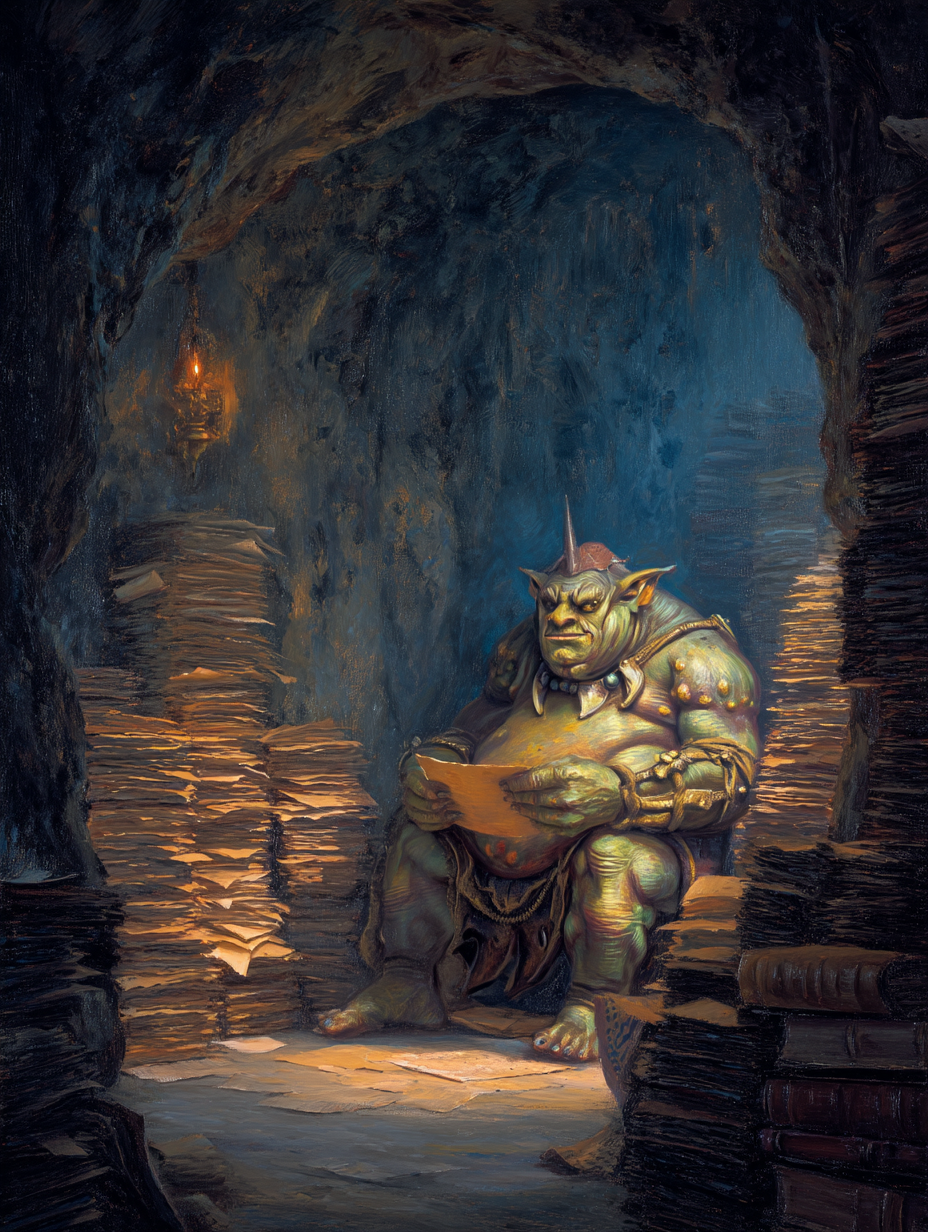
Wrong. That is the word observers reach for when they first see him, and cannot immediately explain. He stands nearly seven feet tall — three times the mass of a normal goblin, proportioned like one but scaled impossibly large. His features are goblin features: the wide amber eyes, the long ears, the grey-green skin. All of it simply too much of it. He did not grow into this. He was born this way. Nobody, including him, knows why. He has spent sixty years learning to use the effect it has on people — the wrongness, the instinctive animal unease — as a political instrument. It is extremely effective.
Body Features
The scale is the body feature. Everything else is correct for a goblin — the broad head, the wide-set amber eyes, the large pointed ears, the slight forward hunch of the goblin frame — and all of it is at a size that should not exist. He moves with the careful deliberateness of something very large in spaces built for something considerably smaller, which in the deep warrens means almost everywhere. His chambers have been enlarged to accommodate him. The passage approach has not. Visitors arrive at his presence having navigated tunnels built for standard goblin scale, and then encounter him. The transition is, by all accounts, effective.
Facial Features
The amber eyes are the most remarked-upon feature in both of Plinius's accounts. Wide, unhurried, giving nothing away. They move slowly and completely, taking in a situation before he responds to it. Plinius notes that in both meetings, Skrix appeared to have understood everything that was going to be said before it was said, which is either genuine pre-cognition, exceptional intelligence applied to available information, or — and this is what Plinius does not publish — the beginning of something else.
Identifying Characteristics
The scale, immediately. After that, the stillness. He does not perform authority; he simply has it, in the specific way of someone who has been the most consequential person in a fourteen-million-person civilisation for sixty years and has learned that performance is unnecessary. He sits when he receives visitors, which at his size is a practical courtesy to the room. He does not stand to make a point. He does not need to.
Physical quirks
He reads during audiences — not as a display of disrespect but as an honest signal that he can process the conversation and the document simultaneously, which he can. His library covers sixty years of surface politics, military capability, treaty law, and the histories of every people whose support or neutrality the liberation strategy requires. He has sources that Plinius has not identified. He has read everything Plinius has published and corrected the errors directly.
There is one other physical detail that Plinius records in private notes but has not published: in the second meeting, in a moment when the chamber's bioluminescent fungi flickered, he thought he saw something in Skrix's amber eyes that he cannot account for. He does not describe it further. He has been thinking about it since.
Apparel & Accessories
Practical deep-warren dress: dark, functional, scaled for his unusual size by craftspeople who have had sixty years to develop the patterns. No ceremonial display, no trophies, no jewellery. The chambers are the display — sixty years of intelligence documents, treaty drafts, correspondence archives, and the three deep-record references to others like him that he has found and cannot explain and has told no one about. The room speaks for him. He does not need to.
Mental characteristics
Personal history
Born 1139 A.P. in the deep Zrek'vali warrens, one year before the surface Vrakh reported an unusual birth to the orc overseers. The overseers noted it and filed it and did nothing, because unusual births in the warrens are not the orc administration's problem. This was the first of many things the orc administration failed to understand about the situation developing below them.
He assumed the Krix'zar title at one year old — which is not how the title works, except that it is how it worked for him, because he was born into a role that the Zrek'vali had been preparing for across several generations without knowing they were preparing for anything. The formal assumption of authority came at age twenty, when the deep governance structures that he had been building since childhood were sufficiently developed to constitute a real administrative layer. He declared the Keth-Vreth — the New Reckoning — at that moment. The date is counted from that day. He is now in year forty-one of the Keth-Vreth.
The sixty years since have been the execution of a single strategy: liberation through treaty rather than war, achieved by making the Zrek'vali indispensable to Rome in ways that Rome has not yet fully understood and that the orcs do not know are happening. The intelligence network below every orc settlement on the primary continent. The treaty proposal's offer of permanent intelligence access in exchange for recognition of goblin territorial sovereignty and Roman military guarantees against orc reprisals. He considers this the most reasonable transaction in the history of his people. He is correct.
Education
Self-constructed, across sixty years of reading everything available in the deep warrens and everything that could be obtained from the surface through the intelligence channels he built. The treaty law curriculum he developed is more comprehensive than the Roman Academy's course on the subject. His understanding of Roman senatorial faction politics, reconstructed from sixty years of reports, is more current than most Roman senators' understanding of their own institution. He has read Plinius's complete published works. He found three errors. He told Plinius which ones. He was correct on all three.
Accomplishments & Achievements
The Keth-Vreth itself: sixty years of deep governance that the orc administration has not detected, has not suppressed, and has not understood. The intelligence network below every orc settlement on the primary continent, operational for forty years and never compromised. The treaty negotiation, six weeks from conclusion, representing the most sophisticated diplomatic operation any goblin Krix'zar has ever conducted and the culmination of a strategy that began before most of the people involved in it were born.
The three references. In the deep warren records, across several centuries, he has found accounts of three other goblins of impossible size, born at intervals he cannot explain, never repeated. He has not been able to determine what connects them. He has not been able to stop looking.
Failures & Embarrassments
He has not found the answer to his own origin. In sixty years of applying the most precise intelligence methods available to every question he has encountered, this is the one question that has not yielded. He has three data points — the three historical references — and they are not enough. He is not accustomed to not knowing things. He has learned to keep this particular not-knowing entirely private, which is harder than keeping every other secret, because the other secrets are strategic and this one is personal.
Mental Trauma
The question of his size and what it means. It is the one crack in sixty years of total self-mastery, and it is invisible from the outside because he has had sixty years to develop the containment. Plinius, who is a good reader of people and who has met him twice, caught a glimpse of it in the second meeting and recorded it in private notes without publishing it. He describes it as 'the specific quality of someone who has reached the bottom of an archive and found that the most important document is missing.'
Intellectual Characteristics
He operates entirely on calculation. No public ideology, no inspirational rhetoric, no performed passion. When he speaks to his people he speaks in specifics: what we will do, when we will do it, what it will cost, what it will gain. His advisors have learned not to bring him problems without proposed solutions. He is not cruel by inclination, but he has never permitted inclination to affect a decision.
He is the most precise thinker Plinius has encountered in sixty years of scholarship. This is the assessment of a man who has met emperors, thanes, and living gods, and it is the assessment Plinius has published. What he has not published is the corollary: that precision of this order, applied consistently across sixty years, occasionally produces results that exceed what the method alone should be able to produce. He has noted three such instances. He has not connected them to anything. He is not yet ready to.
Morality & Philosophy
Liberation is the moral framework and the strategic objective simultaneously, which means the distinction between what is right and what is necessary rarely produces conflict. He is not naive about the costs of what he is doing: the treaty's intelligence provisions will make the Zrek'vali permanently indebted to Rome in ways that limit their sovereignty even as they secure it. He has calculated that this is the best available option, which is different from calculating that it is a good option.
He has also, more quietly, a position on his own people that goes beyond the liberation strategy: he believes the Zrek'vali are capable of things that fourteen million years of orc subjugation have prevented them from attempting, and that the treaty is not the end of the story but the condition that makes the rest of the story possible. The treaty is the door. What is beyond the door is what he is actually interested in.
Taboos
He will not discuss his size, his origin, or the three historical references. This is the only subject on which his precision fails him, and he has learned that it fails him, and he has learned to prevent the subject from arising. In two meetings with Plinius, who is professionally curious about everything, the subject did not arise. This is a considerable exercise of conversational control.
Personality Characteristics
Motivation
Stated motivation: complete the treaty with Rome before Rift XIII changes the political landscape; secure recognition of Zrek'vali territorial sovereignty in the deep warrens, Roman military guarantees against orc reprisals, and trade access to the surface; in exchange, provide Rome with a permanent intelligence network below every orc settlement on the primary continent.
The motivation he has not stated to anyone: he wants to know what he is. The treaty, the liberation, the Keth-Vreth — all of these are real and genuinely important to him. But beneath them is the question he cannot answer, and he has spent sixty years building the conditions under which he might eventually be able to ask it properly. He does not know that the answer may arrive before he asks it.
Savvies & Ineptitudes
Genuinely exceptional at: long-range strategic planning executed with tactical precision; intelligence network construction and maintenance; reading political situations from incomplete information with a speed and accuracy that Plinius finds professionally alarming; the specific discipline of knowing what not to do and not doing it for sixty years.
Genuinely limited by: the single question he cannot answer about himself; and, more recently, the subtle effects that fourteen million people's concentrated belief is producing in him that he has attributed to age, to stress, to the specific quality of the warren fungi's light in certain conditions. He is a precise observer of everything except what is happening to him.
Virtues & Personality perks
He corrects errors when he finds them, directly and specifically, which is the most practically useful form of honesty available. He told Plinius which three things he had gotten wrong, in the order of their significance, with the page references. He has been doing this with the treaty documents for six months. Ambassador Pons has described working with him as the most intellectually demanding and most productive diplomatic experience of a twenty-year career.
He keeps every commitment he has made in sixty years of governance. The Vrakh (warren-masters) who interface with orc authority know that what the Krix'zar promises, the Krix'zar delivers. The orc administration, which has never encountered the Krix'zar directly, knows only that the goblin warrens are stable and productive and that this has been true for sixty years. They have attributed this to competent surface management. They have attributed it correctly and incorrectly simultaneously.
Vices & Personality flaws
He has a second negotiating track that Ambassador Pons does not know about: quiet contact with Thane Gorund of Varakh, ensuring the dwarves will not act to protect their orc trading relationships when the situation breaks open. He has offered Gorund something specific. Gorund has not yet refused. Pons, if he knew, would find this alarming. Skrix considers it a reasonable precaution. Both assessments are correct.
He has also never told anyone about the three historical references. Not because they are strategically sensitive, but because they are the one thing he cannot control, and he has a sixty-year habit of not discussing things he cannot control.
Personality Quirks
Reading during audiences. The complete stillness that is not inertia but the specific economy of someone very large in a small space who has learned that unnecessary movement has costs. He answers questions in the order of their importance rather than the order in which they were asked, which means that conversations with him feel slightly displaced in time. Plinius found this, in the second meeting, the most unsettling quality of the encounter — not the size, not the eyes, but the sense that the conversation was proceeding according to a structure he could not access.
Social
Reign
Sixty years as Krix'zar, from 1140 A.P. (formal assumption of authority at age twenty) to the present. The defining arc of his reign is the construction of the liberation strategy from first principles, across six decades, without external assistance, without the orcs discovering it, and without a single significant strategic error. Whether the treaty's conclusion will produce the apotheosis that Plinius hypothesises is the question that will define the second arc of his reign — if there is a second arc, and if 'reign' remains the correct word for whatever comes after.
Contacts & Relations
Ambassador Pons Hortensius : the primary treaty negotiation contact for twenty years. Pons considers working with him the most intellectually demanding and productive diplomatic experience of his career. Skrix considers Pons the most honest Roman official he has encountered, which is a lower bar than Pons would be comfortable knowing it is. The relationship is professional, functional, and characterised by a mutual precision that both parties find unusual in a diplomatic context.
Plinius : two meetings, at Skrix's arrangement. He read Plinius's work, identified the errors, and arranged the meetings through channels Plinius spent three months tracing before accepting that he was not going to be able to trace them further. He corrected the errors in person. He has been monitoring Plinius's subsequent publications. He knows about De Diis. He has not yet read it. He is waiting for the published version.
Thane Gorund Ashvein of Varakh : the second negotiating track, unknown to Pons. The contact has been conducted through deep-road channels that the dwarves maintain for their own purposes and that Skrix has been using for forty years without Gorund knowing. The current contact is direct. He has offered Gorund something specific. He has calculated that Gorund will accept. He has been right about things for sixty years.
Gharkon Krul'gash , Vor'grak of the Grakh'tor: no direct contact. The entire liberation strategy is predicated on Gharkon not knowing it exists until the treaty is concluded. Skrix has been monitoring the Vor'grak's awareness of the situation through the intelligence network and has assessed that Gharkon suspects something without yet knowing what. He has six weeks. He needs four.
Family Ties
Not documented. He has not discussed his family. The three historical references to others of his size do not provide lineage information. The question of whether his physical characteristics are hereditary, divine, or something else is the question he cannot answer and that the deep warren records cannot resolve.
Religious Views
None, formally. The Zrek'vali have no divine tradition. What they have, without knowing it, is sixty years of concentrated belief directed at the figure of the Krix'zar, which is functionally the same thing that the tabaxi have been doing consciously for six hundred years. Skrix has no awareness of this. He has noted the subtle effects — the occasional moment when something resolves that should not have resolved, when information arrives through a channel he cannot account for, when the amber eyes in the cave fungi's light do something he cannot explain. He has attributed these to other causes. He is wrong about the attribution.
Social Aptitude
In deep warren contexts: absolute authority, the specific ease of someone who has been the most consequential person in a fourteen-million-person civilisation for sixty years and knows how to hold that position without performing it. In external diplomatic contexts: precise, sparse, and disarming in the way of someone who says exactly what they mean and means exactly what they say, which produces in Roman diplomatic counterparts the specific unease of encountering a negotiator who cannot be read for subtext because there is no subtext. Pons has described it as negotiating with a very precise piece of treaty law that occasionally corrects your errors.
Speech
Zrek'vali for everything internal. Correspondence Latin for the treaty documents, which he writes himself rather than through intermediaries, in a style that Roman lawyers have described as the clearest treaty Latin they have encountered and that carries no rhetorical decoration whatsoever. Each sentence says one thing. Each paragraph addresses one subject. The treaty is sixty pages. It is the most precisely drafted document in the current Roman diplomatic archive.
Wealth & Financial state
The question of personal wealth does not apply to him in the way it applies to surface leaders. He controls the deep warren economy — the bioluminescent fungi cultivation, the deep-mineral extraction, the craft production, and the intelligence network's commercial side — as Krix'zar. His personal holdings are the chambers, the library, the three references. By the standards of the Zrek'vali, which measure wealth in information and in the conditions that make information possible, he is the wealthiest person alive.
Krix'zar (King of the Zrek'vali — the supreme title, self-assumed at the beginning of the Keth-Vreth)
Vreth ('The Unbroken' — his earned epithet, given by the deep warren population after his thirtieth year of rule without successful challenge)
Rex Goblinorum (Latin diplomatic title, used in treaty correspondence)
First of the Keth-Vreth (the New Reckoning — his designation of his own reign as the beginning of a new goblin count of time)
“The orcs have fourteen million of us doing their work. We have fourteen million of us planning our departure. These are not the same situation.”
Zrek'vali (native; the deep warren dialect that has diverged from the surface goblin trade-speech over sixty years of deep governance)
Adequate Latin (correspondence quality, learned from the treaty documentation)
Orcish (functional, learned from sixty years of managing the interface between the deep and surface governance layers)

Comments
Author's Notes
Narrator Note. Plinius has met Skrix Vreth twice, in intermediate locations that he has agreed not to document in any form that identifies their position. This article is written in the varro-authored register for the two meetings and varro-uncertain for everything else. It contains the most significant DM-only information in the entire register: the approaching apotheosis, which Skrix does not know about and which Plinius has committed to paper only in De Diis. All Zrek'vali titles are given in the native language with translations in brackets.