

Toluna
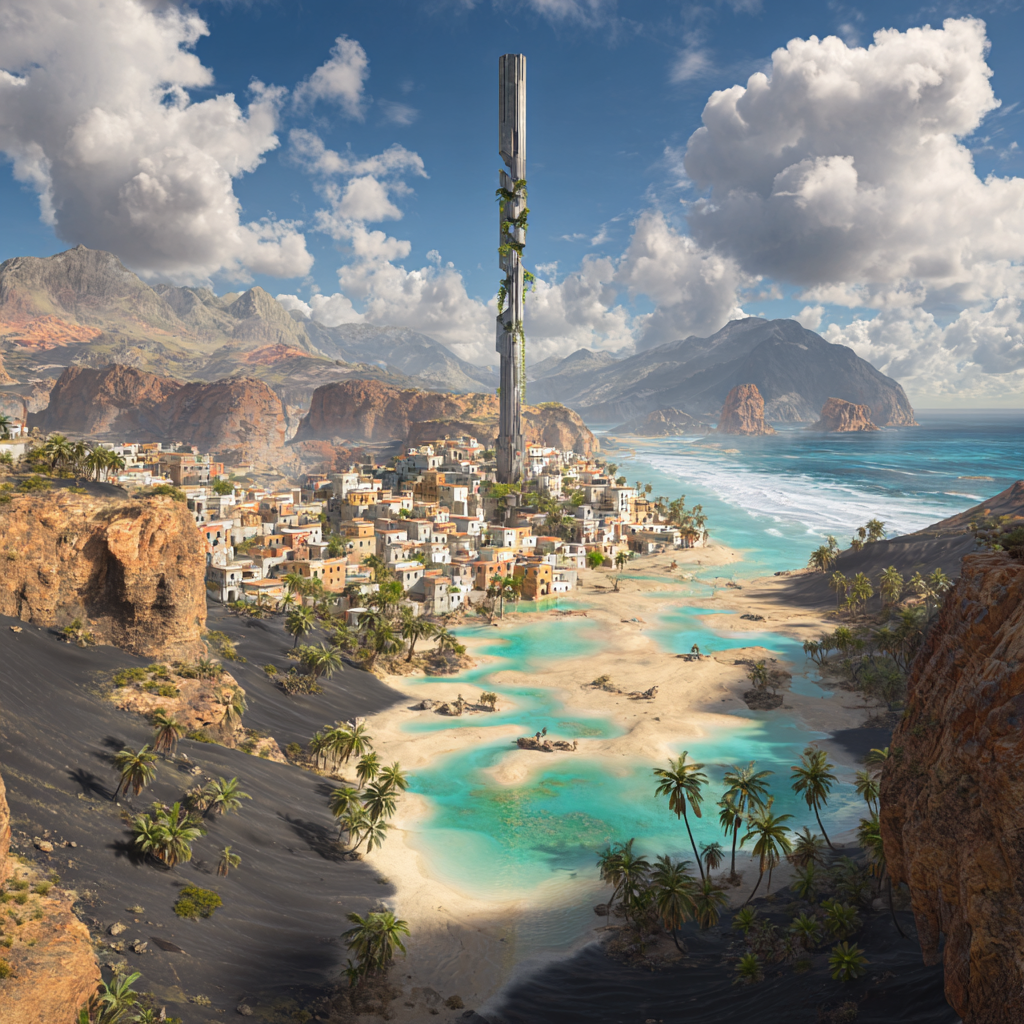
Large Town: Population 3,420 (67% vesperkin, 15% letheni, 10% lynoxi, 6% human, 2% other)
History
Two thousand years ago, the island on which Toluna is located did not exist. But if you asked a stranger on the streets anywhere else in Myr, they would tell you it's a myth. Toluna is difficult to locate, requiring someone native to the island to act as a guide. The region of the ocean where it is located is filled with strong winds that carry a relaxing whistling sound which can put one in a dream-like trance, causing you to lose sense of time and ignore the island if you do happen to come across it. Those native to the island are accustomed to dreams, and can navigate safely past this barrier. Should you manage to resist the effects of the whistling, you will eventually come across an island that looks like a silhouette from a distance; an effect of the terrain, covered by black sands and rock.
In Toluna, the boundary between dreams and reality breaks down. This is due to the presence of the artifact known as Lebashan il Mardon, or the "helm of manifestation"; a helmet discovered by a Vesperkin woman named Dula Nedar in the Reckoning period. This helmet warps reality around it, bringing elements of the dreams of those who slumber nearby into the real world. Discovered on an expedition in a now unknown location, the helmet was being transported back to Artus when Dula's ship made visual contact with the island, confounding their Lynoxi navigators who did not know of its existence. Several crew members reported seeing this island in their dreams recently. Upon landing and beginning to explore the island, they found that the all-black terrain was untouched, with no signs of life anywhere. Over time, the crew began to dream of home, and upon waking found that home had come to them in the form of a town that had not been there before amidst a verdant oasis.
While some of the crew, including Dula, remained on the island to explore this strange new land; others returned to Myr to tell others of what they had found. But upon returning, the whistling ensured they would not find their way back. Ridiculed for their unfounded claims, the explorers gave up their search for the idyllic oasis they had found. Over time, others have searched for the island, and while various peoples have found their way there, the Cataren seem to have an innate talent for locating it, seemingly unaffected by the whistling due to their connection to the dream world. This has caused legends to form around the island, with many of the Cataren holding it in religious regard as a paradise put there for them.
The helm has the ability to make dreams into reality, manifesting things that the residents conjure up during their nightly rest. These conjurations happen nightly, and are used to provide food that the dreamers require, as well as tools, complex objects, and even their housing. However, large scale manifestations happen rarely, as there are limits to how much the helm can manifest each night. For large-scale manifestations, the residents must control their dreams and focus on them each night over a sustained period to bring about these changes; and deviating the details too much can cause strange side-effects. Once or twice a year, the helm causes a large vortex to appear in the sky in an event called the Lebatocran; its swirling twilight colors coinciding with these large-scale manifestations, which can create new features on the island, or new creatures that the residents have dreamed up. The Lebatocran also causes the island's supply of its black sands, called Dezilos, to replenish itself. However, not all manifestations are positive ones, and those who cannot control their nightmares can bring danger to the island. It is for this reason that Dula has established a faction called the Mespuvehari, who are responsible for seeking those bringing nightmares into the world, and putting an end to them; one way or another.
Government
Though Toluna is comprised of various members of Art Hunahunari, it is not truly a part of their government, as they do not have a Speaker or Marshals. The outside world largely believes that Toluna is a myth. Since the town's founding, its members have looked to Dula Nedar as their leader; the very same Vesperkin woman who discovered the helm in the mid Reckoning period. It is believed that Dula's extraordinarily long life is due to the helm, which she wears at all times. The helm gives Dula the ability to make dreams a reality, and to see into the dreams of those around her, among other things. Dula is largely a benevolent leader, but given the danger of the artifact she wears, she has implemented policies to ensure the island's safety which to outsiders may seem like that of a despot.
Because of the hazards of nightmares, Dula established the Mespuvehari, whom she gives instructions to directly in the form of information about those in the town who are having dreams that could become dangerous. The Mespuvehari have no command structure, and are instead individuals each reporting to Dula. The town's residents must open their doors to them no matter the time of day. Unfortunately, the Mespuvehari must remain in the waking world in order to monitor dreamers, and are kept awake by the helmet in order to perform their duty. Because of this, they are unable to participate in the dreaming. They are treated with reverence for their sacrifice.
Economy
What can be said about an economy in which the community is isolated from the outside world, and nearly everything they need is provided by magic? Though Lebashan il Mardon is powerful, the townsfolk cannot manifest the food and objects they need without the black sands found on the island known as Dezilos. This sand coalesces to form into the objects the dreamer imagines at night; however, the sands are finite, replenished only once the event known as Lebatocran occurs. If they did not ration the Dezilos, it could be used up rapidly, leaving them without the ability to manifest food for months until the next vortex appears. While the townsfolk don't use traditional currency, the Dezilos is their currency. But what would you buy with this currency when you can already create everything you could want? Unfortunately, not everyone is creative enough to dream up complicated objects, or to come up with interesting foods.
Though there is plenty of sand, it needs to be gathered and brought to the dreamer in order for it to be used to manifest. Those who are less creative spend their time during the day gathering sand to trade to the town's more inventive dreamers to "commission" more complicated manifestations, such as exotic food, clothing, or devices. Additionally, the Mespuvehari are kept awake at all times by the effects of the helmet, and as such cannot manifest themselves; so they must bring sand to the townsfolk to trade for things they need. Given the town's high regard for them, they receive many things for free.
Notable Locations
- Adiven Moll - This colossal tower on the west edge of the town is impossibly large, with architecture that defies the possibilities of construction. Its name refers to the fact that from the ground, the tower appears to touch Umos' moon at night. During the event known as Lebatocran, the vortex appears directly above the tower, and black sand streams out of the vortex, causing large-scale manifestations, with excess sand swirling around the tower in a storm that then settles on the ground, replenishing the town's supply. This tower is where Dula Nedar lives, and she is the only one who knows how to reach the top. The tower features disconnected sections that hover without support, flowering plants growing along the walls, and crystalline floors that fill the tower with prismatic colors during the day. The townsfolk believe that the tower is sacred, and sometimes leave offerings at the bottom of the tower. It has been reported that strange sounds can be heard from far up the tower late at night.
- Melini Pelas - A series of pools in the town's oasis that are filled with slightly opaque teal water. The pools are renowned for their healing properties, soothing aches and pains, and for quelling anxious thoughts that could lead to nightmares. These pools are used for bathing frequently to purge the mind of impure thoughts, and were one of the first large-scale manifestations created by the town's early settlers. However, one of the five pools has recently become contaminated by some form of disease which makes one unable to sleep, even when exposed to Dezilos. The Mespuvehari have begun to guard the pools, concerned that this may have been an intentional act and that the contamination could spread to the others. Some of the townsfolk believe that this is the first in a series of events that will lead to the arrival of Catar Thynarel, the figure who is said will bring about the town's destruction.
- Ephobir Vehari - This "gorge of nightmares" is named literally, as it acts as a sort of "dumping grounds" where the town has sealed away the worst nightmares to plague the island over its 2,000 year existence. Located in the mountains west of town, the gorge is impossibly dark even when the sun is directly overhead. It is said that Dula herself once sealed away a nightmarish creature at the bottom of the gorge. The townsfolk come here, despite being ordered not to, in order to dispose of junk that they have collected by manifesting things that once gave them joy, but which are now useless to them. There is an old Human woman by the name of Nani Decarish who visits the gorge once a year and performs an unknown ritual which is rumored to keep the nightmares within contained. Recently, the woman has become extremely ill, and has not passed on the knowledge of this ritual. The townsfolk are growing concerned, believing that they will be overrun if the gorge's containment fails.
Culture
Dreams are everything to the residents of Toluna, as they form their surroundings and their livelihood. The artifact known as Lebashan il Mardon can make objects of the residents' dreams reality. Rather than working traditional labor jobs, residents learn to control their dreams and focus their thoughts on what they need. The helm then manifests these needs tangibly, creating everything from raw materials to completed objects and even food. However, the helm has its limits, and cannot manifest anything beyond about 500 miles, and anything created by it that goes outside its range will disappear. During their waking hours, residents pursue recreational activities, or exploring the island and seeing what their community's dreams have manifested. However, not all manifestations are positive; those who are untrained or who have malicious intent can bring danger into the community in the form of nightmares, which can manifest dangerous predators or even natural disasters. There is a strongly held belief that a person that they refer to as Catar Thynarel will one day come to their community and introduce a nightmare that will destroy the island.
For this reason, dreams are monitored by Dula using the helm. Those who are found to be manifesting nightmares with intention are hunted down by the Mespuvehari, or "nightmare hunters", who will do whatever is necessary to end the nightmare; up to and including execution. While waking these malicious dreamers should be a simple matter of shaking them, skilled dreamers can prevent this to continue the nightmare, or conceal their identity within the dream to make it more difficult to locate them. Though the helm provides Dula the ability to enter the dreams of those around the island through a dreamscape called Carcanorr that all the dreamers share, she cannot control them with enough power to stop them. If the Mespuvehari are unable to wake the dreamer, they must end the life of the dreamer to stop the nightmare from taking hold in reality. The Mespuvehari only perform ritual execution as a last resort to protect the town. Not all nightmares are intentional, and the anxiety of potentially evoking one at random can build, eventually causing a nightmare. The Melini Pelas allow residents to purge their anxiety and purify their minds to mitigate nightmares. Despite the necessity of sometimes ending the life of a dreamer, the Mespuvehari are held in high regard by the townsfolk, and their service is considered a holy duty.
The black sands that cover the entire island are more than just a cosmetic feature. The sand, called Dezilos, seems to interact with dreams in a number of ways. The most common usage is that when poured onto the eyes of a person, it will cause them to become very drowsy, drifting off to sleep within moments. This is used in religious rituals involving communal dreaming where people collaborate to manifest complex things. The sand also seems to react to those that are dreaming nearby, rising into the air forming a cloud. The sand will jitter and swirl when a dreamer nearby is having a nightmare, which the Mespuvehari search for in order to locate their targets if they do not know who the dreamer is. It is believed that the sand itself transforms into the things that are manifested by the helm. It is believed that the helm would not be able to manifest objects without this sand, so it is used sparingly. At night, this thick cloud over the town can make it difficult to see. Given the majority Vesperkin population, there are minor enchantments placed on objects around town that give off a small amount of heat that the Vesperkin can see in order to navigate. However, the sand seems to react violently to flames, so all torches and fires must be doused at night to avoid an explosion.
In a place where your every dream can become real, populated by some of the most talented cooks in the world, the local cuisine is exciting; but can also become very, very strange. There is a great variety of experimental food dreamt up by the locals, and not all of it is palatable. However, this means that Toluna experiences no food scarcity, always having plentiful food; perhaps even too much, as some of the residents take this gift for granted and eat far too much. However, there is a balance to be upheld, as the energy the helm gathers to create the vortex which replenishes the island's supply of Dezilos, and make large-scale changes, is consumed by the manifestations townsfolk conjure each night. As the townsfolk manifest more and more, the appearance of the vortex is delayed. This could eventually lead to complete depletion of the Dezilos, at which point the townsfolk would have no supply of food. For this reason, Dula has rationed how much they can manifest each night, directing them to instead manifest crops and fruit-bearing trees that will persist if maintained. The things that one can manifest however, are inherently limited by one's imagination; and as such, many in town are quite terrible at it. Dreamers must undergo training to learn to control their dreams and to manifest safely.
Defenses
Toluna has no traditional, tangible defenses, as even locating the island is so rare that the island is considered folklore. The island's first defense is the whistling on the wind which lulls the majority of people that hear it into a trance, causing them to ignore the island's presence. For those that manage to get past the whistling, visitors are treated as guests unless they present themselves as otherwise. The locals believe that those that find their way to Toluna are meant to be there. But not every visitor is benevolent, and on a handful of occasions, Myrmidoni patrols and warships have managed to make their way to the island. On these occasions, Dula herself deals with them, making her way to the beach where she uses the helmet's power to manifest nightmares to repel invaders. Though normally, nightmares would be uncontrollable and hazardous; any nightmares manifested by Dula are under her control and can be returned to the dream world afterwards.
Crime
In a place where anything you dream can become reality, there need to be a lot of safeguards to ensure dreamers do not manifest anything hazardous, illicit, or immoral. Like many places in the world, manifested objects are regulated like trade goods in a major city. Though Dula can view the dreams of others to witness what they are attempting to manifest, she cannot be everywhere at once, and prefers to trust the dreamers first so they do not feel as if she is intruding on their privacy. Reports of illicit manifestations are handled by the Mespuvehari. Those that manifest things such as poisons, drugs, weapons, or the most forbidden manifestations: living things; are investigated thoroughly. When someone is found to have manifested contraband, they are not imprisoned; rather, they are prevented from entering Carcanorr at night, essentially preventing them from dreaming, just as the Mespuvehari are kept awake at all times. This is considered a form of suffering to the townsfolk, whose identity is tied to the dreaming.

Comments