

Toabenir
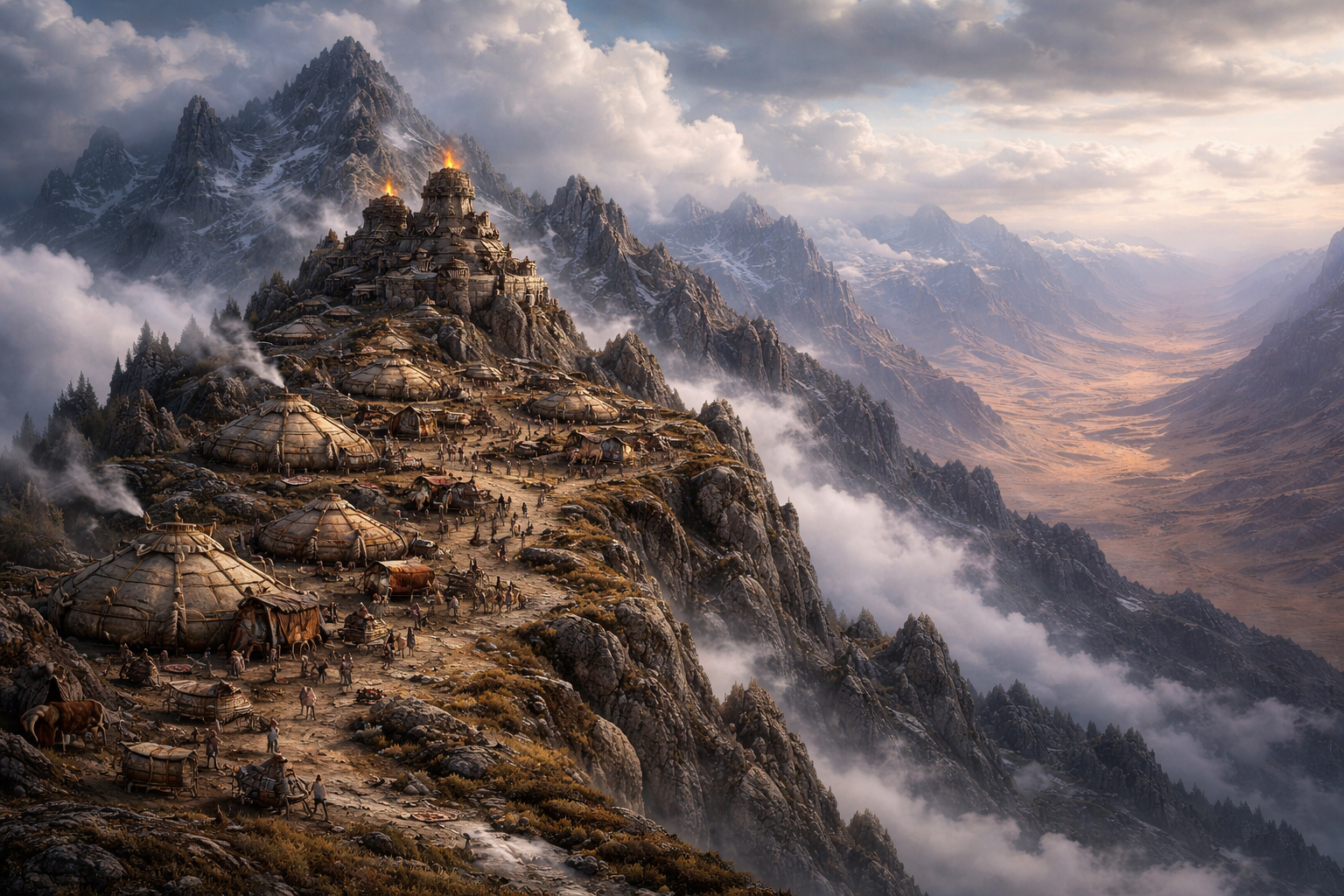
Large Town: Population 2,995 (100% ettinor)
History
The youngest settlement in Gothir, Toabenir was founded high in the mountains southeast of Guruma as a refuge from the Bakari shortly after the Somvukolai anomaly appeared. The town is populated by the Kidokinor tribe, and is found just below the mountain's peak; an environment where only the Ettinor could comfortably survive. The lowland Ettinor of Guruma and Ebondel thought the Kidokinor were cowards for fleeing, but the Kidokinor believe the lowlanders are foolish for charging headlong into a war they are losing and not using the environment to their advantage.
The feud between the Kidokinor and other Ettinor is not only because of their choice to take shelter in the mountains, however; they have chosen to break a tradition long held by all tribes of the Ettinor, doing something which most Ettinor consider a taboo. Traditionally, Soulbinding is practiced by very few Ettinor, as they believe that only those who have met specific requirements are permitted to learn the art. The three conditions other tribes require of someone to be instructed in Soulbinding are that they must have returned from death's door, to have consumed the remains of one's parents, and to seek Estrea's approval by means of a secretive ritual only Soulbinders are privy to. The Ettinor consider Soulbinding a sacred tradition as practicing it implies a control over death, something which only Estrea should possess. The Kidokinor have broken this tradition by teaching the art to all who seek it, a choice made by Ganlok Iduna Eshen, the aged tribal leader of Toabenir. This heretical decision has turned the other tribes against them, and were it not for the war with the Bakari and the perilous conditions of the mountains, Toabenir would be under siege by the lowland tribes, who want them to meet Estrea for their blasphemy.
About 20 years into their self-imposed exile from the other tribes, angered by their brethren's collusion with their perceived enemies, the Letheni; Ganlok Iduna waged war on the Vedathor Somuly, leading his people to the lowlands to attack caravans transporting critical supplies to the front line to aid in the war against the Bakari. This caused severe casualties not only on both sides of the conflict, but to the ones fending off the Bakari to the southeast. These attacks on caravans directly resulted in the loss of the city of Koranir, south of Ebondel, and nearly every Ettinor in residence being turned into Bakari. This war lasted a very short time, only about a year; but the collateral damage was far greater than the number of dead from combat between the tribes. An unfortunate repercussion of this war is that other Kidokinor that are not associated with Toabenir have faced anger and violence directed at their distant tribesmen despite not having taken part in the conflict. The other tribes have sworn that upon ending the war with the Bakari, Toabenir will be their next target.
The Kidokinor rely on their farm animals to provide necessary food sources, and have managed to raise a large flock providing milk, eggs, and meat. However, predators have long been a problem, sneaking into their farms at night and eating their livestock. Though there are plenty standing guard at night, these predators seem to be capable of slaughtering these animals undetected. Because of the spiritual culture and the unseen nature of the creature preying on these animals, they have taken to calling them the Usol Muteroki, meaning "night stalkers". This has placed a great strain on Toabenir's food supply and has even caused conflict between residents who are struggling to feed themselves properly. If the creatures are not dealt with soon, either the Kidokinor will need to seek outside assistance for food, or the residents will begin to turn on each other.
Government
The residents of Toabenir are led by their tribal leader, Ganlok Iduna Eshen. His name, meaning "the white death", was earned through a lifetime of violent combat, and his status as one of the most powerful Soulbinders alive. He is also responsible for the invention of the art of Ugamal Kidolai, or "shadow singing". This extension of Soulbinding utilizes the voice to bind and beckon the spirits that a Soulbinder captures, with the spirits being bound not to soulstones, but to the body of the Soulbinder itself; appearing as moving tattoos on their skin. Other tribes despise Ganlok Iduna for breaking with tradition and teaching his tribe Soulbinding, viewing him as a heretic. But none can deny his power, which he has used to keep his people safe. Because of the unique properties of the mountain on which they reside, he can even beckon his spirits anywhere on the mountain, regardless of where he is located. Due to this advantage, he has several perches around Toabenir where he can look down the mountain and call upon his spirits to attack approaching Bakari or to assist other Kidokinor that require assistance without needing to physically be there. None in Toabenir appear to know how old he is, and know only that he has been there long before the town's oldest residents. There are rumors that he led the Kidokinor to the mountains himself nearly a century ago.
Economy
Like many Ettinor settlements, the Kidokinor do not rely on external resources, with each member of the community providing for themselves. The mountain has a number of animals and some monstrous creatures which the Kidokinor have learned to prepare as food. There are also various plants that grow further down the mountains, and a handful of caves leading to the interior of the mountain with access to the Deephollow. Though the Kidokinor don't need outside resources, one thing that they crave from merchants is entertainment; games, stories, songs, and alcohol. Because the path to Toabenir is so perilous, these merchants are often met much further down the mountain, sometimes close to the base.
There are only a handful of goods that the Kidokinor have to offer as exports in trade for these luxuries. There are quite a few medicinal herbs found in the mountains which they harvest and create potent medicines from that are invaluable to the war effort against the Bakari. The town also has a large number of sheep, whose wool they use to weave intricate textiles with patterns that are very popular in northern Arak and southern Myr.
Notable Locations
- Kideni ma Delamok - The "mountain peak of songs" as it is known is the tip of the mountain that the Kidokinor reside upon. The sound travels far and wide down the mountain, and those who sing from atop the peak can be heard miles away from the base of the mountain. This effect has allowed the Soulbinders of Toabenir to project their voices far enough to defend the mountainside with their spirits without having to physically be there. When the town's warriors die, their bodies are brought to the peak of the mountain, and Soulbinders sing a song glorifying their life, usually exaggerating their deeds; after which they are brought to Taomari ma Omek. The greater a warrior's reputation, the louder and more dramatic the song. Due to the hate other tribes hold for the Kidokinor, they celebrate when they hear these songs drifting down from the mountain, as it indicates that a powerful warrior of theirs has died. It is unclear why sound carries so far from this mountain in particular.
- Taomari ma Omek - This cave that the Kidokinor call the "cave of stories" is very important to the locals. This sacred place serves as a crypt of sorts for the honored dead. When the Kidokinor die, after having their song sung at the mountain peak, they are brought here to have the spirits bound to their body in their tattoos transferred to the cave walls before they fade. The spirits inhabiting their bodies are extracted and bound to the cave walls, which contain a large amount of Acroniten, creating moving murals depicting the warrior's triumphs so that they will be remembered. Afterwards, the dead's family is given privacy to consume their remains within the cave.
- Morea ma Omek - A large cave located south of town that is home to a mysterious entity that calls itself Morea. This figure appears to the Ettinor as what they perceive as a woman with cerulean blue skin with shimmering scales, deep red eyes, thick long white hair, and feathered arms and legs. Initially assuming it was a monster, the Kidokinor attacked her; but they were repelled in embarrassing fashion; however, she did not harm them. In future visits, some of the Kidokinor began to believe she was a goddess, and began to worship her; bringing her offerings, especially information, which she seems to crave. Those that please her may be gifted with valuable information in return. A religion of sorts has begun to form with her as the figurehead, and Ganlok Iduna has taken notice. Once, he personally journeyed to the cave with his most powerful Soulbinders and confronted her, but even with all his might, she beat him badly. Despite her power, she left him alive, wanting only to humiliate him, further securing her power over the Kidokinor that follow her. Ganlok Iduna has forbidden his people from going to the cave, and those that do are not welcome back within the town. Thus far, Morea seems to never leave the cave.
Culture
Soulbinding is widespread in Toabenir, unlike any other Ettinor settlement in the world, due to Ganlok Iduna Eshen breaking tradition and teaching all who wish to pursue the path the art of Ugamal Kidolai, or "shadow singing". These Soulbinders beckon spirits not from soulstones, but from tattoos that move about their bodies, depicting the various creatures they have killed and bound to themselves. The Soulbinder beckons these spirits with song, which tells the story of their triumph over the creature they are calling forth. Tattoos are a status symbol in Toabenir, and the more you have, the more respect you may command, as they are tangible evidence of your bravery and strength. Those without tattoos are seen as weak or cowardly, and looked down upon by the town's strongest. In Kidokinor society, it is considered disrespectful to look another warrior in the eyes when speaking to them, and it is customary to instead gaze upon their tattoos. Those without tattoos are considered unworthy to speak to those with many, as they have not yet proved themselves worthy of respect. Those unable to learn Ugamal Kidolai may resort to tattooing themselves to present the illusion of strength from a distance; but as these tattoos do not move as those on a Soulbinder, they are an obvious fabrication and will earn scorn rather than respect.
The town has been facing a food crisis for some time now. When they initially migrated into the mountain, they had planned to raise large quantities of cattle at the base of the mountain and descend to retrieve resources; but this became cumbersome over time and the energy expent doing so outweighed the energy from the food they brought back up. The Kidokinor raise a good amount of cattle in the town itself now, using them for milk, eggs, and other byproducts; but if they were to slaughter all their cattle they would not survive long. For this reason, meat is not their primary food source, and they only harvest their livestock's meat when it dies naturally. In the Deephollow, they have managed to cultivate large colonies of mushrooms using powerful compost they have created from the byproducts of creatures they hunt. In addition, they cultivate crops such as barley, wheat, and potatoes along the countryside on the western side of the mountains, which are largely untraveled by the other tribes. It is rare, but they will occasionally attack caravans bound for Ebondel for supplies to supplement their food sources.
The Ettinor do not need clothing for warmth, and with the importance placed on the display of their tattoos as a form of status, clothing is very minimal. Locals wearing more clothing typically do so to conceal their lack of status; though on occasion more powerful Soulbinders will conceal their tattoos to move about incognito, as it guarantees eyes will look away from them. But clothing can be very important when hunting, concealing them from the creatures they are stalking. The only other occasion they wear clothing to conceal their tattoos is during a funeral, as a sign of respect to the dead; by hiding their tattoos, they do not draw attention away from the dead. Additionally, they create textiles for decoration, hanging them from their homes and leaving banners to mark their territory. These textiles have very intricate and unique designs that have become a popular export; though the Kidokinor's reputation and behavior has made them undesirable to deal with for many.
Something unique found in Toabenir is their storytelling traditions. Stories are told all over the world, sometimes embellishing the truth or inventing tales of heroes to entertain children. However, the Kidokinor have found inspiration in isolation through their view of the sky. With clear views of the other planets in the night sky, they have created stories about worlds beyond their own; something no other culture has yet aspired to. In particular they have focused on Proxon, perhaps because of its red hue; which reminds them of the steppes below. They do not record these stories on parchment, instead singing these tales over cooking fires or sometimes to large audiences in public locations. One prevalent tale is that of Manal Nandoki, an ancient Ettinor who they tell created a rope so long that he cast it into the sky, catching hold of Proxon and climbing the rope to reach the other planet. The tale tells that when he reached the red planet, he found Estrea there, in Etoka Guanir, the "great desert" that they believe great warriors are taken to after death. The story goes that he found Estrea lounging on the shores of an oasis and he was invited to bathe with her, and told her of his people. Manal was gifted with great strength for his bravery in ascending to Proxon and seeking her there. Upon his return, he used this great strength to fell the beast known as Vaivevir, a terrifying and massive lizard who was devouring Ettinor all across Gothir, with a single punch.
Defenses
Toabenir is nearly impossible to breach by outside forces, being so high in the mountains and monitored on all sides by Soulbinders capable of beckoning spirits along the mountainside to attack invaders remotely. For this reason, the Kidokinor do not have any structural defenses in the town itself. Besides the spirits they command, there are plenty of large rocks on the mountaintop that could be pushed down the mountain to crush their enemies if necessary. But the Kidokinor aren't the only thing to worry about on the mountainside. There are several predatory creatures that inhabit the mountains that could very well attack long before travelers are within sight of the town.
Crime
In addition to the Bakari that drove the Kidokinor into the mountains, the ancestors of the residents of Toabenir were adversely affected by the event known as Vadakolai, or "the branding", during which Letheni from the Veldunorin ith Derunadel, retreating from a failed siege on Ebondel, razed villages along their retreat path and took villagers captive, eventually putting them to work in mines, which killed many; and throwing their corpses over the walls of Guruma at their brethren, branded with vulgar messages. This story has remained within the cultural memory of the Kidokinor, and the town's residents despise the Letheni. For this reason, any Letheni who come within sight of Toabenir are killed without remorse or mercy. Officials in Guruma warn all Letheni coming into Gothir not to travel anywhere near the mountains below the town. Other races are accepted for the most part, though they are not permitted into the town; instead, they are permitted to trade with the Kidokinor, and residents will descend the mountain to meet with them.
With so many Soulbinders in residence, there are laws specifically tailored to crimes committed involving the practice. The most important law that Soulbinders must abide by is that binding the spirit of another Kidokinor is forbidden. Doing so is punishable by death, after which you will be denied having your stories told in Taomari ma Omek, regardless of your prior deeds. Another taboo which can earn you an early demise would be to bind the souls contained within the Acroniten walls of Taomari ma Omek, as it is considered honor fraud. The cave is kept under guard most of the time to monitor those visiting to ensure none defile the cave's sacred walls.

Comments