

Suvatha
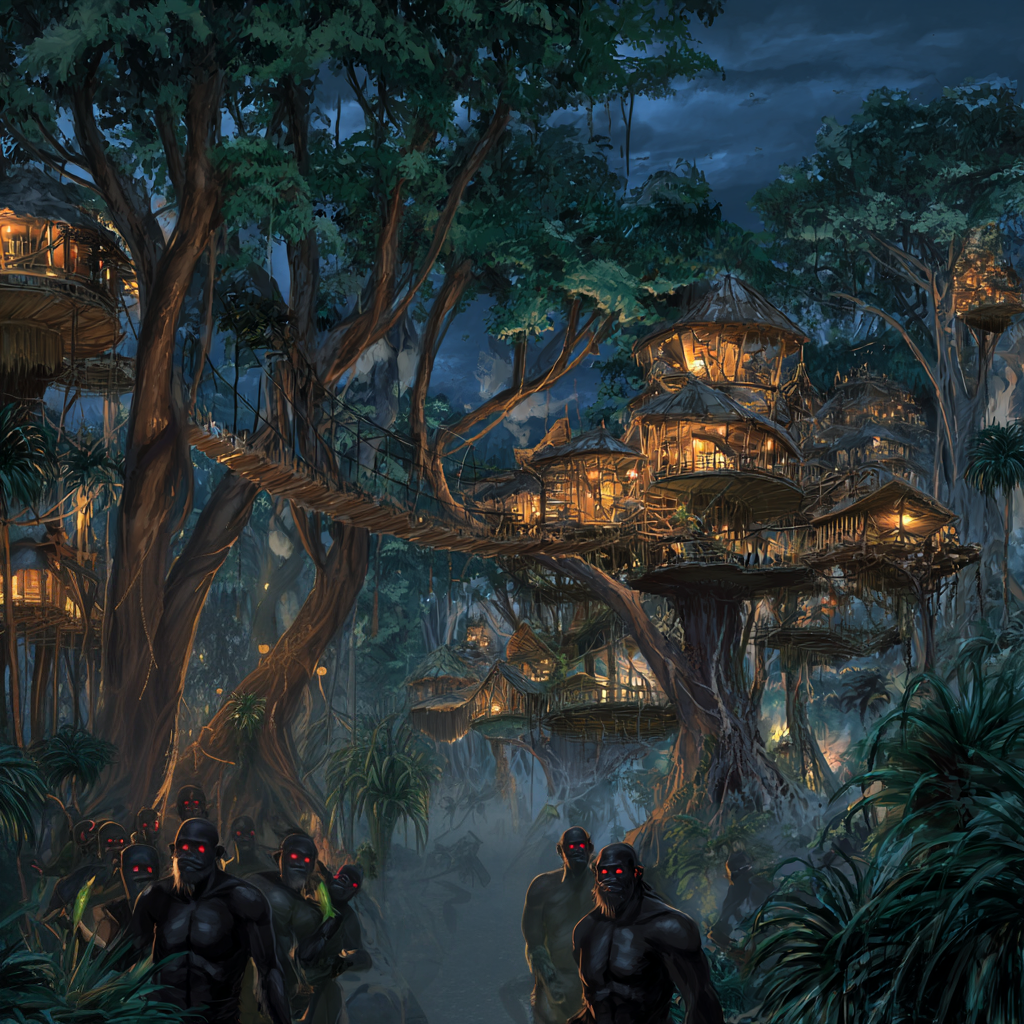
Small City: Population 11,056 (100% ettinor)
History
Suvatha is one of the oldest settlements in all of Gothir, and has slowly grown into a sprawling network of treetop homes and bridges. To live on the forest floor in the Hamato Lai Daolok is to court Estrea, as other than the numerous predators that roam the jungle during the day, what emerges during the night is far worse. At night in Suvatha, the spirits of countless Ettinor who have died within the jungle appear and begin to roam, searching for their kin. The spirits, which the Ettinor call Toma Sari, are trapped in this form by a Wellspring anomaly from the Reckoning period which causes the bodies of those who are not either consumed, or destroyed by fire, to be trapped within the jungle to forever roam, trying to satiate a hunger which cannot be fulfilled. These spirits call out for their kin, taunting and cursing them for leaving them behind, tormenting the Ettinor. These spirits cannot understand mortals who attempt to communicate with them, and simply go through their nightly ritual.
The Daolokinor tribe call Suvatha their home, and in the wake of the great migration of Ettinor following the Somvukolai anomaly, they are the most numerous tribe in Gothir. They have mastered the art of surviving in the jungle, and use it as their defense from the Bakari, who fear the jungle; and for good reason, as the Toma Sari sense the Bakari as kin and will tear them apart. Being so deep within the jungle, the Vedathor Somuly has been unable to reach Suvatha to attempt to enlist the aid of the Daolokinor. The Toma Sari are not all Ettinor, as a number of spirits of the Vedathor Somuly roam the northwestern reaches of the jungle where they fell attempting to reach the city.
Historically, the Daolokinor are the most hated tribe of Ettinor, using poison to hunt and cultivating diseases within their very blood. The other tribes were ignorant of the true nature of the jungle for a long time, as during times of conflict, the Daolokinor would lure their enemies into the jungle and retreat into the treetops as darkness fell while the Toma Sari tore their enemies apart. They are also known for using fear tactics, making terrifying sounds to demoralize their enemies, and employing traps; something which other Ettinor consider dishonorable. The Daolokinor themselves consider their tactics and culture to be simply using every advantage of their environment to survive and destroy the monsters that plague this world. Because of their isolation from the rest of Gothir, their culture has diverged significantly from other Ettinor.
Despite their cultural differences, the Daolokinor have been one of Gothir's greatest assets in the fight against the Bakari. The Bakari seem to have some degree of fear of the Daolokinor, and are highly susceptible to their poisons. In 289 AE, there was a large push by the Vedathor Somuly to attempt to recapture the ruined city of Koranir, south of Ebondel. A scout from Suvatha reported the movement of these forces pushing southward and a large group of Daolokinor began watching them from afar. As the soldiers descended upon Koranir, the Bakari saw them coming and retreated to the tops of the bluffs surrounding the inner city. As the soldiers entered and found the city empty, the Bakari flanked them from both sides and began to throw massive rocks down upon them, also transforming several of the Ettinor that had accompanied the group with their bite. The Daolokinor, accustomed to moving vertically, crept up on the Bakari and used their poisons to subdue them, giving the Vedathor Somuly time to escape. A retreat was called and the Daolokinor left with them, using their potent blow darts to tranquilize the Bakari from afar, and brought the wounded to Suvatha; the first time outsiders had been there in hundreds of years. They found the Daolokinor surprisingly hospitable despite their vilification. After healing the wounded soldiers, the Daolokinor escorted them back to Ebondel. Since this event, the Daolokinor have begun to cooperate with the other Ettinor to help fight the Bakari.
Government
Due to the size of the city, Suvatha does not have single Ganloki who command tribes; instead, Suvatha has a council of elders, called the Solue ma Karodan, who lead the Daolokinor of the city. This council consists of ten Ettinor, each tending to a section of the city. Each elder, or Haken, has a number of attendants, called Loadin, that assist them. Although the Hakeni act in unison and collaborate on city matters; the Daolokinor often view the Haken of their district as their sole leader, which can lead to conflict. The Hakeni each have homes of their own where the Loadini come to consult with them about issues that are being dealt with, or where the Daolokinor can seek their guidance; but when the Solue ma Karodan convene to discuss city-wide matters, they do so at a tower called Suatil Vikosebar that rises above the city canopy, covered by a thatched dome, and a hole in the center where smoke exits from the fire that burns in the brazier in the center.
The structure of the city's governing council is not the only cultural difference in the way the city is led. Unlike other tribes in Gothir, succession is not determined by collective support of the perceived strongest members of the tribe. Instead, each Haken trains their Loadini to succeed them. When it comes time for a Haken to abdicate their position, or when they die, the Loadini must undergo ritual combat to determine the successor, with the Loadini who are not victorious either dying, or surrendering. If a Loadin surrenders during this combat, they remain Loadin to the new Haken, but will never again qualify to succeed their Haken; being seen as cowards. If at any point, one of the Hakeni has only Loadini who have formerly surrendered during this ritual combat, the Loadini are made to undergo a trial from which there can only be one survivor, with the survivor being "redeemed" in the eyes of the community, and once again becoming eligible to succeed the Haken; after which new Loadini are selected.
Economy
Suvatha has no need of money, being isolated from the outside world. Instead, they use a primitive trade system to circulate goods. However, the majority of the city's inhabitants are self-sufficient, providing for themselves. They live with the understanding that if they cannot provide for themselves, then they will die. Those who have served their community well may be cared for by their neighbors when they grow old, but many do not live to see the age where they require such attendance. The jungle provides many different food sources. While the Ettinor need meat to survive, they supplement their diet with the fruits and plants that grow throughout the jungle. Despite how hazardous the jungle is, every single thing that grows within the jungle is edible to the Daolokinor due to their poison tolerance; though some foods require more preparation than others to make them safe to eat. Nearly all poisons that the Daolokinor cultivate come from the wildlife and monstrous creatures within the jungle. There are deposits of Acroniten beneath the jungle, but the Daolokinor rarely mine here due to the dangers of being near the ground, preferring to venture outside the jungle to surrounding areas for mineral resources.
Notable Locations
- Hamato Lai Daolok - The jungle that surrounds Suvatha which stretches over 1,000 miles from north to south. It is dense, with the coasts lined by mangrove trees, and two distinct biomes present; the majority of the jungle being covered by dense kapok trees, and a very dense bamboo region in the middle. The kapok trees provide a great foundation for building, and the bamboo has served as a plentiful building material that is used to build most structures in the city. Thick vines hang from the canopy that allow the Ettinor to swing from tree to tree. The ground is dense with fern plants and other vegetation, with many edible plants that serve as a supplementary food source. The jungle is prone to harsh rain storms which can flood the ground, making vertical habitation necessary. To make long-range exploration possible, the Ettinor have constructed a number of outposts along frequent routes to allow shelter from the Toma Sari at night. When the Toma Sari emerge at night, all the jungle goes silent, except for their relentless taunting and anguished screams.
- Ossak Kishar - Located a few miles east of Suvatha, the "bone forest" is an enormous clearing where trees are replaced by massive, sharp bones jutting out from the ground. Though the Daolokinor do not know the origins of the bones, what is more unnerving about them is the fact that the bones are not randomly placed; the majority of the exposed bones appear to form the shape of a ribcage. No predators even remotely close to this size have ever been spotted in Gothir, let alone the jungle. Even more unsettling is the markings carved into the bone, which the Daolokinor have not been able to decipher. The Solue ma Karodan has forbidden the city's residents from taking any of the bone from here, fearing what may happen if they are disturbed; but that hasn't stopped them from exploring the area and searching for answers.
- Salamak ma Tior - The site of a large-scale battle that occurred over a thousand years ago in which a gigantic serpent came across Suvatha and climbed into the canopy, attacking and killing several hundred warriors. The Daolokinor were able to lure the serpent away from the city and into the wilds, where after many lost their lives, they were finally able to fell the great beast. A monument was constructed to honor the hundreds who lost their lives in the battle, depicting an Ettinor beheading the great serpent. Over time, a tree has grown over the monument, leaving it partially exposed. Due to the large number of spirits who died here at once, a large number of Toma Sari rose from the site, as their comrades were not able to pinpoint the site in time. The sheer number of Toma Sari that manifest at the site at night causes a concentration of spectral Flow powerful enough to warp reality. Any who wander within a half mile of the site at night will be pulled into the Ethereal plane. The Daolokinor have attempted to destroy the remains of the ancient warriors that rest here in the hopes of decontaminating the area, but time has caused the bones to scatter and be pulled into the ground. Some of the more brave residents of the city will journey to the monument to pay their respects, but it is very hazardous, as the monument lies just far enough from the city that even if you were to set out at dawn, you may not make it back before dark.
Culture
It is impossible to live in Suvatha without a degree of spirituality, as the spirits that roam these jungles are hard to ignore. In the dead of night, these dark shades with their glowing red eyes roam the forest floor, calling out to their brethren whom they believe left them behind, taunting them and beckoning them to face them; to face judgment for their failures. They stop at the base of trees, looking up at the Ettinor that stand guard, mocking them in the hopes of provoking confrontation. The spirits cannot climb, and are only a danger if you are unable to make it to the shelter of the treetop city before darkness falls. They are drawn to fresh blood, and will swarm you if you are wounded; able to sense a fresh cut from seemingly miles away. The only way to prevent the dead from this fate is to ensure their remains are properly dealt with immediately following their death. If the remains of a body within the jungle are not either consumed within three days through the Ettinor's cannibalistic traditions, or consumed by fire, the spirit will rise as Toma Sari, the shades that haunt the jungle. These shades can be incredibly difficult to put to rest, as it requires locating all of their remains, and destroying them with flame. This can be extremely difficult if the other predators of the jungle have gotten to their remains first, and scattered them around. A Soulbinder can lay these spirits to rest, but very few of them remain in Suvatha.
The city's buildings lie within the canopy of the trees, built in a circular pattern around the tree trunks and connected by bridges. Most of the city's structures are built from bamboo, being easy to harvest and plentiful; as taking time to chop down larger trees draws attention. Some of the supports holding up the city's structures are truly elaborate. Because of the necessity of remaining high up, the Ettinor have adapted, learning to leap between the trees and swinging from vines to traverse the jungle. Though other predators make their home up high, the Ettinor have mastered the lore of these creatures and no longer fear them, even if they still present a danger. Instead, these predators have become the prey, with the Ettinor hunting them for their blood, venom, hides, and other parts; using them to craft poisons and other tools of their trade. One weapon that nearly every Ettinor learns to use is the blow gun, which uses darts tipped in potent poisons they use to paralyze or otherwise subdue their prey. They have made a practice of repeatedly exposing themselves to these poisons in order to immunize themselves, which becomes incorporated into the contagion that lives within their blood. The more they expose themselves, the more powerful this contagion they carry becomes; after which they simply coat their blow darts in their own blood. This tactic is the number one element of the Daolokinor's culture that other Ettinor find dishonorable and cowardly.
Though food is not scarce in the jungle, it does fight back, and it doesn't keep for long. The Daolokinor discovered a method of preserving meat by smoking thin cuts of it at low temperatures for long periods of time, creating dry sheets that they call Aremok. This is not only useful for long-term storage, but due to the Ettinor's ability to absorb the traits of creatures whose meat they consume, this allows them to bring this meat with them to gain temporary and diluted traits of these monsters far away from where the creature was killed. The Daolokinor are also fond of nuts and fruit, especially Emuveni and Ogiroli; a sweet and salty tree nut cluster that keeps one full for hours and tastes earthy, and a fleshy green fruit with a mild sour heat.
When the Daolokinor are not hunting, gathering, or performing their trades, there are a few activities they use to occupy their time, especially to distract from the noise created by the Toma Sari. At night, to distract from the wailing and beckoning of the Toma Sari, the city's residents will often play music and sing, hoping to drown out the spirits below; but peace would not last long if the city was constantly playing music. Those who need to rest or need silence will often stuff their ears full of the soft material within the seed pods of the kapok trees, or beeswax. Those who are keeping watch are not permitted to do so, as it prevents them from being able to hear predators approaching or a crisis nearby. These night watchmen are held in high regard, as the residents are aware of how difficult their duty can be. They receive gifts from the residents as thanks for their service. Occasionally they have to put a stop to the more foolhardy residents who are bored and seeking a thrill, swinging from vines at night testing their skill and luck leaping over groups of Toma Sari, which has gotten more than a few young foolish Ettinor killed.
Defenses
Being elevated off of the forest floor, many of the jungle's predators cannot climb, and thus cannot reach the Daolokinor in their homes. However, for the few predators who can reach them, such as those capable of flight, the city has a large defense force that keeps watch all day and night. The homes found throughout the city use bamboo as the primary building source to create their structure, but as many Ettinor do, the Daolokinor collect the bones of their deceased and creatures they have killed, using them as a kind of "armor" for their homes. There are far too many Ettinor in the city for every home to be covered in bones, even in spite of the city's age. However, there is enough for buildings to be reinforced. To add a durable shell around the bamboo, they pack clay around the frame of the house to insulate them. The roofs of most buildings are made of woven bamboo which has been cut into thin strips, even weaving these strips around the branches of the trees they sit in.
However, the creatures that stalk the jungle are the least of their worries, with the most important of their defenses dedicated to mitigating the threat of the Toma Sari, the restless spirits that taunt them at night from the forest floor. Though these spirits cannot reach the city itself, their taunting is not always simple to just ignore, as many of the Ettinor feel guilty for failing to lay their family members and comrades to rest before they rise. Some Ettinor, in their guilt, leap to the forest floor at night to give themselves to the judgment of their ancestors. For this reason, a portion of the city's defense force, called the Sal Duamaki, are dedicated to quickly retrieving the fallen bodies of those who have been killed in the jungle and returning them to the city so that their families can consume their remains. If the body falls too far from the city to be returned to their families, the body is burned to lay the spirit to rest.
Crime
In an area with so much danger constantly around them, one would expect crime to be more common. However, the Daolokinor, like many Ettinor, do not have materialistic desires like other cultures, so theft is not much of an issue at all. Violence can be a problem, but murder is uncommon due to traditions upheld by the Solue ma Karodan. In Suvatha, if there is a conflict between two residents, they can petition their Haken to permit them to challenge another resident to Drekar Nuatok; a type of "trial by combat", where the two fight to the death. If the accuser wins, their petition is considered justified, and it is not a crime. However, if the accuser loses the fight, then assuming they survive, they are executed by their Haken for shaming them with a false accusation. Those executed by their Haken are considered disgraced, and their remains are burned, denying their family the right to consume them. Because of the consequences of failure, some more cowardly Daolokinor will instead wait for the cover of night and ambush the one whom they have hostilities with and shove them off of a bridge to be torn apart by the Toma Sari below.

Comments