
Sun Sloth Conservation Enforcement
Sun Sloths
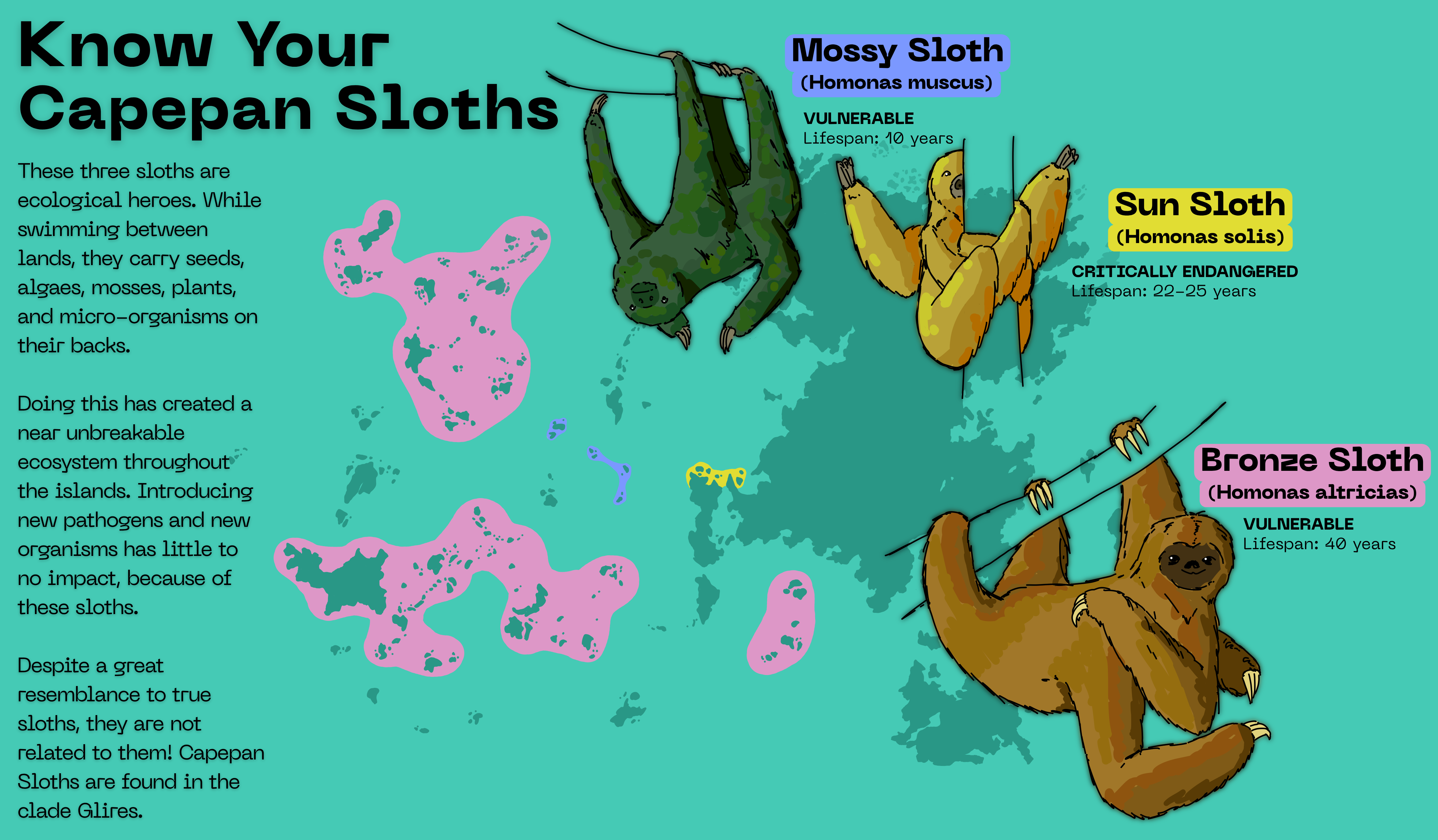
Unfortunately, these animals aren't doing so well. There are approximately 200 sun sloths left in the wild, and they are crucial to their native ecosystems!
Our officers have helped re-introduce thirty sloths in the last five years.
Our Officers
Some of the methods our officers use, particularly with the removal of invasive species, is questionable at best; if we had any other fast method of countering invasive animals, we would use those. Unfortunately, we feel eradicating invasive animals is the best course of action.
A Brief History
Our first sun sloths were acquired nearly fifty years ago. We got a pair, Sami and Ola. The two sisters were inseparable from birth, and we designed a brand new enclosure to fit three, in the hopes we might get a third, a male. Two years later we received a gift from the Emesema Wildlife Park, on an island on Capepo. It was a male sloth named Erio!
Just six months later Sami fell pregnant, and we were lucky enough that she gave birth to triplets, an incredibly rare feat for a sun sloth. All three survived to adulthood; one was sent as a gift back to the Wildlife Park that gave us Erio, and we kept the other two.
Through more trading with wildlife parks, we were about to get our number of sloths up to a whopping ten! We tripled the size of the enclosure and increased our number of staff to accomodate for such a large number of sloths. But as our population grew, the population of native sloths on Capepo had taken a hit. From what was already a vulnerable species had been reclassified to critically endangered, so we felt personally responsible to do something about it.
The Enforcement's first trip to Capepo revealed a whole host of issues. Invasive species from other planets had completely outcompeted sun sloths and starved them out. Pollution from industrial regions in the south had also had a major impact on the environment.
The SSCE was put together prior to this trip, but it revealed problems way beyond what was speculated. Plans to relocate invasive species were scrapped in favour of simply culling them where it would have the least negative impact. This caused issues with locals who found the practice barbaric, but there truly was no other way around it. Culling these invasive species wasn't just aiding sun sloths, it was supporting nearly three thousand endangered animals.
In the last thirty years, the wild population has gone from roughly fifty, to two hundred. Thirty of these were from the last five years. This is all thanks to the SSCE and their incredible work!




Honestly, though? There are some invasive species around here I would like to eradicate....
Visit my brand new world during Summer Camp 2026!
Summer Camp Hub 2026
Brand new world for Summer Camp. Fabric Artists and Arachnophobes welcome